In the U.S. bond market, agency bonds are debt securities issued by federal agencies, instrumentalities or government-sponsored enterprises (GSEs). Supranational bonds are issued by institutions owned or established by multiple countries, such as multilateral development banks. Both can trade against a sovereign bond benchmark. To interpret the yield difference, identify who owes the payments and what support the security can draw on. New York Fed on agency debt, World Bank Treasury on IBRD debt.
Who owes the payments?
A marketable U.S. Treasury security is a direct obligation of the United States. An agency label covers several arrangements, so check the offering documents for the legal issuer, the source of payment and any guarantee. TreasuryDirect on marketable securities.
- Federal instrumentality debt. Tennessee Valley Authority’s 2025 Series C Power Bonds are payable solely from TVA’s net power proceeds. The offering circular specifies that the United States neither owes nor guarantees those payments. TVA offering circular, Source of Payment.
- Government-sponsored enterprise debt. Fannie Mae owes the payments on debt under its Universal Debt Facility. Treasury has a separate agreement to provide funds to Fannie Mae under specified conditions to maintain positive net worth. The circular expressly excludes a U.S. guarantee of the debt. The funding agreement can support the issuer’s ability to pay while leaving Fannie Mae as the obligor. Fannie Mae offering circular, Summary.
- An explicit federal guarantee. Ginnie Mae guarantees timely principal and interest on qualifying mortgage-backed securities issued by private lenders, and the U.S. government backs that guarantee with its full faith and credit. Mortgage prepayments still affect when investors receive principal. HUD on Ginnie Mae’s single-class MBS.
Supranational debt. Under its Global Debt Issuance Facility, the International Bank for Reconstruction and Development (IBRD, part of the World Bank) issues notes as its own unsecured obligations. The member countries supply paid-in capital and commit to contribute more if IBRD makes a qualifying call to meet borrowing or loan-guarantee obligations. This callable capital is contingent funding owed to IBRD when called under its rules. The bondholder’s payment claim is on IBRD. IBRD prospectus, Condition 3, IBRD FY2026 Information Statement, Capital Activities.
Read the programme prospectus alongside the pricing supplement or final terms for the specific issue. For example, the Final Terms for IBRD’s HKD notes with ISIN XS3317469834 identify IBRD as issuer, specify unsecured and unsubordinated status, and list call and put options as inapplicable. The terms identify the claim and cash flows that belong in the comparison. IBRD Final Terms, Summary of the Notes.
What does 25 basis points measure?
Suppose a synthetic five-year, noncallable USD agency bond has a yield to maturity of 4.25% and the same-maturity sovereign benchmark yields 4.00%. Both are fixed-rate with yields quoted on the same nominal annual basis, compounded semiannually. The yield spread is
At the same bond yield, a second estimate of the five-year sovereign benchmark at 4.10% gives a 15 bp spread.
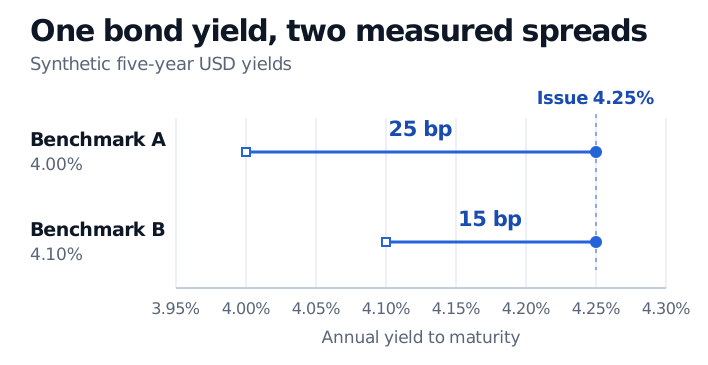
Changing only the sovereign benchmark changes the measured spread by 10 basis points.
A quoted spread can reflect expected credit losses, compensation for bearing credit risk, and differences in liquidity or investor demand. A heavily traded benchmark can carry a price premium, lowering its yield and widening the measured spread. The 25 bp alone cannot isolate expected loss. New York Fed research on agency debenture liquidity, New York Fed research on the Treasury benchmark premium.
The Government Bond Markets lesson explains how trading liquidity and demand to borrow Treasuries in the repo market affect benchmark yields. The preview is public and the full lesson requires membership. Government Bond Markets lesson.
For a relative-value comparison, use same-time prices, match currency and yield conventions, and check the timing of the cash flows. Equal final maturities can still give different interest-rate exposures when coupons or redemption terms differ. For a callable bond, the issuer’s right to redeem early changes the cash-flow schedule as rates move. An option-adjusted spread fits the bond price using cash flows that reflect modelled interest rates and early redemption.
Sources
- Federal Reserve Bank of New York, Agency Debt Securities.
- U.S. Treasury, History of Treasury Marketable Securities Products and Programs.
- Tennessee Valley Authority, 2025 Series C Power Bonds offering circular.
- Fannie Mae, Universal Debt Facility offering circular, 8 November 2024.
- U.S. Department of Housing and Urban Development, Programs of HUD, Government National Mortgage Association.
- World Bank Treasury, IBRD Debt Products FAQs.
- IBRD, Global Debt Issuance Facility prospectus, Condition 3, and FY2026 Information Statement, Section VIII.
- IBRD, Final Terms for XS3317469834, 10 March 2026.
- Federal Reserve Bank of New York, Repo and the Liquidity Risk Premium, Staff Report 1189.
- Federal Reserve Bank of New York, US Treasury Market Functioning from the GFC to the Pandemic, Section 2.2.2.