Accretion/dilution analysis tests whether an acquisition raises or lowers the acquirer's earnings per share (EPS) for a specified period. Compare forecast combined EPS under the deal with forecast standalone EPS for that same period. Higher EPS is accretive, lower EPS is dilutive, and equal EPS is neutral. The comparison shows whether the earnings the deal adds can cover its financing costs and the effect of issuing new shares.
How much must the target earn?
In a hypothetical deal, the acquirer would earn USD 100 million for its common shareholders on 50 million shares over a full year. Assume the acquisition and financing take effect at the start of that year. The target contributes USD 30 million of earnings, incremental after-tax financing costs reduce earnings by USD 5 million, and the acquirer issues 5 million new shares. All new shares are outstanding for the full year. There are no synergies, purchase-accounting effects, or other changes.
Combined EPS is about USD 2.27. Relative to the USD 2.00 standalone forecast, the exact increase is , or 13.64% accretion. Use the unrounded EPS in the percentage calculation. If standalone EPS is near zero or negative, focus on the change in dollars per share. A percentage is unstable near zero, undefined at zero and reverses the sign of the change when the baseline is negative.
Each new share needs USD 2 of earnings for EPS to stay flat. The 5 million new shares therefore require USD 10 million in additional earnings. Add the USD 5 million financing cost and the target must contribute USD 15 million to break even. Below that threshold, the deal dilutes EPS even if combined earnings rise.
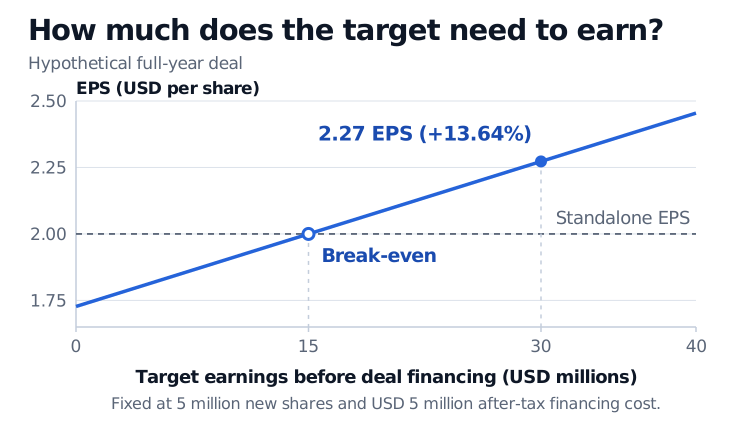
Target earnings vary while financing and share issuance stay fixed. The horizontal dashed line marks the acquirer's standalone EPS.
Read the assumptions behind the EPS number
A later close changes both sides of the calculation. In a forecast for the closing year, include target earnings and deal-related effects for the applicable period and weight new shares by how long they are outstanding. Check that both cases use the same earnings basis and share-count convention. For example, the effect of employee options on diluted EPS is a separate calculation from the change in EPS caused by the deal. Also check when cost and revenue synergies begin and whether the forecast includes integration costs and additional amortisation from purchase price allocation.
The Pinnacle–Synovus merger filing shows why the label pro forma needs context. The adviser projected EPS accretion for Pinnacle in 2026 and 2027 under assumptions that included fully phased-in cost savings and excluded merger costs. The same filing separately presented Article 11 pro forma financial statements that started from historical results and applied transaction accounting adjustments. Pinnacle–Synovus Form S-4/A
Under U.S. Regulation S-X Article 11, the main pro forma income statement shows basic and diluted per-share amounts with specified accounting adjustments. It treats relevant new shares as outstanding from the start of each period shown. Eligible management estimates of synergies and related offsets, if presented, go in a separate reconciliation in the notes. 17 CFR § 210.11-02(a)(7) and (9)
Test the price separately
The example clears the EPS hurdle without telling us how much the buyer paid. An acquirer can raise near-term EPS and still overpay if the target's cash flows and deal benefits fall short of the value given up. Discounted cash-flow valuation puts the price, timing, and risk of those future cash flows into the comparison. Aswath Damodaran, Acquisition Valuation, p. 7
Sources
- Steel Newco Inc., Pinnacle–Synovus Form S-4/A, 29 September 2025, unaudited pro forma financial information and illustrative financial impact analysis.
- 17 CFR § 210.11-02, Preparation requirements, paragraphs (a)(6), (7) and (9).
- Aswath Damodaran, Acquisition Valuation, p. 7 on standalone, control and synergy value.