Yield curve control (YCC) is a monetary policy in which a central bank targets or caps government bond yields at selected points on the yield curve. It can buy eligible bonds to defend the target. For a rates desk, the terms of that bid determine which bonds receive direct price support. Federal Open Market Committee minutes.
A level target aims to keep a yield near a stated rate, sometimes within a band. A ceiling leaves room for yields to fall below it. Under YCC, the amount the central bank buys can vary with the pressure on the targeted yield. Under quantity-based quantitative easing (QE), the central bank announces an amount or pace of purchases to put downward pressure on yields. Both policies can operate at the same time. Reserve Bank of Australia yield target review.
A yield ceiling implies a price floor
Suppose the central bank caps the annual, continuously compounded spot yield at 1% on an eligible 10-year government zero-coupon bond. The fictional bond promises 100 at maturity and pays no coupons. With 10 years remaining at settlement, the price falls as the yield rises. The cap therefore translates into a minimum price per 100 of face value. Gürkaynak, Sack and Wright, §2.1.
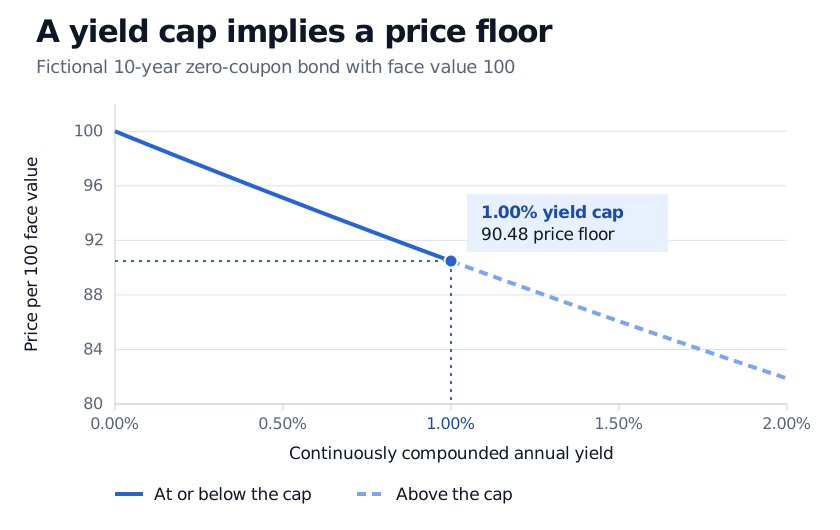
Fictional example with 10 years remaining at settlement. The dotted guides show the 1% yield ceiling and its equivalent price floor of 90.48 per 100 of face value, rounded.
At a price of 89, the yield would be about 1.17%. If eligible sellers can reliably sell to the central bank at the implied floor, they have little reason to accept 89. The bank may need few purchases when that commitment is credible. If it limits or pauses purchases, the market price can fall below the implied floor and the yield can exceed the ceiling. Federal Open Market Committee minutes.
A coupon bond has several cash flows, so converting its quoted yield into a purchase price requires its coupon schedule and the market's settlement and yield conventions. Gürkaynak, Sack and Wright, §§2.1–2.2.
The SelfMadeQuant Bonds and Yields lesson works through the continuous-compounding calculation for a zero-coupon bond. The preview is public and the full lesson requires membership.
Reading a targeted yield
Yields at untargeted maturities can still move as expectations for future short rates or the term premium change. The term premium reflects the compensation investors require for holding longer bonds. Gürkaynak, Sack and Wright, §3.1.
Concentrated purchases can also make the target bond harder to trade or borrow. A rates model that treats the target yield as a proxy for policy-rate expectations can miss repricing visible in neighbouring bonds or overnight index swaps. Reserve Bank of Australia yield target review.
- Australia. The Reserve Bank of Australia initially targeted the three-year government bond yield. By July 2021 it had decided to keep targeting the April 2024 bond as its remaining maturity shortened. The bond’s yield climbed above target in late October, by which time overnight index swap rates were already well above the bond’s yield. The bank ended the target on 2 November 2021 and continued its separate bond purchase programme. Reserve Bank of Australia yield target review.
- Japan. In January 2024, the Bank of Japan aimed for 10-year Japanese government bond yields around zero and treated 1% as a reference for market operations. On 19 March 2024, it announced the end of the YCC framework and made the overnight rate its primary tool. January policy statement · March policy decision.
Sources
- Federal Reserve, FOMC minutes, 9–10 June 2020
- Gürkaynak, Sack and Wright, The U.S. Treasury Yield Curve, §§2.1–2.2 and §3.1
- Reserve Bank of Australia, Review of the Yield Target, June 2022
- Bank of Japan, Statement on Monetary Policy, 23 January 2024
- Bank of Japan, Changes in the Monetary Policy Framework, 19 March 2024