Follow the state, not just the signal
| Function | What it must establish |
|---|---|
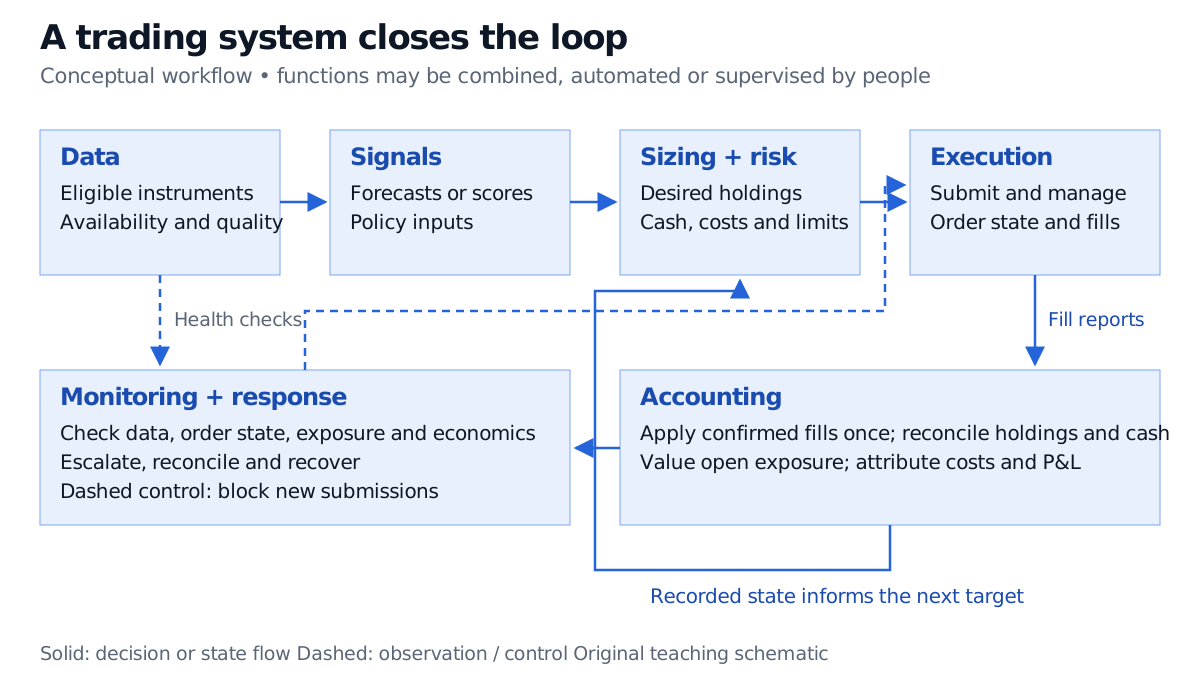
| Data | Instrument identities, timestamps, information availability and quality checks. A corrected historical series is not automatically what the trader knew at the time. |
| Signals | The forecast, score or condition produced by the authorised rule using available information. |
| Sizing | The desired holdings after considering existing positions, cash, expected trading costs and competing portfolio demands. |
| Risk controls | Whether the proposed exposure and potentially executable orders fit the mandate and limits; what blocks or escalates a decision. |
| Execution | Submission, acknowledgements, partial fills, rejections, cancellations and the remaining order state. |
| Accounting | Confirmed holdings, cash, fees, valuations and reconciliations against authoritative records. |
| Monitoring | Whether data, orders, exposures, economics and infrastructure behave as expected, with a defined response when they do not. |
These are functions, not a requirement for separate software services. A small system may combine them, and people may perform some steps. A forecasting notebook or order-entry screen alone does not cover the full workflow.
The ledger is a test of the connections
| Recorded event | Change in shares | Trading cash flow | Fee cash flow | Net cash change |
|---|---|---|---|---|
| Purchase fill | +10 | −USD 1,000 | −USD 2 | −USD 1,002 |
| Sale fill | −10 | +USD 1,050 | −USD 2 | +USD 1,048 |
| Round trip | 0 | +USD 50 | −USD 4 | +USD 46 |
With no remaining shares or other cash flows, the cash reconciliation gives the completed trade's net profit:
The system should be able to connect this result to the decision, orders, unique execution records and fees that produced it. Replaying an already applied fill must not add the shares or cash flow again. A target of 10 shares is insufficient evidence for the purchase entry; the stipulated fills are what justify it.
USD 46 verifies this invented reconciliation. It does not establish that the strategy has an edge, that its orders were permissible, or that the system will remain reliable. It is also a cash profit, not a return: no investment-capital denominator or holding period has been specified.
A stop is an action, not a position report
Suppose the system loses contact with its execution venue after submitting an order. A timeout establishes that a response was not received; it does not establish rejection. Automatically sending the same instruction again can create duplicate exposure.
A defined response can block further submissions, retain unresolved orders as potentially executable, obtain authoritative order and fill records, and reconcile holdings before resuming. Stopping new orders does not close existing positions. Requesting cancellation does not prove that every working order has been cancelled.
Sources
- Rishi K. Narang, Inside the Black Box: A Simple Guide to Quantitative and High-Frequency Trading, 2nd edition (Wiley, 2013), Chapter 2, pp. 17–20, and Chapter 10, “How Quants Monitor Risk,” pp. 193–195 — production-system functions, data and research, and exposure, P&L, execution and systems monitoring. The diagram and ledger here are original teaching constructions.
- FINRA: Regulatory Notice 15-09, Guidance on Effective Supervision and Control Practices for Firms Engaging in Algorithmic Trading Strategies, 26 March 2015, sections II–IV — development, testing, validation, monitoring and reconciliation; checked 26 October 2026.