A trade allocation policy sets how an investment adviser assigns an aggregated market order’s fills, prices and costs to the participating accounts. In a client-to-client cross trade, one advisory client buys a security from another. An allocation determines who gets the fills from an outside execution. In a cross, the agreed price determines how much the buyer pays and how much the selling client receives.
Who gets a partial fill?
Two fictional clients want to buy the same stock. Account A requests 150 shares and account B requests 100. Both are eligible under their mandates, trading restrictions and cash limits. The desk records their orders before trading and combines them into one 250-share buy order. The market fills only 100 shares. Under the firm’s stipulated pro rata policy, each account gets the same fraction of its eligible request, . A gets 60 shares and B gets 40. That leaves 90 shares unfilled for A and 60 for B.
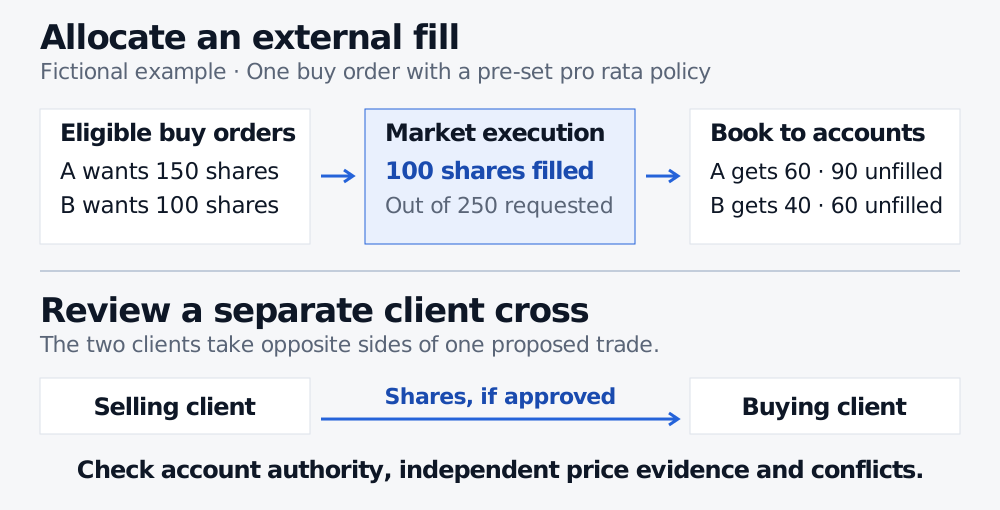
The first flow distributes an outside fill among buyers. The second pairs a seller with a buyer.
A desk can decide in advance how to handle indivisible lots, very small fills and price or fee allocation across multiple executions. The SEC’s interpretation of the U.S. adviser’s fiduciary duty allows the allocation method to reflect client objectives and the advisory relationship. It calls for eliminating allocation conflicts or giving full and fair disclosure that allows informed consent. Pro rata is one possible method. SEC interpretation IA-5248, §II.C, pp. 26–27
Cherry-picking can occur when someone waits to see price moves and then assigns favourable fills to a preferred or personal account. A reviewable process timestamps the eligible orders and policy version before execution, reconciles the booked quantities to the market fills and records the reason and approval for any change. Reviewers can compare late changes against price moves and look for a pattern of favourable allocations. In a 2024 settled order, the SEC found that representatives made late allocations that disproportionately directed profitable trades to their own accounts. SEC order IA-6734
The Post-Trade Analysis lesson shows how to match unique executions to their parent order. The preview is public and the full lesson requires membership.
When one client sells to another
Suppose a different client wants to sell a holding that another client independently wants to buy. Before crossing the orders, the adviser checks both account mandates and trading authority, captures timely independent price evidence and compares each client’s terms with those realistically available in the market. The relevant amounts are the buyer’s all-in cost and the seller’s net proceeds. Avoiding a spread or brokerage charge can benefit both clients, but a stale price can favour one side, and a need to raise cash in one account can create pressure to trade at the other account’s expense. Record why the trade serves each client and what approvals and disclosures apply. SEC interpretation IA-5248, §§II.B–C
Adviser capacity. U.S. Advisers Act §206(3) addresses an adviser trading as principal for its own account with a client or acting as broker for the other party in a client trade. Where it applies, the adviser ordinarily must disclose its capacity in writing and obtain consent for the transaction before settlement. Rule 206(3)-2 provides a conditional route for certain agency crosses where the adviser or a qualifying affiliate brokers both sides. It requires prospective written consent after full written disclosure, transaction confirmations, annual reporting and the ability to revoke consent. Its conditions exclude crosses recommended to both sides by the adviser or by the adviser and a control affiliate. Advisers Act §206 · Rule 206(3)-2 · SEC interpretation IA-1732, §II
Under the SEC’s 1998 interpretation, an adviser arranging a particular agency trade between two of its advisory clients acts outside §206(3)’s broker prong if it receives no direct or indirect compensation for effecting that trade apart from its advisory fee. The adviser still owes fiduciary duties to each client under §§206(1) and (2). SEC interpretation IA-1732, §III and note 22
Registered fund on one side. If one client is a U.S. registered investment company and the other acts as principal and is an affiliate of the fund or of one of its affiliates, Investment Company Act §17(a) generally restricts the trade. Rule 17a-7 exempts specified transactions, including certain crosses with accounts affiliated solely through a common adviser. Among its conditions are cash against prompt delivery, readily available market quotations under Rule 2a-5, the independent current market price as defined by Rule 17a-7, consistency with the participating funds’ disclosed policies, no brokerage commissions, fees or other remuneration apart from customary transfer fees, and board procedures, quarterly review and records. The required quote must be reliable and unadjusted, for the identical security in an active market the fund can access. An evaluated price alone falls short. In October 2026 the SEC proposed expanding the range of eligible securities. The current rule’s quotation requirement still applies as of November 2026. Investment Company Act §17 · Rule 17a-7 · Rule 2a-5(c) · SEC proposal IC-36358
Sources
- SEC IA-5248, Commission Interpretation Regarding Standard of Conduct for Investment Advisers
- SEC IA-6734, First Allied Advisory Services and Cetera Investment Advisers
- Investment Advisers Act §206
- 17 CFR §275.206(3)-2, Agency cross transactions for advisory clients
- SEC IA-1732, Interpretation of Advisers Act §206(3)
- Investment Company Act §17
- 17 CFR §270.17a-7, Exemption for specified affiliated transactions
- 17 CFR §270.2a-5(c), Readily available market quotations
- SEC IC-36358, Investment Company Cross Trading (October 2026 proposal)