A U.S. registered fund is an investment company registered with the Securities and Exchange Commission (SEC) under the Investment Company Act of 1940. The Act governs how these companies are organised and operate. For a liquidity or performance model, the fund’s structure helps determine which price belongs in the analysis and whether an investor exits through the fund or through a trade with another investor. Investment Company Act § 8
What exactly is registered?
The 1940 Act governs registration of the investment company. Section 8 provides for a notification of registration, filed on Form N-8A, and a registration statement that identifies the fund’s classification and describes policies such as borrowing and investment concentration. The Securities Act of 1933 governs registration of the securities offered to investors. These are separate legal requirements even when a single document covers both. For example, Form N-1A can serve as a registration statement under both Acts for an open-end management company. SEC investment-company registration guide · SEC Form N-1A, General Instructions B
A qualifying private fund can fall outside the 1940 Act’s definition of an investment company. For example, § 3(c)(7)(A) generally requires the issuer’s outstanding securities to be owned exclusively by investors who were qualified purchasers at acquisition, and requires that the issuer be neither making nor then proposing a public offering. The status of the offering under the 1933 Act is a separate question. Investment Company Act § 3 · Securities Act § 5
Which structure sets the exit terms?
Section 4 divides investment companies into three principal classes. A unit investment trust (UIT) has no board of directors and issues redeemable units representing interests in specified securities. Face-amount certificate companies form a separate class. Section 5(a) divides management companies into open-end and closed-end companies. The open-end definition turns on whether the management company offers or has outstanding any redeemable security it issued. Investment Company Act § 4 · Investment Company Act § 5
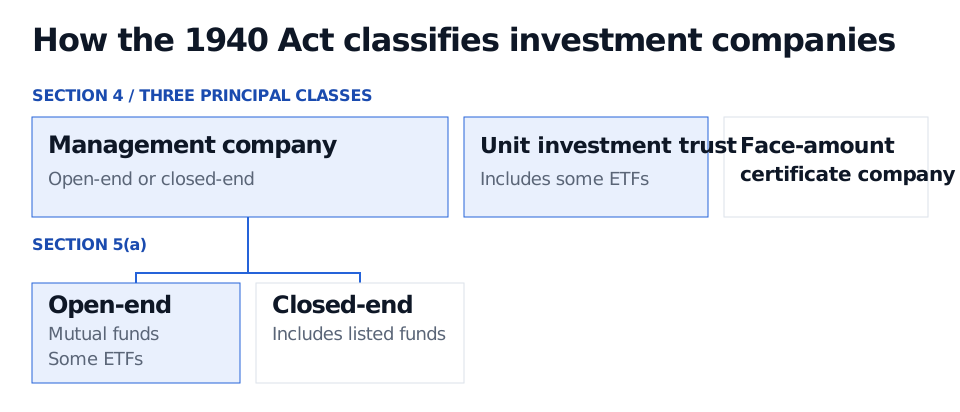
The open-end and closed-end labels sit within the management-company branch. Registered ETFs appear in two branches.
- Conventional mutual fund. In this open-end structure, a valid purchase or redemption order generally uses the net asset value (NAV) per share next calculated after receipt, subject to the fund’s dealing terms and any applicable charges. SEC Mutual Funds · Rule 22c-1(a)
- Registered closed-end fund. Investors in a listed closed-end fund normally exit by selling at the available market price. A registered interval fund is also closed-end and can offer limited periodic repurchases at NAV. SEC Closed-end Funds · Rule 23c-3(b)
- Registered exchange-traded fund (ETF). A retail investor generally trades at the market price. Rule 6c-11 provides conditional relief for eligible registered open-end management companies that issue and redeem creation units with authorised participants and list their shares on a national securities exchange. An ETF organised as a UIT falls outside that rule’s scope. For example, the January 2026 filing for the State Street SPDR S&P 500 ETF Trust identifies its 1940 Act registration as a UIT, its SEC exemptive order and its separate 1933 Act registration of units on Form S-6. Rule 6c-11 · State Street SPDR S&P 500 ETF Trust filing
An exchange listing alone leaves the legal structure unresolved. Exchange-traded commodity trusts can register their offerings under the 1933 Act and trade on the same kind of exchange as ETFs while remaining outside the 1940 Act’s registered-fund framework. SEC Exchange-Traded Products
What the NAV number tells you
Suppose a fictional fund has USD 105 of assets, USD 5 of liabilities and 10 identical shares outstanding at the same valuation time.
The USD 10 is the portion of the fund’s net assets attributable to one share at that valuation. For an exchange-traded share, compare its market price with NAV from the same valuation time to measure a premium or discount. SEC Net Asset Value
Registration status comes from the fund’s SEC filings. To model custody or financing risks, read the fund’s disclosed policies alongside the rules that apply to its structure. For example, § 17(f) addresses safekeeping of securities for registered management companies, and § 18 sets distinct capital-structure requirements for registered open-end and closed-end companies. Investment Company Act § 17(f) · Investment Company Act § 18