Personal account dealing policies are a firm's rules for securities trading by its staff in their own accounts and in other accounts covered by the policy. They govern which accounts staff disclose, which trades need approval or are blocked, and what the firm reviews afterwards. A quant who sees a rebalance before the client's orders reach the market could buy first and benefit if the client's buying moves the price. A pretrade check can stop that order, and brokerage records let the adviser check whether any trade went through. SEC adopting release IA-2256, §§II.C and II.G
One request and two records to reconcile
Nora is a quant analyst at a fictional SEC-registered investment adviser. She can see the desk's nonpublic client orders, so she is an access person under Rule 204A-1. The firm's policy requires her to disclose her securities accounts when she joins and when she opens a new one. It also requires preclearance before she places a personal single-stock order and blocks such orders in issuers on its restricted list. A firm may use restrictions alongside an information barrier or a blackout period around client trading. The scope and length of a blackout depend on the firm's policy. Rule 204A-1(e)(1) · IA-2256, §§II.B and II.C.1
At 09:08, Nora requests approval to buy the already-listed shares of fictional Alder Systems through her disclosed brokerage account. At 09:10, compliance checks the applicable restriction and finds that Alder is already on the list. At 09:12, it records the denial with the issuer, account, time and reason. Nora places no order. The denial belongs in the preclearance log. Her brokerage statement has no Alder execution to report.
Suppose Nora did execute a permitted trade in a different reportable stock that quarter. The brokerage confirmation records the execution, with its date, security, side, quantity and price. Her holdings report gives a snapshot of what she holds and identifies the institutions where she keeps securities accounts. Each record answers a different question. Compliance can compare an executed trade with its preclearance decision, restrictions in effect at the time and any related client orders. A trade after a denial is a reason to investigate, and the facts needed to establish insider trading liability are a separate question. Rule 204A-1(a)(3) and (b) · IA-2256, §II.G
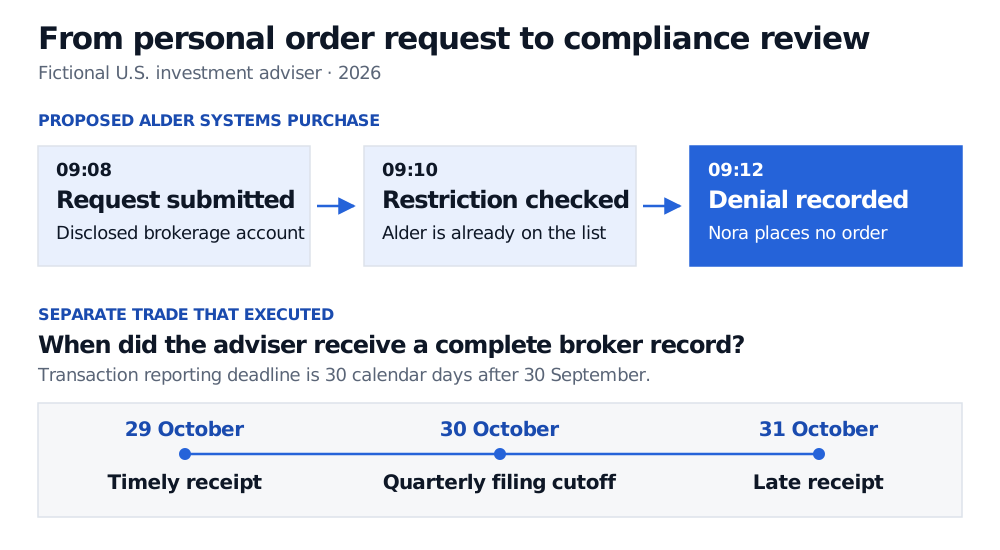
The preclearance log captures intent and the firm's decision. The broker record captures an actual execution, and the receipt date matters when it stands in for a quarterly transaction report.
What U.S. Rule 204A-1 requires
The rule applies to investment advisers registered or required to register under section 203 of the Investment Advisers Act. They must maintain and enforce a written code of ethics and review their access persons' personal securities reports. An access person is a supervised person who can see nonpublic client securities trades or reportable fund holdings, helps make securities recommendations to clients, or can see those recommendations before they are public. Directors, officers and partners are presumed to be access persons when providing investment advice is the adviser's primary business. Rule 204A-1(a) and (e)(1)
Prior approval. The rule requires access persons to get the adviser's approval before acquiring direct or indirect beneficial ownership in a security in an initial public offering or a limited offering as defined by the rule. Nora's proposed secondary-market buy of already-listed shares was subject to the firm's broader preclearance policy. The SEC's 2004 adopting release describes wider preclearance, restricted lists and blackouts as controls firms can adopt. Where the adviser is its only access person, the rule waives self-approval and reporting to oneself if the adviser keeps the records that would otherwise have to be reported. Rule 204A-1(c)–(d) and (e)(6)–(7) · IA-2256, §§II.C.1 and II.D
Holdings and transactions. The first holdings report is due within 10 days of becoming an access person. Its snapshot can be dated up to 45 days before that designation. Later reports are required at least once every 12 months, using holdings current as of a date no more than 45 days before submission. The reports identify holdings in reportable securities in which the person has direct or indirect beneficial ownership and name the brokers, dealers or banks with which the person maintains securities accounts for their direct or indirect benefit. Transaction reports cover transactions in reportable securities in which the person had or acquired direct or indirect beneficial ownership and are due within 30 days after each calendar quarter. Direct obligations of the U.S. government and shares of money market funds are examples of securities excluded from the rule's reportable-security definition. Rule 204A-1(b)(1)–(2) and (e)(3), (9)–(10)
Reporting exceptions. The code may excuse reports on securities held in accounts the access person cannot influence or control, directly or indirectly. It can also omit transaction reports for trades under an automatic investment plan. The duplicate-record exception covers a separate transaction report when it would repeat information in broker trade confirmations or account statements the adviser keeps and receives within 30 days after quarter-end. For Nora's other trade in the quarter ending 30 September 2026, a complete broker record received on 29 October and kept in the adviser's records can meet that condition. A record first received on 31 October misses the 30 October cutoff. The exception leaves the holdings report and any applicable pretrade approval requirement in place. The adviser must keep access-person reports or the substitute broker information, a record of its access persons, and its IPO and limited-offering approval decisions with their reasons. Rule 204A-1(b)(3) · 17 CFR §275.204-2(a)(13)