Investment adviser registration is the regulatory process for firms required to register as advisers with the U.S. Securities and Exchange Commission (SEC) or state securities authorities. Fiduciary duty is the adviser’s obligation to act in the client’s best interest through duties of care and loyalty. For a portfolio team, even a choice between two share classes of the same fund calls for a client-specific reason when the classes offer the same exposure but one pays the adviser more. Advisers Act §203 · §203A · SEC interpretation IA-5248, §II
When does registration come into play?
The federal definition generally covers a person or firm in the business of providing securities advice or analyses for compensation, subject to statutory exclusions. A firm that charges for managing client securities portfolios ordinarily meets that test. A firm that gives securities advice for a fee without taking custody or trading for the client can meet it too. Advisers Act §202(a)(11)
SEC registration is subject to exemptions and the federal–state allocation of oversight. Regulatory assets under management, the type of client and whether the adviser must register with and is subject to examination by its home state can affect where it registers. Advisers use Form ADV to apply. Some exempt advisers also file a report on Form ADV. The federal fiduciary standard arises from the advisory relationship under the Advisers Act, and the SEC enforces it through §206. Advisers Act §203 · §203A · §206 · Form ADV instructions · IA-5248, §II.A
What the adviser owes the client
Care starts with understanding the client’s objectives and having a reasonable basis for advice that serves those objectives. It includes seeking best execution when the adviser selects brokers for client trades and monitoring as appropriate to the relationship. Ongoing portfolio management generally calls for ongoing monitoring. An adviser delivering a one-time financial plan is unlikely to owe ongoing monitoring without an agreement to provide it. The parties can define the scope of the service with full and fair disclosure and informed consent. A general waiver of fiduciary duty is ineffective. IA-5248, §§II.A–B
Loyalty requires the adviser to put the client’s interests ahead of its own, disclose material facts about the relationship, and eliminate or fully and fairly disclose conflicts that could bias its advice. A disclosure must give the client enough specific, understandable information to give or withhold informed consent. Where that is infeasible, the adviser should eliminate the conflict or reduce it enough to make full and fair disclosure and informed consent possible. Even with informed consent to a conflict, the adviser still needs a best-interest basis for its advice. IA-5248, §II.C
The standard follows the advisory relationship. A separate rule, Regulation Best Interest, applies when a broker-dealer acting in its brokerage capacity recommends a securities transaction or strategy to a retail customer, including an account recommendation. 17 CFR §240.15l-1(a)–(b)
Same fund, different incentive
Suppose a fictional SEC-registered adviser manages a client’s portfolio on an ongoing basis. The client wants diversified U.S. equity exposure for a long-term allocation, and the adviser has determined that a particular mutual fund fits that allocation. The client qualifies for both of its share classes. They hold the same underlying portfolio, provide the same services, and have identical purchase and exit terms and tax treatment. The client pays the same separate advisory fee in either class, with no offset for fund payments.
Class A has an annual expense ratio of 0.20%. Class B charges 0.45%, including a 0.25% 12b-1 distribution fee paid out of fund assets. In this arrangement the adviser receives 0.15% of the assets held in Class B each year through the fund’s distributor, which keeps the remaining 0.10%. The adviser receives no distribution payment on Class A. SEC staff FAQ on adviser compensation, share-class discussion and note 2
Assume a constant USD 100,000 in the chosen class for one year with no contributions, withdrawals or compounding in the fee illustration. Class A costs USD 200 in fund expenses. Class B costs USD 450. The extra 25 basis points cost the client USD 250 for the year.
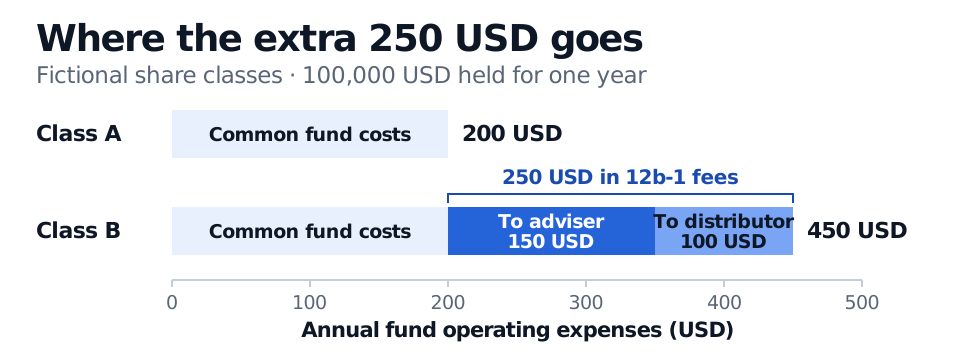
The 12b-1 fee accounts for the entire cost difference, and only part of that fee goes to the adviser.
The adviser’s USD 150 payment comes out of Class B’s USD 450 expense total. A cost comparison that adds the adviser payment to that total counts it twice.
The care question is what the client gets for the extra cost. Here the higher fee buys no additional exposure or service and avoids no other charge. Class A is the better-supported recommendation under those assumptions. When eligibility, services, transaction costs or the cost of moving an existing position differ, the adviser has to weigh those facts against the ongoing cost in light of the client’s objectives. IA-5248, §II.B.1
The loyalty question is who benefits from the choice. If the adviser recommends Class B or selects it for the client under this arrangement, a generic statement that it “may receive compensation” obscures an actual payment. The client needs enough detail to see who pays whom, what triggers the payment, how it affects the adviser’s incentives, and that the lower-cost class is available. Form ADV’s brochure instructions address these disclosures. Even if the client understands and consents to this payment arrangement, the adviser still needs a reason the higher-cost class serves the client. IA-5248, §II.C · SEC staff FAQ on adviser compensation, disclosure and share-class selection
For an ongoing account, a change in class eligibility or a new fee offset can reopen the analysis. The adviser then compares continuing to hold with converting or selling, using the account’s actual switching costs and tax consequences. IA-5248, §II.B.3 · SEC staff FAQ on adviser compensation, ongoing recommendations
Sources
- U.S. Investment Advisers Act §202(a)(11), definition of investment adviser
- U.S. Investment Advisers Act §203, registration
- U.S. Investment Advisers Act §203A, federal and state oversight
- U.S. Investment Advisers Act §206, prohibited transactions
- SEC Commission interpretation IA-5248, effective 12 July 2019
- SEC Form ADV general instructions
- SEC Division of Investment Management staff FAQ on adviser compensation, 18 October 2019
- Regulation Best Interest, 17 CFR §240.15l-1