Timberland investment is exposure to forest land and the right to earn income from its timber. A stand can add saleable wood or grow into higher-value grades while the owner waits to cut it. The investor therefore forecasts merchantable volume, local prices and harvest dates separately. A rise in volume can coincide with a fall in the value of the standing timber if local prices fall far enough. USDA Forest Service research on timberland valuation
Start with the sale terms
A stumpage sale transfers the right to cut specified standing trees. Under a typical stumpage arrangement, the buyer handles cutting and hauling. A delivered-log sale pays for logs at the delivery point, such as a mill, and the seller arranges and pays for cutting and hauling. The delivery price is a gross receipt for that seller. To compare it with a stumpage bid, use the same wood grades, volume units and payment dates, and account for who bears each cost. Rayonier's 2025 filing describes both channels and distinguishes lump-sum stumpage from contracts that pay as timber is cut. Rayonier, 2025 Form 10-K, Note 4
Suppose a fictional stand yields 1,000 cubic metres of saleable logs of one grade. At an assumed delivered price of USD 60 per cubic metre, the owner collects USD 60,000. Cutting and hauling cost USD 15,000, leaving USD 45,000. An assumed stumpage bid of USD 45 per cubic metre leaves the same amount if the buyer pays for cutting and hauling. The equality is a feature of these bids and assumes the same cash timing. Both figures are before the cost of buying or managing the land, replanting, financing, fees and taxes.
What does one more year buy?
Leave the same stand uncut for a year and assume its merchantable volume grows by 5% to 1,050 cubic metres, all in the same grade. At the same delivered price of USD 60 and cutting and hauling cost of USD 15 per cubic metre, the extra wood adds USD 2,250 after those costs. Assume the owner pays another USD 1,500 to hold the stand for the year. With the cash all arriving or leaving at year-end, the delayed harvest leaves USD 45,750. At an assumed annual effective discount rate of 6%, its present value is , about USD 43,160 today, versus USD 45,000 for selling now.
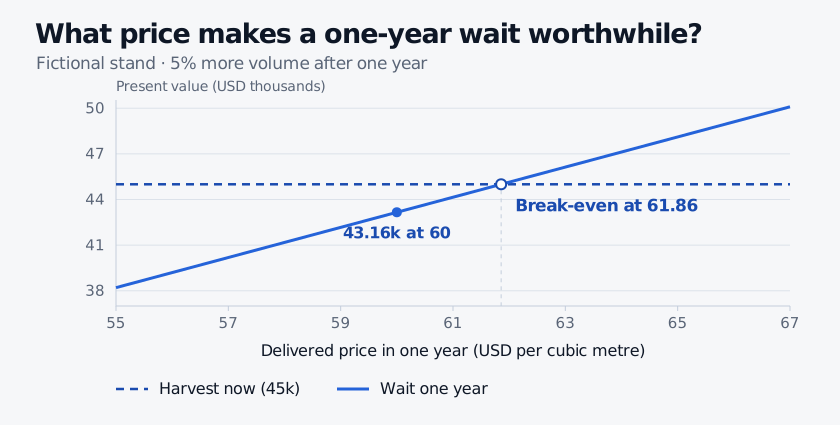
With next year's volume and costs held fixed, a delivered price of about USD 61.86 per cubic metre makes the two harvest dates equally valuable today.
The break-even price comes from working backward. To match USD 45,000 today, the stand must generate USD 47,700 next year after carrying costs. Add the USD 1,500 carrying cost, divide by 1,050 cubic metres, then add USD 15 per cubic metre for cutting and hauling. This isolates one harvest decision. A full comparison also captures when the next stand can be planted and harvested, any change in product mix, and the risk of losing timber while waiting. Fire, wind, pests and disease can cut merchantable volume or damage its grade. Wet ground can make the tract inaccessible when a sale is planned. Local mill demand and hauling costs can move independently of tree growth. USDA Forest Service, Timber Investment Considerations · Rayonier, 2025 Form 10-K, Item 1A
Value the rights the investor actually buys
In a discounted cash flow valuation, project harvest receipts by species and grade, then date outlays for planting, upkeep, roads and taxes. Check which acreage is physically and legally harvestable. Model ancillary revenue such as hunting licences or mineral leases only where those rights transfer and the uses can coexist with the harvest plan. The terminal value reflects the land and any remaining trees or other rights the next buyer receives. Timber sold during the forecast comes out of that closing inventory. For a fund investor, apply management fees and any performance fees on their contractual bases to move from property cash flows to investor cash flows. Rayonier, 2025 Form 10-K, Item 1 and Note 4 · Kanieski da Silva et al., 2024