Term Loan A (TLA) and Term Loan B (TLB) are labels for separate classes of corporate term debt. In syndicated lending, a TLA typically repays principal faster through scheduled instalments, called amortisation. A TLB typically amortises more slowly and leaves more to repay as a lump sum, or balloon, at maturity. Slower paydown frees up cash for the borrower early on and increases the amount it must fund at maturity. Lim, Minton and Weisbach, §§2.2–3.1
Banks often participate in A tranches, while B tranches are commonly structured for non-bank institutional investors. Both investor groups can hold either class. Under a term loan, principal repayments generally reduce debt without restoring the right to draw that amount again. A revolving credit facility typically allows a borrower to draw again within the agreement’s limits. Lim, Minton and Weisbach, §§2.2 and 3.2, Pitney Bowes credit agreement, §2.01
Same maturity, different cash demand
Compare two fictional USD 100 million loans, both due at the end of year five. The A loan repays 10% of original principal each year and the B loan repays 1%. For each loan, the fifth instalment and the remaining balloon fall due together. The table shows principal only and assumes no prepayments.
| Principal repayment (USD millions) | Term Loan A | Term Loan B |
|---|---|---|
| Each of years 1–4 | 10 | 1 |
| Fifth instalment | 10 | 1 |
| Balloon after the fifth instalment | ||
| Total due at maturity | 60 | 96 |
| Total over the life of the loan | 100 | 100 |
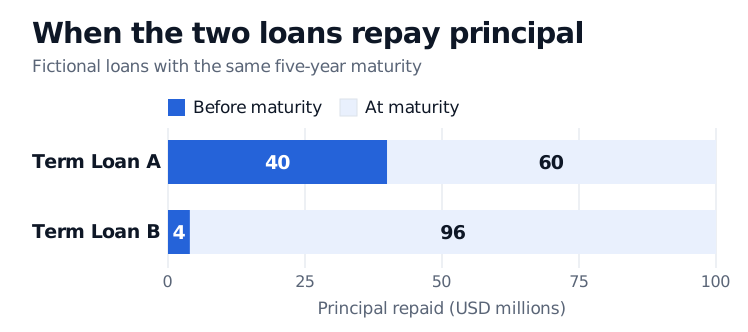
Each maturity amount includes both the fifth instalment and the balloon.
The B schedule moves USD 36 million of principal from the first four years to the final date. A debt-sizing model can show ample coverage of early payments and still reveal a funding shortfall at maturity.
What a filed agreement says
Pitney Bowes’ September 2026 amendment illustrates the difference. Its A schedule steps up from 1.25% per quarter to 1.875% and then 2.50%, using the balance on the fourth amendment’s effective date. Its 2026 B tranche uses 0.25% per quarter of the balance on the fifth amendment’s effective date. Each calls for repayment of the residual at its own maturity. The agreement also specifies how prepayments adjust future scheduled instalments. Pitney Bowes credit agreement, §2.09(a)–(c), (e)
Maturity, pricing, fees and financial covenants depend on the deal. Generac’s filing for June 2025, for example, reported leverage and interest coverage tests for its then-current A tranche and no financial maintenance covenant for its B tranche. The actual agreement supplies the terms and payment dates for the cash forecast. Generac June 2025 Form 10-Q, Note 10