A revolving credit facility, or revolver, is a line of credit that lets a borrower draw, repay and draw again during the commitment period, within the limits and conditions of the agreement. It can fund a seasonal inventory build or bridge a delay in customer payments. As a backstop against funding liquidity risk, its value depends on how much cash can actually arrive by the payment deadline. Verra Mobility credit agreement, §§2.01, 2.03 and 7.01–7.04
How much can the borrower draw?
A fictional distributor has a USD 100 million commitment and USD 30 million in outstanding loans. The issuing bank has also provided a USD 10 million standby letter of credit (LC) to a supplier. The LC is undrawn, so the distributor has received no loan proceeds from it. The agreement still reserves USD 10 million of capacity because the bank has promised to pay the supplier if the supplier makes a valid demand under the LC. With the commitment as the binding ceiling and all draw conditions satisfied, the distributor can borrow another million. Verra Mobility credit agreement, §1.01 (LC Exposure) and §2.13
In an asset-based revolver, the borrowing base can impose a lower ceiling. The agreement specifies which assets count, what fraction of their value the lender advances, and what reserves to deduct. For example, older receivables can become ineligible even as the company's need for cash grows. If the distributor's borrowing base fell to USD 75 million with the loan and LC unchanged, the lower ceiling would leave million available. This simplified calculation assumes no other exposures or limits. Verra Mobility credit agreement, §1.01 (Availability, Borrowing Base, Eligible Accounts and Line Cap)
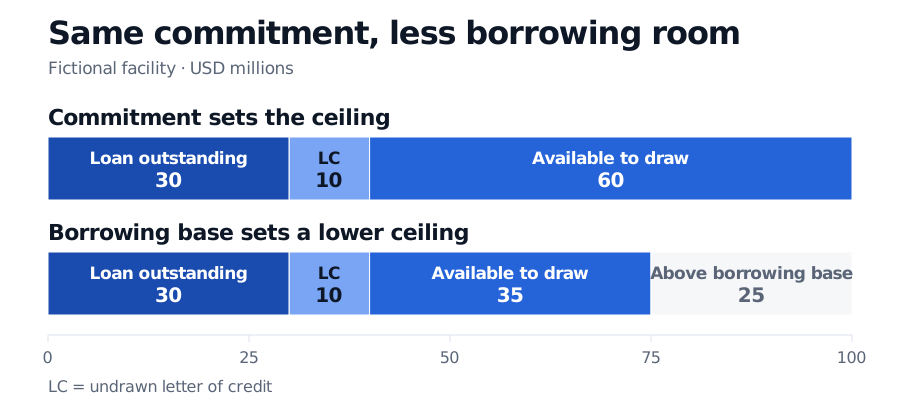
The borrowing base can shrink while the commitment, loan balance and letter of credit stay fixed.
The fee depends on what the agreement counts
Assume the fictional agreement charges 0.50% per year on the unused commitment after deducting loans and the outstanding LC. In the base case, all balances stay fixed for 365 days and the agreement uses Actual/365 Fixed, a day-count fraction of . The unused-line fee is million, or USD 300,000. Loan interest and any separate LC fees are additional.
Actual fee bases can differ from available borrowing room. Verra Mobility's October 2025 agreement bases its unused-line fee on commitments, excluding those of defaulting lenders, less average daily revolving loans and stated LC amounts. The loan deduction excludes swingline loans, a short-term borrowing option within the facility. It uses Actual/360 for fees. Global Medical REIT L.P.'s October 2025 agreement provides for a switch from a fee on unused commitments to one on the entire commitment if its debt-rating pricing election takes effect. Verra Mobility credit agreement, §§2.05–2.06 and 2.12, Global Medical REIT L.P. credit agreement, §2.1(a)–(b)
When the backstop may fail
An available amount is conditional funding capacity. In a cash forecast, keep it separate from cash on hand and from the USD 30 million already owed. A new cash draw increases cash and funded debt when it settles. The funding forecast therefore depends on the notice cutoff, conditions such as accurate representations and no continuing or resulting default, and whether the line still has time to run. At maturity the commitment can end and the outstanding loans can fall due. Verra Mobility's filed agreement also illustrates a springing maturity, where specified notes or refinancing debt still outstanding near maturity can bring the scheduled maturity forward. Verra Mobility credit agreement, §1.01 (Initial Maturity Date), §§2.03–2.04, 2.07 and 7.01–7.04
Low availability can itself activate a financial covenant. Verra Mobility's agreement requires a fixed-charge coverage test when availability falls below a specified threshold. The drawable amount under one facility answers a separate question from debt capacity, which asks how much debt the borrower can service under its cash-flow outlook and repayment terms. Verra Mobility credit agreement, §10.11(a)