A systematic internaliser (SI) is an investment firm that executes client orders against its own account outside a trading venue under the applicable SI regime. In the current EU definition, the qualitative test concerns organised, frequent and systematic dealing in equity instruments, without operating a multilateral system; a firm can also opt into SI status. For an execution researcher, the key fact is the counterparty: the client trades with the dealer's balance sheet rather than being matched with another client's order.
This article describes the EU framework checked on 31 October 2026. The term has a separate UK definition. “Systematic” here is a regulatory description of a dealing business, not a claim that its investment strategy is algorithmic or quantitative.
Follow the shares and cash
Suppose a fictional dealer sells 100 shares from its own inventory to a client buying at EUR 50.01 per share. The contemporaneous accessible reference ask price is EUR 50.02. Assume a complete fill, an unchanged reference quote with sufficient size, and applicable lot and price rules permitting the stipulated EUR 0.01 price steps. Ignore fees.
The client pays EUR 5,001. Buying the same quantity at the reference ask would cost EUR 5,002, giving a gross benchmark benefit of
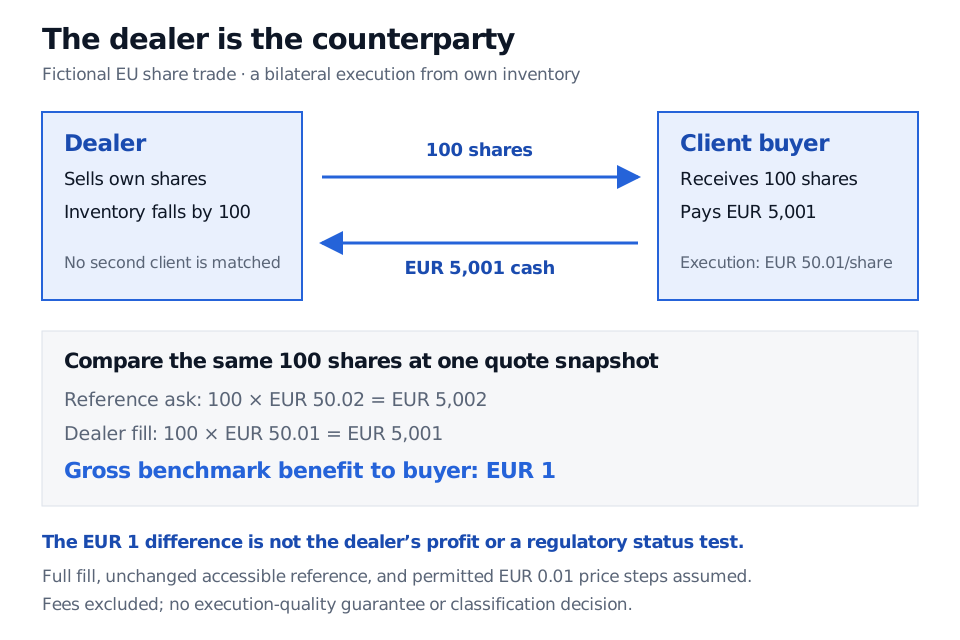
Original fictional bilateral execution. Full execution, an unchanged accessible reference ask and permitted EUR 0.01 price steps are stipulated; fees are excluded.
The dealer delivers its own shares and receives the cash. Its inventory falls by 100 shares. The EUR 1 is the buyer's price comparison, not the dealer's profit. Dealer profit requires inventory acquisition or valuation information, hedging and funding costs, fees and an explicit measurement horizon. Managing inventory also exposes a dealer to price moves and adverse selection.
One favourable trade establishes neither SI status nor best execution. The latter involves more than a single price: MiFID II Article 27 considers costs, speed, execution and settlement likelihood, size and other relevant factors where its duties apply. A counterfactual reference ask is useful only if its timing, availability and quantity are credible.
Trades, Quotes and Market State develops those benchmark checks. Its preview is public; the full lesson requires membership.
Status comes from the business, not this calculation
MiFID II Article 4(1)(20) defines the current EU category. The 2024 review replaced the old quantitative assessment with a qualitative one for equity instruments. A historical spreadsheet of dealing-frequency and market-share thresholds is therefore not the current mandatory SI test.
ESMA's 10 October 2025 transition statement expressly says firms no longer need to perform that quantitative test. Firms satisfying the qualitative equity requirements, or opting into the regime, must register as SIs. Removing the numerical test did not make status entirely voluntary. The opt-in route also remains relevant to non-equity instruments, as the adopted 2026 amendment to RTS 3 confirms in recital 1.
The statement also makes a material jurisdictional qualification: revised MiFID II directive provisions generally apply when transposed into national law. The EU definition and ESMA guidance are the starting point; assessing a particular firm also requires its applicable national implementation and notification position.
A dealer is different from a multilateral matching system
An SI is not a regulated market, MTF or OTF—the categories included in the EU definition of a trading venue. An MTF brings together multiple third-party buying and selling interests under its rules. The SI model instead places the investment firm on the other side of the client trade. Calling a client-crossing system “internal” does not turn multilateral activity into bilateral SI dealing.
Likewise, “dark pool” describes non-display and is not a substitute for the EU legal classification. MiFID pre-trade transparency waivers concern a separate venue transparency framework. US Regulation NMS supplies another jurisdiction's rules; it does not determine EU SI status.
Two different transparency questions
Before execution: must the dealer publish a firm quote? MiFIR Article 14 requires public firm quotes for relevant equity instruments traded on a trading venue where the firm is an SI and there is a liquid market. For the instruments covered by that article without a liquid market, quotes are disclosed to clients on request. The quoting framework has size conditions; SI status does not mean every possible block trade must have a public quote.
Use the current RTS 1 for technical calibration. The adopted Delegated Regulation (EU) 2025/1246 inserted Articles 11a and 11b concerning the scope threshold and minimum quote size. These are quoting provisions, not a revival of the abolished quantitative status test. The fictional share above supplies no regulatory liquidity classification or standard-market-size determination.
After execution: who publishes the trade? MiFIR Article 20 requires relevant transaction price, volume and time information to be made public through an approved publication arrangement (APA), subject to the applicable publication and deferral rules. This concerns investment firms more broadly than SIs.
Responsibility is allocated separately by Article 21a's designated publishing entity (DPE) regime. For an in-scope trade between two investment firms, where exactly one party is a DPE, it publishes through the APA; where both or neither are DPEs, the selling entity does so. DPE status identifies a reporting responsibility; it is not SI status, and the DPE is not itself the APA. Off-venue execution therefore does not imply an invisible completed transaction.
Finally, the FCA's UK definition uses its own wording and conditions, including “substantial”. Keep jurisdiction and rule date with execution records rather than applying one SI label across EU and UK observations.
Sources
- EUR-Lex: MiFID II, current consolidation of 6 June 2026, Article 4(1)(20)–(23)
- EUR-Lex: Directive (EU) 2024/790, recital 7 and Article 1(3)(b)
- ESMA: MiFID II/MiFIR transition statement No. 2, 10 October 2025
- EUR-Lex: adopted Delegated Regulation (EU) 2026/392, recital 1
- ESMA: MiFIR Article 14 — public firm quotes
- EUR-Lex: RTS 1, current consolidation of 2 March 2026
- EUR-Lex: adopted Delegated Regulation (EU) 2025/1246, Article 2(9) and Article 3
- ESMA: MiFIR Article 20 — post-trade disclosure
- ESMA: MiFIR Article 21a — designated publishing entities
- ESMA: MiFID II Article 27 — best execution
- FCA Handbook: systematic internaliser — UK definition