Regulation NMS is the US Securities and Exchange Commission's framework of rules for the national market system. It connects quotation access, intermarket price protection, pricing increments, market data and execution disclosures. For a quant, these rules help determine which prices a router must consider and which historical market state a simulation must reconstruct. The SEC's 2005 adopting release consolidated earlier national-market-system rules and added major equity-market reforms.
“NMS” does not mean one exchange or one consolidated order book. An exchange-listed share can trade across exchanges and off-exchange trading centers. The framework governs connections among those markets; it does not merge their queues or promise a fill wherever the best price appears.
Start with the instrument and the rule
Rule 600 defines an NMS stock as an NMS security other than an option. Its definition of NMS security depends on transaction reporting under the relevant plans. The stock-focused rules below therefore cannot be applied indiscriminately to every OTC security, futures contract or option. Off-exchange trading in an NMS stock is different from trading a non-NMS OTC security. Some other provisions do cover options: Rule 606 expressly includes specified options-order routing disclosures. See the current Rule 600 definitions and Rule 606 scope.
The main components answer different questions:
| Provision | What it contributes |
|---|---|
| Rule 600 | Definitions, including NMS stocks, protected quotations and the national best bid and offer. |
| Rule 610 | Access to quotations, access-fee constraints, fee transparency and restrictions concerning locked or crossed quotations. |
| Rule 611 | Trading-center policies and procedures to prevent non-excepted trade-throughs of protected quotations in NMS stocks. |
| Rule 612 (Sub-Penny Rule) | Minimum pricing increments for specified bids, offers and orders—the regulatory side of tick size. |
| Rules 605 and 606 | Execution-quality and order-routing disclosures, respectively, for their covered populations. |
This is a working map, not an exhaustive inventory. The current Regulation NMS text also contains market-data and other requirements. An NBBO observation, a routing report and a venue's regulatory obligations are different objects.
A one-cent difference on 100 shares
Consider a fictional US NMS stock. Stipulate a protected, accessible ask of USD 100.02 for 100 shares. A hypothetical buy of 100 shares executes elsewhere at USD 100.03. Hold the displayed price and size fixed for this arithmetic and exclude fees:
The purchase costs USD 10,003 rather than USD 10,002: USD 1 worse before fees. This is a price comparison against the stipulated ask, not a complete analysis of the order's execution quality.
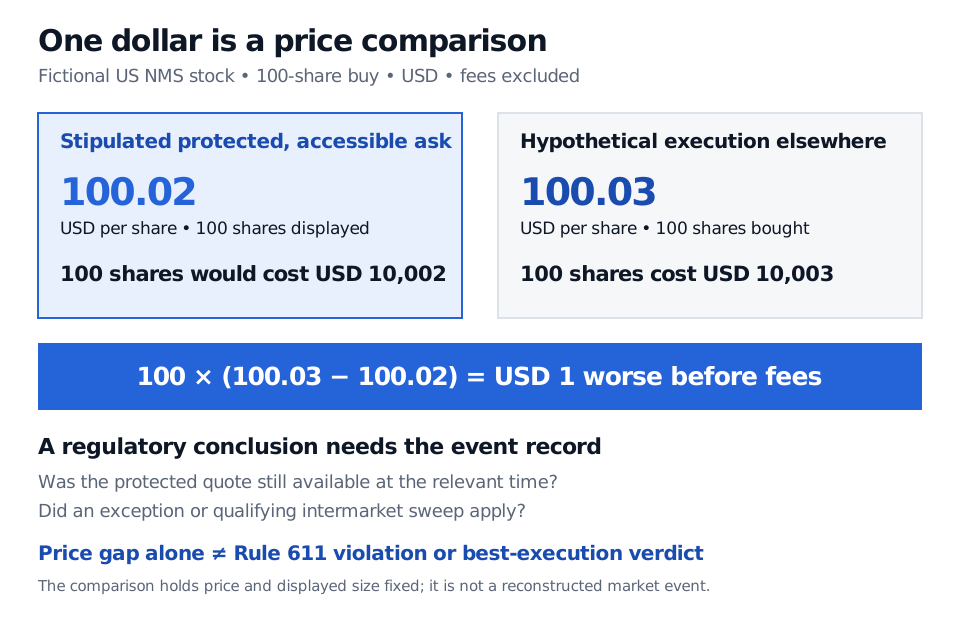
Original fictional comparison, in USD. The quote's price and displayed size are held fixed for the calculation; a regulatory assessment requires the actual event record.
Rule 611 requires trading centers to maintain and enforce reasonably designed policies and procedures, surveil their effectiveness and address deficiencies. It has exceptions, including specified system problems, auction transactions and intermarket sweep arrangements. A qualifying sweep involves obligations to address better protected prices; marking an order “sweep” is not permission simply to ignore them. The current Rule 611 text supplies the operative conditions.
To assess an actual apparent trade-through, establish the relevant quote state and timing, its protected status, available size, routing record and any exception or exemption. A later screenshot cannot establish all of that. Nor does a better price deeper in an order book automatically have the same protected status as a qualifying best quotation.
Best execution is a separate obligation. For FINRA members, Rule 5310 requires reasonable diligence to identify the best market in the circumstances. Order size and terms, market conditions and quote accessibility matter. Neither the USD 1 comparison nor the absence of a Rule 611 violation proves that this broader duty was satisfied.
Which version applies in October 2026?
Status checked 31 October 2026. An adopted amendment, its compliance date and a proposal to change it must be distinguished:
- Pricing increments and fee caps: the SEC adopted amendments in 2024, including a half-cent minimum increment for certain NMS stocks and reduced access-fee caps. Its 11 June 2026 order, Release 34-105656, extends temporary compliance relief for the amended minimum-increment provisions and Rule 610(c) fee caps until the first business day of November 2027. The earlier November 2026 date is superseded. The order does not put every related reform on hold: round-lot and odd-lot definitions and Rule 610(d) fee transparency were outside the earlier partial stay. SEC temporary-relief order.
- Trade-through and locked/crossed-market rules: the SEC's 11 June 2026 proposal, Release 34-105655, would rescind Rules 611 and 610(e). The official docket remains marked Proposed; the current eCFR retains both provisions. The proposal itself does not repeal them.
A historical backtest therefore needs dated rule and exemption assumptions. Reading the amended pricing grid in isolation can misstate the requirements that applied during temporary relief. Likewise, applying today's market-data definitions retrospectively can misclassify old quotations.
Preserve evidence before scoring the router
For research, retain venue, instrument, quote prices and sizes, event and receipt times, order instructions, routing messages and execution records. Treat a missing quote or unknown exception flag as missing evidence. A price-only dataset can measure some slippage; it cannot recreate every regulatory condition.
The owned lesson Trades, Quotes and Market State develops causal quote reconstruction, clock differences and stale-state flags. A public preview is available; the full lesson requires membership.
Execution disclosures provide another lens, with limits. Rule 605's standardized statistics concern covered executions; Rule 606 concerns covered routing and associated relationships. Their populations and purposes differ. Rule 605 itself warns that its statistics alone cannot reliably establish whether a broker obtained the most favorable reasonably available terms for a particular customer order. Use the Rule 605 disclosure framework alongside the event evidence, rather than turning an aggregate ranking into a verdict on one fill.
Sources
- SEC — Regulation NMS adopting release, 34-51808 (2005), opening summary: historical origins and principal reforms.
- eCFR — Regulation NMS within 17 CFR Part 242, especially Rules 610–612: current codified text, read together with applicable relief.
- eCFR — Rule 600, definitions of NMS security, NMS stock, protected quotation and intermarket sweep order.
- eCFR — Rule 605 and Rule 606: execution and routing disclosures and their limits.
- SEC — Temporary exemptive relief, 34-105656 (11 June 2026), introduction and Sections II–III: amended pricing-increment and fee-cap compliance relief.
- SEC — Proposed rescission docket, S7-2026-20: scope and proposed status of the June 2026 action.
- FINRA — Rule 5310, Best Execution and Interpositioning, paragraph (a)(1): reasonable-diligence obligation and relevant factors.