The Sub-Penny Rule is Rule 612 of US Regulation NMS: it sets minimum price increments for accepting, ranking and displaying bids, offers, orders and indications of interest in NMS stocks. It is a rule about permitted trading interest, not a blanket ban on executions with more than two decimal places. For a quant, confusing those two fields can create impossible simulated orders or falsely flag valid trade prices.
The familiar ordinary rule is a USD 0.01 increment at order or quotation prices of USD 1.00 or more, absent an applicable exemption. Below USD 1.00, the increment is USD 0.0001. This is an NMS-stock rule, not a universal tick rule for every financial instrument. The amended text and the transition described below must be read together. SEC Rule 612 FAQ, introduction.
A half-cent bid and a half-cent execution
Consider a fictional NMS stock with a bid of USD 10.00 and an ask of USD 10.01, under an ordinary one-cent order grid with no relevant exemption. Someone proposes a new bid at USD 10.005. That price improves on the displayed bid, but is between the permitted grid prices: accepting, ranking or displaying that explicitly priced bid is disallowed under the assumed grid.
Now consider a different instruction that uses a permitted midpoint execution mechanism. Its execution price can be
That execution is not automatically prohibited. The SEC's original adopting release, section IV.C.4 expressly distinguishes midpoint, volume-weighted and price-improvement executions from impermissibly priced orders or quotations. The execution must not arise from such an impermissible order or quote; other applicable rules and venue conditions still matter.
A buyer filled at 10.005 rather than the ask of 10.01 receives USD 0.005 per share of price improvement, or USD 0.50 for 100 shares, before fees. One cent contains two half-cent steps. The bid–ask spread, the permitted tick size and the execution price answer different questions.
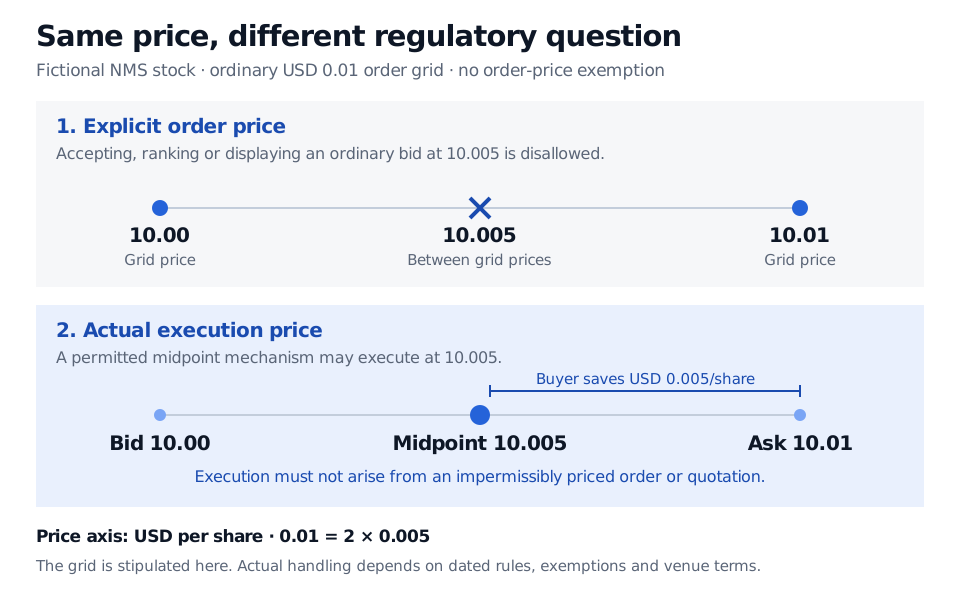
Original fictional NMS-stock example in USD per share. The upper panel tests an explicit order price; the lower panel illustrates a possible execution, not a guaranteed fill or permission for every midpoint-labelled instruction.
Why the date changes the answer
Status checked 31 October 2026. The 2024 amendment introduced a half-cent increment for certain NMS stocks, rather than for every stock. Under the codified amended Rule 612, prices at or above USD 1.00 use:
| Stock's time-weighted average quoted spread during the evaluation period | Assigned increment |
|---|---|
| USD 0.015 or less | USD 0.005 |
| Greater than USD 0.015 | USD 0.01 |
The primary listing exchange measures that spread; it is not a trader's instantaneous spread observation. The amended rule also specifies evaluation and operative periods, and assigns stocks that become NMS stocks during an operative period a one-cent increment.
Adopted does not mean already required. The SEC's 11 June 2026 order, Release 34-105656, sections II–III extends temporary relief from compliance with amended Rule 612 and the associated minimum-increment indicator provision until the first business day of November 2027. Therefore the amended table is not evidence that all eligible stocks already quote in half cents as of this article's check date. The November 2025 date printed in the 2024 small-entity guide is superseded for compliance timing.
Three checks before rejecting a price
First identify the field: an explicit limit order price, a quote, a benchmark and an actual execution are different objects. Hiding an impermissibly priced order does not resolve the rule's acceptance or ranking restrictions.
Next identify the price band. It is the order or quotation price that matters, not the last trade. On the ordinary grid, an order at 0.9999 satisfies the federal increment test; one at 1.001 does not. A venue need not accept every increment the federal rule permits. These distinctions appear in the SEC's historical FAQ questions 5–6; its old venue descriptions should not be treated as a current venue inventory.
Finally identify the dated rule and any exemption. Rule 612(d) permits the SEC to grant exemptions by order, whose scope and conditions must actually cover the instruction. Decimal precision alone establishes neither a violation nor an exemption. In particular, the historical FAQ question 1 rejects accepting an impermissibly priced explicit order and then rounding it as a cure.
For the broader mechanics, Market, Limit and Conditional Orders explains price constraints and order handling; the full lesson requires membership, with a public preview available.
Sources
- SEC — Regulation NMS adopting release, 34-51808, section IV.C.4–5: execution-price distinction and acceptance of impermissible orders. Historical 2005 rulemaking.
- SEC staff — Rule 612 FAQ, introduction and questions 1–2, 4–6 and 13. Historical staff interpretation, last modified 21 October 2005; not a Commission rule.
- eCFR — 17 CFR 242.612, paragraphs (a)–(d), codified amended text; read alongside the compliance-relief order.
- SEC — Release 34-105656, 11 June 2026, sections II–III: relief until the first business day of November 2027.
- SEC — Tick Sizes: A Small Entity Compliance Guide, 21 November 2024: amendment summary; its original compliance date is superseded by later relief.