Distinguish US execution-quality and routing disclosures, calculate a single fill’s spread and price improvement, and read the 2026 reporting changes carefully.
SEC Rules 605 and 606
SEC Rules 605 and 606 are US disclosure rules for execution quality and order routing, respectively. They sit within Regulation NMS. For a quant comparing brokers or venues, they supply different evidence: the prices and timing achieved on covered orders, and the destinations and relationships behind covered routing decisions. Combining them requires matching their populations.
Two report families, different questions
Disclosure
What the reader learns
Rule 605: monthly execution-quality reports
Standardized statistics for covered NMS-stock orders, including spread and execution-speed measures, with detailed and summary reports. Reporting entities include market centers and qualifying larger brokers and dealers.
Rule 606(a): public quarterly routing reports, broken down by month
Where non-directed held NMS-stock orders and covered non-directed customer options orders were routed, together with specified payments, fees, rebates and material venue relationships.
Rule 606(b): customer-requested information
Customer-specific routing information; a distinct, more detailed report covers qualifying not-held NMS-stock order handling, subject to exceptions. This is not simply the public report filtered by customer.
Non-directed means the customer has not specified the routing venue. A not-held order gives the broker discretion over time and price. These distinctions affect which disclosure applies. See the current rule text and the SEC's explanation of the 2018 routing amendments. Rule 606 does not make every customer's detailed trading history public.
One buy, three benchmarks
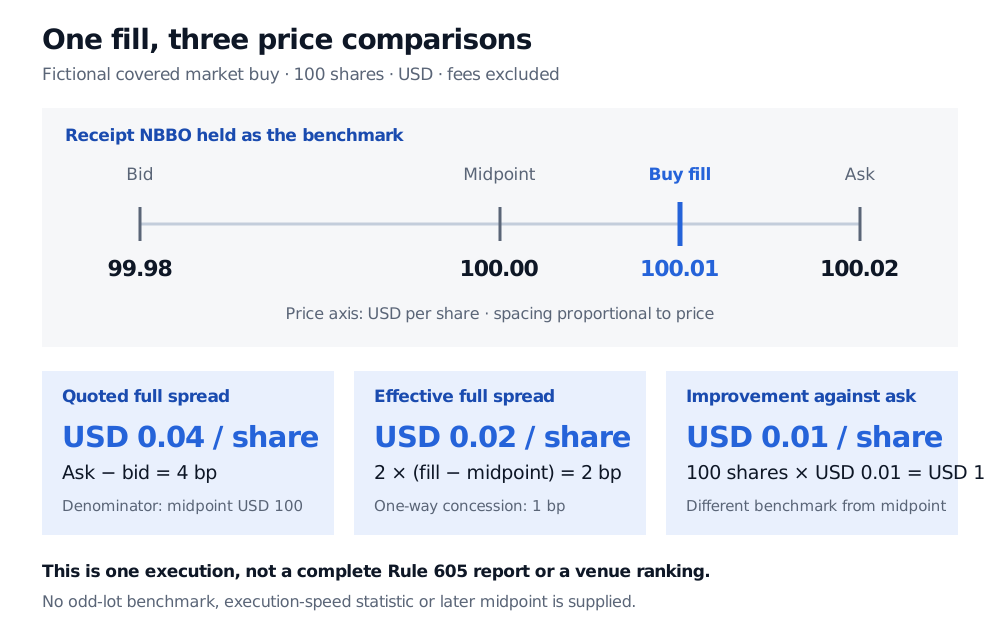
Consider a fictional covered market order to buy 100 shares, received during normal continuous trading. Stipulate a valid receipt NBBO of USD 99.98 / 100.02 and one complete execution at USD 100.01. Exclude fees. The receipt midpoint is USD 100.00.
For this buy, the effective full spread is twice the difference between execution price and receipt midpoint:
2(100.01−100.00)=0.02USD per share.
Using the same USD 100 midpoint denominator, multiply each proportional spread by 104 to express it in basis points: 4 bp quoted and 2 bp effective. The buyer's one-way midpoint concession is only USD 0.01 per share, or 1 bp. Multiplying the full effective spread by the shares would double that one-way concession.
Price improvement uses another reference: the buy executes USD 0.01 below the receipt ask, giving 100×0.01=1 USD of gross improvement. Paying above the midpoint and receiving improvement against the ask can happen simultaneously.
Fictional buy of 100 shares at USD 100.01 against a receipt NBBO of 99.98 and 100.02, midpoint 100.00. Quoted full spread is USD 0.04 per share or 4 basis points; effective full spread is USD 0.02 or 2 basis points; improvement against the ask is USD 0.01 per share or USD 1 total.
Original fictional single-fill arithmetic, excluding fees. Receipt quotes are the stipulated benchmark; these calculations do not constitute a complete Rule 605 report.
The sign and clock matter. For a sell, reverse the subtraction: twice the difference between midpoint and execution price. Rule 600 defines share-weighted averages; midpoint-or-better limit orders use first executability rather than receipt for the effective-spread benchmark. A generic trade-time midpoint calculation is therefore not automatically a Rule 605 statistic. Rule 600 definitions and the current staff FAQs, especially Q27 and Q37 explain these conventions.
This one fill does not reproduce the complete reporting fields or aggregation. No execution duration, later midpoint or odd-lot benchmark has been supplied. In a multi-fill report, preserve the required share weights and denominators: averaging per-fill percentages need not equal dividing the reported average spread by the reported average midpoint.
Read the reporting date as carefully as the number
Status checked 31 October 2026. The 2024 Rule 605 amendments expanded reporting entities and covered-order categories, added a summary report, and captured fractional-share, odd-lot and larger orders. They also revised execution-time and other quality measures. A broker or dealer outside the market-center definition generally enters the regime at 100,000 customer accounts through which NMS-stock transactions are effected, under Rule 605(a)(7)'s conditions.
The SEC extended the general compliance date to 1 August 2026: collection begins then, with August reports due by the end of September. Best-available-displayed-price improvement statistics have separate timing. The SEC's April 2026 staff FAQ Q39 specifies collection beginning 1 November 2026, with November reports due by the end of December. That benchmark incorporates relevant best odd-lot information; the toy ask comparison above does not calculate it. The FAQ states staff views, rather than creating law.
Scope also changed through the 1 April 2026 exemptive order, Release 34-105136. It provides narrowly conditioned relief for certain fractional-position exits, replaces halt and crossed-market exemptions, extends the inactive-security exemption to brokers and dealers, and rescinds the temporary exemption for manually received orders. For example, the fractional-position relief concerns a separate market-center report for specified dividend-related fractional holdings; it is not a blanket exemption for fractional-share trading or for a qualifying broker's broker-dealer report. Read the order's conditions, rather than carrying an old FAQ exclusion into a new dataset.
Routing share is not a quality score
Suppose a fictional broker routes 50%, 30% and 20% of one defined group of non-directed orders to venues A, B and C. Those percentages describe destinations. They do not say A fills 50% of shares, earns a 50% quality score, or would beat B for the same incoming order.
Read the associated payment for order flow, fees, rebates and relationship disclosures alongside execution outcomes. The SEC's routing-disclosure framework makes such incentives more visible. A disclosed payment identifies a potential conflict to examine; its presence alone does not measure the customer's execution loss.
For a defensible comparison, align security, month, order size, order type, instructions, market conditions and reporting version. Check cancellations, partial fills and the denominator behind each percentage. A venue receiving easier, smaller orders can look better in aggregate without offering better outcomes for the orders another venue receives. Combining a broker's routing shares with unmatched venue averages cannot resolve that selection problem.
Nor are these disclosures the best-execution duty itself. Rule 605's introductory text expressly warns that its statistics alone do not reliably determine whether a broker obtained the most favorable terms reasonably available for a particular order. Reports help frame an investigation; the order record supplies the circumstances.
For the mechanics behind the spread comparisons, Spread Measurement develops full versus one-way costs, later-midpoint measures and aggregation. The public page is a preview; the full lesson requires membership.
Sources
eCFR — 17 CFR Part 242, Rule 600(b)(8)–(13), Rule 605 and Rule 606: current definitions, scope and disclosure requirements.