EU equity transparency waivers, reference-price arithmetic and the current 7% volume cap, with clear boundaries around large-in-scale eligibility and post-trade reporting.
MiFID pre-trade transparency waivers
MiFID pre-trade transparency waivers are regulatory permissions for specified trading arrangements or orders to operate without the public pre-execution disclosure otherwise required. For a quant studying European equity execution, they explain why some executable interest is absent from the displayed order book—and why a hidden trade needs a more specific classification than “dark pool.”
The familiar MiFID label covers a framework whose EU equity waiver provisions sit in MiFIR Article 4. This article describes that EU regime as checked on 31 October 2026. It does not apply the same rules to bonds, derivatives or UK trading.
Four routes to non-display
Article 4 permits competent authorities to waive the Article 3 disclosure obligation for four categories:
Waiver
What makes the category distinctive
Reference price
A matching system derives its price from the first-admission venue or the most relevant market in terms of liquidity, using a widely published, reliable reference.
Negotiated transaction
A venue formalises a negotiated trade satisfying the relevant conditions: within the current volume-weighted spread, an eligible illiquid-instrument reference-price arrangement, or conditions other than the current market price.
Large in scale (LIS)
An order is large relative to normal market size under the applicable regulatory calibration.
Order management facility (OMF)
An order is held pending disclosure under the prescribed conditions.
These are conditional categories. Privately agreeing a price does not by itself establish a negotiated-transaction waiver; calling an order a “block” does not establish LIS status. The authority grants the waiver for an arrangement, rather than a trader declaring an exemption whenever discretion is convenient.
RTS 1 supplies the technical detail. Its Article 7 uses instrument-specific rules and, for relevant shares, average-daily-turnover bands and Annex II thresholds. There is no single monetary LIS cutoff valid for every equity instrument. Article 8 separately specifies OMF conditions, including the treatment of the hidden portion of a reserve order. An iceberg order therefore needs more analysis than “some size is hidden.”
A midpoint calculation answers only the pricing question
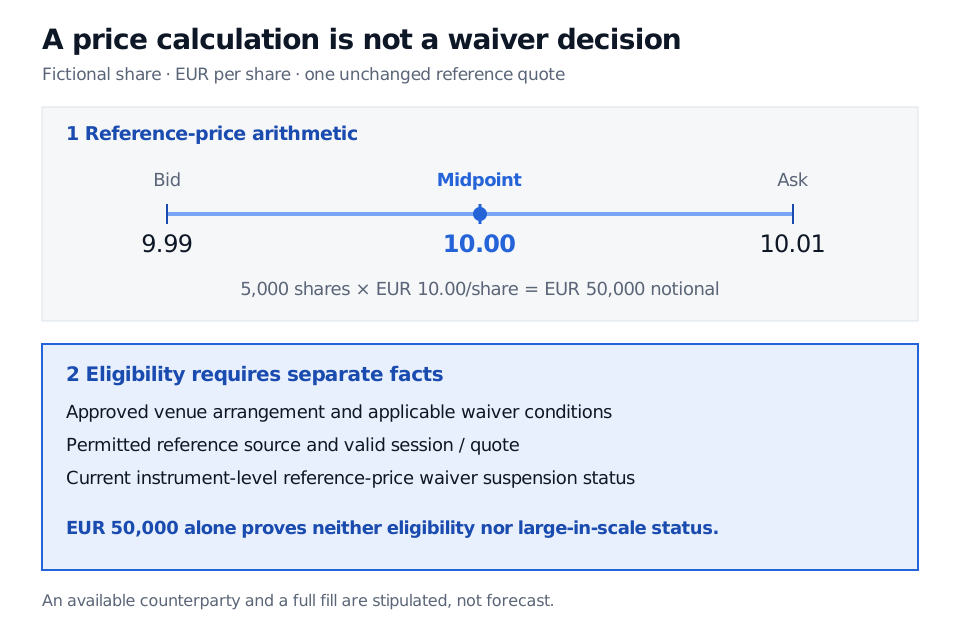
Suppose a fictional share has an eligible reference-market bid and ask of EUR 9.99 / EUR 10.01. Article 4(2) specifies the midpoint as the reference during the relevant continuous-trading setting:
m=29.99+10.01=10.00 EUR per share.
Stipulate an available seller and a complete 5,000-share match at that unchanged reference. Its notional is
5,000×10.00=50,000 EUR.
Fictional EUR share quote: bid 9.99, midpoint 10.00 and ask 10.01. A stipulated 5,000-share midpoint fill has EUR 50,000 notional. Eligibility requires separate waiver, reference-source and suspension checks; this amount establishes no large-in-scale status.
Original fictional reference-price illustration. A full match and unchanged permitted reference quote are stipulated; the arithmetic supplies no waiver or large-in-scale eligibility decision.
EUR 50,000 establishes neither LIS status nor permission to use any waiver. The example calculates a price and an amount. It leaves the venue's approved arrangement, eligible reference source, instrument status and applicable conditions to be established separately. A matching price also does not create an opposing order or guarantee a fill. Article 4's opening/closing-price fallback is restricted to outside the continuous trading phase; a missing continuous-session midpoint is not a general invitation to use yesterday's close.
For the data problem behind that distinction, Trades, Quotes and Market State develops quote timing, stale prices and the difference between a reference mark and a fill. Its preview is public; the full lesson requires membership.
The volume cap is now a single 7% cap
Older accounts describe a 4% venue-level / 8% Union-level double volume cap. Those are historical parameters, described in the 2024 reform's recital 6, rather than the operative EU framework today.
Under current MiFIR Article 5, the cap concerns reference-price-waiver trading in each instrument across the Union. If its share exceeds 7% of total Union trading volume in that instrument, venues suspend that waiver for three months. Decisions rely on ESMA's published data and must be taken within two working days of publication. ESMA calculates using the previous 12 months and publishes quarterly results.
This is a market-wide restriction on a specified waiver, not a limit saying that an individual order may hide 7% of its quantity. Nor is it a blanket 7% ceiling on all LIS, negotiated or otherwise non-displayed trading.
ESMA's 10 October 2025 statement confirms that the single mechanism became operational with results published on 9 October 2025. Its current reporting page also records the subsequent 2026 publication system. A historical double-cap dataset and a current single-cap dataset therefore encode different regimes.
Use adopted rules, and keep the boundaries visible
The transparency revision is no longer merely a consultation. Delegated Regulation (EU) 2025/1246 was published on 3 November 2025 and entered into force on 23 November 2025; its Article 3 deferred specified provisions to 2 March 2026. The current RTS 1 consolidation incorporates those changes. In particular, the adopted amendment changed OMF reserve-order provisions; an old technical-rule extract can misstate current treatment.
Three neighbouring questions still need separate answers:
After-trade publication: a pre-trade waiver concerns information before execution. A post-trade deferral changes when transaction information is published. RTS 1 Articles 12–15 govern that separate analysis; one permission does not automatically supply the other.
Dealer internalisation: a systematic internaliser has a separate off-venue framework, including quoting requirements. Its status is not one of the four venue waivers.
UK execution: the FCA's MAR 11A.2, with provisions dated 30 March 2026, is a UK rulebook. Its reference-source wording must not be imported into an EU Article 4 eligibility test.
For an execution study, retain the instrument, venue, trade/waiver classification, reference quote and timestamp, applicable rule version and suspension period. Otherwise a change in the permitted venue set can masquerade as a change in a strategy's trading skill.