Sponsored repo is a way for an eligible client to clear a repurchase agreement through an approved sponsor. In the U.S. Treasury market, the Fixed Income Clearing Corporation (FICC) admits eligible clients as Sponsored Members through its Government Securities Division (GSD). For the obligations FICC accepts and novates, it becomes the central counterparty, replacing the original payment and delivery obligations with obligations to and from FICC. Eligible obligations can then be netted even if the original trades were with different dealers. For a funding desk, the practical question is how much cash and which securities must be available at each deadline. FICC GSD Rulebook, Rules 3A and 5
What the sponsor takes on
In FICC’s Sponsored Delivery-versus-Payment (DVP) service, settlement exchanges a specified security against payment. The client can execute with its sponsor (done-with) or, where supported, with another eligible counterparty (done-away). The sponsor submits trades, handles clearing and settlement processing, and guarantees the client’s covered payment and delivery obligations to FICC. The client remains responsible for its allocated settlement obligations. FICC GSD Rulebook, Rule 3A §§2 and 6–9, DTCC’s Sponsored Service overview
The repo’s opening exchange and closing exchange can follow different rules. For a Sponsored DVP repo executed with the sponsor and due to start on the trade date, the opening leg settles bilaterally. In FICC’s separate Sponsored General Collateral (GC) service, the opening leg settles at the tri-party clearing agent bank, and only the closing leg can be novated once the rulebook conditions are met. DTCC’s Treasury clearing FAQ on start-leg novation, FICC GSD Rulebook, Rule 3A §7(b)
When a 100 million payment becomes 30 million
Suppose a sponsored client has two fictional U.S. dollar repo closing legs. The first requires it to pay USD 100 million, and the second entitles it to receive USD 70 million. Assume both legs have been novated and are eligible to offset in the same settlement netting set for the same client account, Treasury issue and Monday settlement date. Start with zero cash and ignore all other flows. Looking only at the cash side, the net payment in millions of U.S. dollars is
Now move the receipt to Tuesday. The client needs USD 100 million on Monday. Tuesday’s receipt brings the cumulative outflow back to USD 30 million. The two-day totals match, while the funding required on Monday differs by USD 70 million.
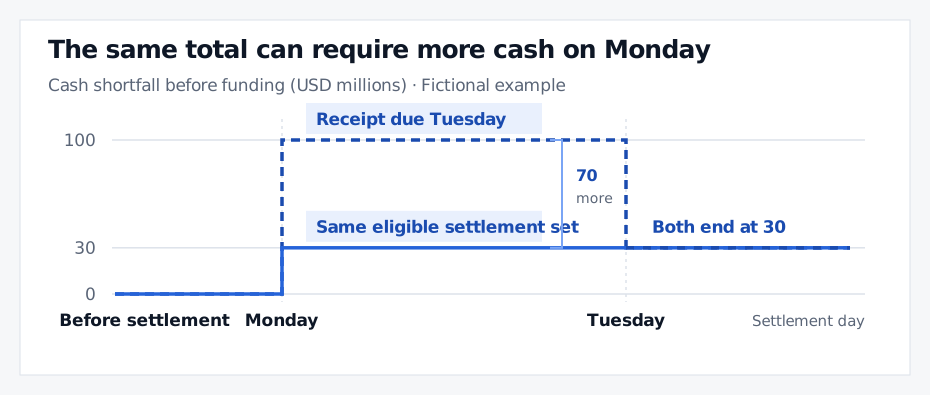
Fictional cash shortfall before external funding. The Tuesday receipt brings both paths to the same total, but one requires USD 70 million more on Monday.
FICC’s Sponsored DVP process nets eligible securities settlement positions by security identifier (CUSIP), then determines the associated payment and delivery obligations. The example isolates the cash timing. A live settlement forecast also needs the securities quantities and values, any funds-only adjustments, and the applicable account and cutoff. FICC treats the sponsor’s own dealer account separately from its sponsored-client omnibus account in ordinary-course settlement. FICC GSD Rulebook, Rule 3A §§7–11 and Rule 11 §§2, 4 and 6
Settlement cash pays for deliveries. Clearing margin protects against losses if a participant defaults and positions have to be closed out. The sponsor posts the applicable Clearing Fund deposit or segregated customer margin to FICC. It may also have to make a settlement payment before collecting from the client. Those are separate demands on the sponsor’s liquidity. FICC GSD Rulebook, Rule 3A §§8–10
The Margin and Collateral lesson compares a repo haircut with collateral for a CCP and works through the timing of a margin call. The full lesson requires membership and has a public preview.
Where the U.S. clearing requirement applies
As of 8 November 2026, the SEC lists 30 June 2027 as the trade-submission compliance date for eligible U.S. Treasury repo. The rule requires covered clearing agencies to have policies and procedures designed to require each direct participant to submit eligible secondary-market transactions to which it is a counterparty. Eligibility is subject to exclusions and exemptive relief, including specified inter-affiliate and non-U.S. transactions. Sponsorship is one way a client can access clearing. SEC Treasury Clearing Implementation, SEC order on inter-affiliate and non-U.S. repo
Sources
- FICC Government Securities Division Rulebook, Rules 3A, 5, 11–13 and the Margin Component Schedule.
- DTCC Sponsored Service and DTCC Treasury clearing FAQ, access, settlement and start-leg novation.
- SEC Treasury Clearing Implementation, SEC Release No. 34-102487, and SEC Release No. 34-106789, trade-submission dates and selected exemptions.