A side letter is a separate agreement that gives a private-fund investor terms that supplement, modify or clarify the main fund documents for that investor. It might reduce a management fee or grant additional reporting rights. A most-favoured-nation (MFN) clause gives a covered investor a contractual way to obtain more favourable terms granted to another investor, subject to the scope and conditions of the clause. Two limited partners (LPs) can therefore invest in the same fund and face different fees. ILPA model limited partnership agreement, § 20.6.2 · Third Point Enhanced LP agreement, § 8.6
Which deal can the investor elect?
Start with the investor’s terms under the limited partnership agreement (LPA) and any existing side letter. Then identify which investors and provisions the MFN clause covers. The ILPA whole-of-fund model calls for notice of side-letter terms reasonably promptly after the final close. Its matching provision excludes several categories, including rights tied solely to another investor’s particular legal or tax circumstances and rights to nominate an advisory committee representative. ILPA model limited partnership agreement, § 20.6.2
An executed agreement shows how different the conditions can be. In Third Point Enhanced LP’s 2019 agreement, TP Re’s fee-matching provision covers specified affiliated funds, excludes certain investors and compares against investors whose aggregate investment in the relevant fund is no larger than TP Re’s defined aggregate investment and whose initial lock-up or term is five years or less. For a later agreement that triggers the provision, the general partner gives prompt written disclosure and TP Re has 30 days from receipt to elect. An election also carries the applicable restrictions and less favourable terms in the triggering agreement. The 30-day window and comparator tests come from this contract. Third Point Enhanced LP agreement, §§ 8.6.1 and 8.6.4
Put the effective rate into the cash-flow forecast
Suppose a fictional LP pays 100 basis points per year and another LP gets 80 basis points. Assume both rates apply to the same constant fee base of USD 10 million, with no offsets. If the other LP and the lower rate qualify, and a valid election makes that rate effective for the whole year, the annual management fee drops from USD 100,000 to USD 80,000.
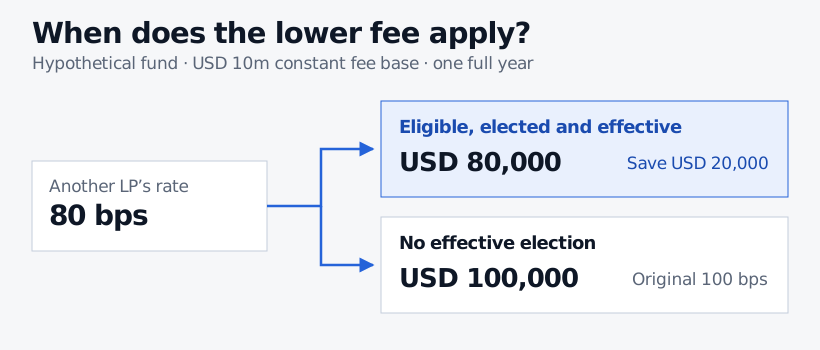
In the hypothetical fund, the same 80 bps disclosure can lead to two different annual fee forecasts.
Check the base as well as the rate. The ILPA model starts with committed capital and later switches to a defined measure of invested cost, with deductions for assets that have been realised or written down. If the fee base or election changes during the year, calculate each fee period under its applicable terms. A lower fee paired with a longer lock-up can also affect when the LP can get cash back. Record the notice date, election deadline and effective date separately so a disclosed rate enters the forecast for the right period. ILPA model limited partnership agreement, §§ 8.3–8.4 · Third Point Enhanced LP agreement, § 8.6.4
U.S. regulatory context
The Fifth Circuit vacated the SEC’s 2023 private-fund adviser rules, including the preferential-treatment rule, effective 5 June 2024. Under the Advisers Act, advisers owe their clients duties of care and loyalty, as described in the SEC’s 2019 fiduciary interpretation. For advisers to covered pooled vehicles, Rule 206(4)-8 separately prohibits fraud and materially misleading statements or omissions involving investors or prospective investors. An MFN election right comes from the applicable fund documents. SEC announcement on the vacatur · SEC fiduciary interpretation · Rule 206(4)-8
Sources
- ILPA Model Limited Partnership Agreement (Whole-of-Fund Waterfall), July 2020
- Third Point Enhanced LP, Second Amended and Restated Exempted Limited Partnership Agreement, February 2019
- SEC, Announcement Regarding the Private Fund Advisers Rules, October 2024
- SEC, Commission Interpretation Regarding Standard of Conduct for Investment Advisers, June 2019
- 17 CFR § 275.206(4)-8, Pooled Investment Vehicles