Securitisation risk retention requires a sponsor to keep an economic exposure to the credit risk of assets it securitises. The policy aims to give the sponsor a financial incentive to screen assets before they back an issue of asset-backed securities (ABS) and monitor them after closing. For a credit analyst, the retained position's place in the cash flow waterfall determines which shortfalls the sponsor shares. U.S. final rule preamble, 2014
What the 5% measures
Under U.S. Regulation RR, the sponsor is the party that organises the deal and transfers assets to the issuer, directly or through an intermediary. The base requirement generally applies to the sponsor, and a majority-owned affiliate can generally hold the interest. The standard route measures retention at closing. Other routes and exemptions apply to qualifying transactions, including the exemption for certain qualified residential mortgage securitisations. 17 CFR § 246.2 · § 246.3 · 17 CFR Part 246, including § 246.13
- Vertical. Take at least 5% of each class of ABS interests if using vertical retention alone. A single vertical security that entitles its holder to the specified share of payments from each other class can also deliver that exposure.
- Horizontal. Hold an eligible residual interest that takes payment shortfalls first and sits last for principal and interest. If using it alone, its fair value must reach at least 5% of the fair value of all ABS interests issued in the transaction, measured under U.S. GAAP. A qualifying cash reserve can substitute for some or all of the horizontal amount.
- Combined (L-shaped). Add the vertical percentage to the eligible horizontal fair value as a percentage of the total ABS fair value. The sum must be at least five percentage points. 17 CFR § 246.4, standard risk retention
Same par, different losses
Suppose a fictional deal has three tranches, all with principal amounts stated at par in USD millions. A 5% vertical slice takes one twentieth of each class.
| Class | Par | Par retained vertically |
|---|---|---|
| Senior | 80 | 4.00 |
| Mezzanine | 15 | 0.75 |
| Junior | 5 | 0.25 |
| Total | 100 | 5.00 |
Assume principal losses go to the junior class first, then to mezzanine, then to senior. Ignore amortisation and other credit support. A USD 4 million pool principal loss falls entirely on the junior class. The vertical holder loses USD 0.20 million, its 5% share of that write-down. A holder of the whole junior class, also with USD 5 million of par at closing, loses the full USD 4 million.
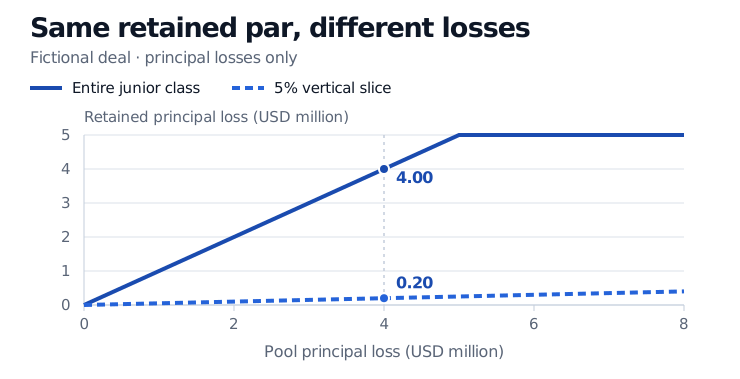
The two positions have the same par at closing. The vertical slice takes 5% of the principal loss, while the full junior holding absorbs losses until its principal is exhausted.
Now assume the full junior class has a closing fair value of USD 2.4 million and all ABS interests together have a fair value of USD 96 million. The junior holding contributes to the horizontal test, even if the interest meets the first-loss eligibility conditions. Horizontal retention alone would require USD 4.8 million of fair value. The USD 5 million of junior par gives no answer to that test. 17 CFR § 246.4(a)–(b)
The SelfMadeQuant lesson works through the order in which tranches take losses and how reserves and excess spread can absorb losses first. The preview is public and the full lesson requires membership. Non-Agency MBS, ABS, and the Securitization Waterfall
Reading an actual deal
In its November 2021 prospectus, Honda Auto Receivables 2021-4 Owner Trust disclosed a vertical interest. American Honda Finance Corporation planned to retain at least 5% of every note class, and its wholly owned depositor planned to retain all the certificates initially. For class A-1, the cover shows USD 315 million issued and USD 299.25 million offered. The USD 15.75 million difference is exactly 5% of that class. The “Credit Risk Retention” section identifies the retained certificates as well as the notes. Honda Auto Receivables 2021-4 Owner Trust, Form 424B5
A seller's interest in a credit-card ABS master trust is a retained interest in the revolving pool. Section 246.5 provides a separate retention route for qualifying revolving deals. Its base test compares the seller's interest with 5% of the unpaid principal of outstanding investor ABS interests, subject to the section's measurement rules. 17 CFR § 246.5(a)–(c)
Legal true sale concerns whether the transfer of the receivables is legally a sale. Honda discusses that issue separately in its bankruptcy risk factors. Accounting consolidation asks whether the issuer belongs in the reporting entity's financial statements. Upstart, for example, reported retaining a vertical slice plus the remaining residual certificates in one deal and consolidating the entities after determining it was their primary beneficiary. Honda prospectus, “Risk Factors” · Upstart Form 10-Q, June 2026, Note 3
Sources
- Federal Register, Credit Risk Retention final rule, 24 December 2014. The preamble explains the incentive behind the rule.
- U.S. Regulation RR, 17 CFR Part 246, current text checked 8 November 2026. §§ 246.2–246.5 cover definitions, the base requirement, standard retention and revolving pools. § 246.13 sets out the qualified residential mortgage exemption.
- Honda Auto Receivables 2021-4 Owner Trust, Form 424B5, 16 November 2021. See the cover table, “Credit Risk Retention” and the bankruptcy risk factors.
- Upstart Holdings, Form 10-Q for the quarter ended 30 June 2026, Note 3. See the discussion of consolidated and unconsolidated variable interest entities.