A special purpose vehicle (SPV) is a separate legal entity set up for a limited job. In a cash securitisation, an issuing SPV holds receivables and issues asset-backed securities to fund their purchase. A true sale transfers ownership of the receivables under applicable law. Bankruptcy remoteness is the deal’s design to isolate those assets from an affiliate’s insolvency and reduce the likelihood that the SPV itself enters insolvency. For a noteholder, the distinction matters when the originator fails while the underlying borrowers are still paying. Hyundai Auto Receivables Trust 2026-C prospectus, pp. 127–128
Same borrowers, different claims
A fictional auto lender wants funding against the receivables from contracts A and B. In both arrangements below, borrowers continue to pay the originator in the ordinary course. Assume the sale or pledge is effective as specified against competing creditors, with no prior liens, avoidance or pooling of estates. The sale has no originator guarantee of borrower payments.
| Sale and assignment to an issuer SPV | Originator borrowing with a pledge | |
|---|---|---|
| Who owns A and B? | The SPV issues notes to finance the purchase and owns the receivables. | The originator keeps the receivables and gives its lender a lien on them. |
| Where does the payment go? | The originator collects as servicer and remits to the SPV’s collection account. The trustee distributes cash under the deal’s payment rules. | The originator collects for its own account and owes debt service under its loan agreement, even if borrowers pay late. |
| What does the funder hold? | Noteholders hold debt issued by the SPV. The trustee holds a lien for them on the SPV’s collateral. | The lender holds a claim against the originator, secured by the pledged receivables. |
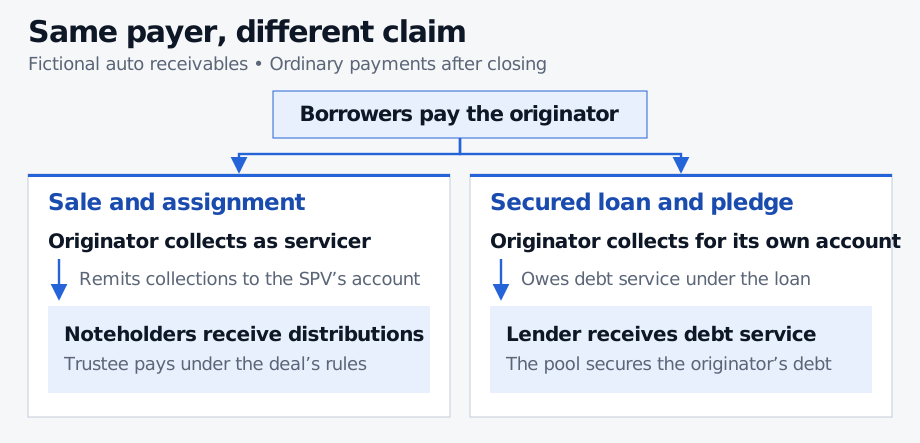
The arrows trace ordinary payments after closing. Each funding contract defines the final payment obligation.
If the originator files for U.S. bankruptcy, the estate generally includes its legal and equitable property interests at filing. Under the stated sale assumptions, the sold interest belongs to the SPV and sits outside that estate. Noteholders still depend on the pool’s performance and on servicing and remittance. Under the pledge assumptions, the receivables enter the originator’s estate subject to the lender’s lien. The automatic stay generally restricts enforcement against estate property, so even a secured lender can face delays. In a real deal, an otherwise valid sale can also be challenged under statutory avoidance powers. 11 U.S.C. §§ 541(a)(1) and (d), § 362(a) and (d), § 548(a), Hyundai 2026-C prospectus, pp. 127–128
Two transfers in a filed deal
Hyundai Auto Receivables Trust 2026-C uses two sale steps. Hyundai Capital America transfers the receivables to a depositor under the purchase agreement. The depositor transfers them to the issuing trust under the sale and servicing agreement. Both agreements state the intended sale and provide a fallback security interest if the relevant transfer fails as a sale. The indenture separately grants the trustee a lien on the trust’s collateral for the noteholders. The fallback grant addresses possible recharacterisation of a transfer. The indenture grant secures the trust’s own notes. Receivables Purchase Agreement, § 2.01, Sale and Servicing Agreement, § 2.01, Indenture, Granting Clause
Legal characterisation depends on the applicable law and the rights and obligations the documents actually create. The 2026-C prospectus identifies the possibility that a court could treat the first transfer as a pledge despite the sale warranty. In the sale and servicing agreement, an uncured breach of certain seller warranties can require the seller to repurchase the affected receivable. Separately, the agreement permits the servicer to hold and mix some collections with its own funds before remittance. The prospectus flags that if the servicer goes bankrupt, this could leave the issuer without a perfected interest in those collections. That makes the remittance schedule and account terms material even if the sale of the receivables stands. Butner v. United States, 440 U.S. 48, 54–55, Sale and Servicing Agreement, §§ 3.03 and 5.02–5.05, Hyundai 2026-C prospectus, pp. 127–128
How the structure limits insolvency exposure
The 2026-C trust agreement limits what the trust can do, requires separate assets and records, and restricts who can initiate bankruptcy proceedings under the agreement, subject to applicable law. These provisions are meant to preserve the entity’s separate operation and limit pathways into bankruptcy. Substantive consolidation is a separate legal risk in which a court pools entities’ assets and liabilities for bankruptcy purposes. A true-sale opinion addresses how a court should characterise the transfer on the assumed facts. A nonconsolidation opinion addresses whether separate estates should be pooled. The prospectus describes counsel’s expected opinion that the depositor’s assets would stay separate in a Hyundai Capital America bankruptcy, assuming, among other things, that the parties actually observe specified separateness practices. Counsel’s opinion is a qualified legal assessment. A court resolves a disputed characterisation or consolidation question. Sears Credit Account Master Trust II, filed form of counsel’s opinion, §§ II–III, Trust Agreement, §§ 2.03, 4.01–4.03 and 11.08–11.09, Hyundai 2026-C prospectus, pp. 127–128
The balance sheet asks a different question
Accounting consolidation and derecognition determine which entity or group reports the receivables. Under IFRS, a reporting entity first determines whether it controls and must consolidate the SPV under IFRS 10. If the SPV is consolidated, the sale within the group is eliminated and the receivables remain in the group’s accounts. A transfer outside that group is assessed under IFRS 9, including how much risk and reward the transferor keeps and, in some cases, whether it retains control of the assets. A legally separate, bankruptcy-remote SPV can therefore still be part of the originator’s accounting group. IFRS 10, ¶¶ 7 and B86(c), IFRS 9, ¶¶ 3.2.1 and 3.2.3–3.2.9
Sources
- Hyundai Auto Receivables Trust 2026-C, final prospectus, 15 September 2026, especially pp. 127–128 on insolvency.
- 2026-C Receivables Purchase Agreement, § 2.01 on the first sale and fallback grant.
- 2026-C Sale and Servicing Agreement, §§ 2.01, 3.03 and 5.02–5.05 on the second sale, repurchase, remittance and distributions.
- 2026-C Indenture, Granting Clause on collateral for the notes.
- 2026-C Amended and Restated Trust Agreement, §§ 2.03, 4.01–4.03 and 11.08–11.09 on purpose, separateness and limits on petitions.
- Sears Credit Account Master Trust II, filed form of counsel’s opinion, §§ II–III on transaction-specific legal analysis and qualifications.
- U.S. Bankruptcy Code § 541, § 362, Automatic stay, and § 548, Fraudulent transfers and obligations on estate property, the automatic stay and avoidance.
- Butner v. United States, 440 U.S. 48, 54–55 (1979), on how property interests are determined in bankruptcy.
- IFRS 10 Consolidated Financial Statements, ¶¶ 7 and B86(c), and IFRS 9 Financial Instruments, ¶¶ 3.2.1 and 3.2.3–3.2.9.