A credit-card ABS master trust holds a revolving pool of credit-card receivables that can support multiple issues of asset-backed securities over time. As cardholders pay down balances, new eligible receivables can replenish the pool. For an investor modelling repayment, the amount cardholders pay is only the starting point. The deal's allocation rules and the security's repayment phase determine when cash reaches investors.
One pool can fund several issues
In Citi's deal, the card issuer keeps the accounts and transfers the right to collect the designated receivables. New spending on those accounts can create new receivables for the trust. The deal may also permit or require the seller to designate additional eligible accounts. The pool's balance and composition can change as spending, repayments and losses vary. Citibank Master Trust I pooling and servicing agreement, §§2.01 and 2.09
The same pool can back several series of investor certificates with their own terms. The seller's interest is the retained share of the pool alongside the certificate interests. In Citi's structure, one of those certificates sits between the two trusts. The master trust issues a collateral certificate representing a share of its assets to a separate issuance trust, which issues notes backed by that certificate. Citi Class 2025-A1 prospectus, “The Master Trust”
Where 100 million of principal goes
A servicer separates principal collections, which repay the amounts borrowed, from finance charge collections, which can include card interest and specified fees. The latter can fund servicing fees, investor interest and coverage of charge-offs under the deal's cash flow waterfall. The figures below track principal only. Citi Class 2025-A1 prospectus, “Allocation of Collections, Losses and Fees” and “Deposit and Application of Funds”
Take a fictional trust with USD 1,000 million of principal receivables at the start of a revolving month. The single investor series accounts for 800 million and the seller's interest for 200 million. Stipulate that the trust allocates 100 million of principal collections pro rata using these opening shares.
- Investor allocation: million.
- Seller allocation: million.
Assume the trust uses the entire 80 million investor allocation to buy newly generated eligible receivables. Investors then receive zero principal that month. The 20 million identifies the share allocated to the seller. Its cash treatment depends on the agreement and is outside this example.
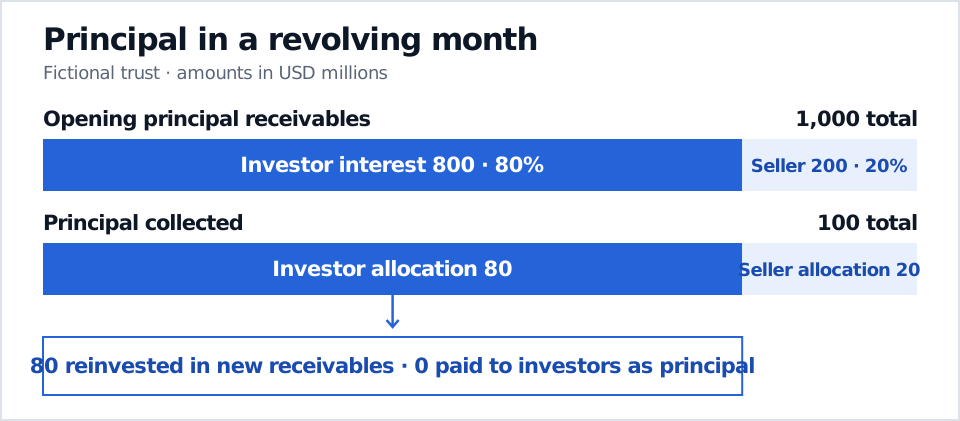
The bars compare shares of two different totals. The arrow shows how the investor allocation is used in this revolving month.
When the same kind of collection funds repayment
In scheduled accumulation, a deal can set principal collections aside in a funding account ahead of an expected payment date. Under early amortisation, a contractual trigger redirects available principal towards paying down the affected series ahead of schedule. In Citi's filed example, missing a required addition of receivables by the contractual deadline can trigger early amortisation. Timing still depends on available cash, so an early trigger can start monthly paydowns without an immediate payoff. Citi Class 2025-A1 prospectus, “Targeted Deposits of Principal Collections to the Principal Funding Account” and “Early Amortization Events”
A model also needs the allocation base for each phase. Citi describes fixing the invested amount used for certain principal allocations when funding or repayment begins. The invested amount used for finance charge allocations does not freeze on that basis. Slower principal collections can then leave a note short of cash on its expected payment date even though the legal maturity date is later. Citi Class 2025-A1 prospectus, “Allocation of Collections, Losses and Fees” and “Principal Payments”
The SelfMadeQuant lesson on non-agency MBS and the ABS waterfall compares collateral types and explains how different claims share a pool's cash and losses. The preview is public and the full lesson requires membership.
Sources
- Citibank Credit Card Master Trust I, Third Amended and Restated Pooling and Servicing Agreement, 10 November 2016. §§2.01 and 2.09 cover receivable transfers and account additions. §§4.03, 6.03 and 9.01 cover collections, new series and early amortisation.
- Citibank Credit Card Issuance Trust, Class 2025-A1 prospectus. The master trust and application-of-funds sections describe Citi's two-trust structure, separate allocations and principal funding.