Risk-based capital (RBC) is a U.S. insurance regulatory capital requirement that scales with the insurer’s size and the risks in its assets and operations. The National Association of Insurance Commissioners (NAIC) develops the formulas and model acts. State insurance regulators use RBC to flag potential capital weakness and intervene before an insurer can no longer meet its obligations to policyholders. A ratio can fall even when available capital is steady if the formula assigns a higher capital requirement to the insurer’s exposures. NAIC, Risk-Based Capital overview
What the ratio divides
The numerator, total adjusted capital (TAC), starts with statutory capital and surplus from the insurer’s statutory financial statements and incorporates the adjustments specified in the RBC instructions. The denominator, Authorized Control Level RBC (ACL RBC), is a dollar amount produced by the applicable formula, including basic operational risk. The formula depends on the reporting entity and filing year. For example, life RBC includes a charge for interest rate risk, property and casualty (P&C) RBC includes catastrophe risk, and health RBC includes underwriting charges for health coverage. NAIC Model Act No. 312, §§1–2 · NAIC Model Act No. 315, §§1–2 · NAIC, Risk-Based Capital overview
Suppose a fictional insurer has USD 300 million of TAC and USD 150 million of ACL RBC. On the ACL basis, its ratio is
Company Action Level RBC (CAL RBC) is twice ACL RBC in the model acts, so the same insurer has USD 300 million of CAL RBC and a ratio of on that basis. Both figures describe the same capital position. MetLife’s 2025 Form 10-K illustrates why the distinction matters. It describes the ACL-based regulatory ratio for individual insurers and separately reports an internally defined combined ratio that divides the sum of TAC for selected subsidiaries by the sum of their CAL RBC. NAIC Model Act No. 312, §1 · MetLife, 2025 Form 10-K, Note 19, “Statutory Equity and Income”
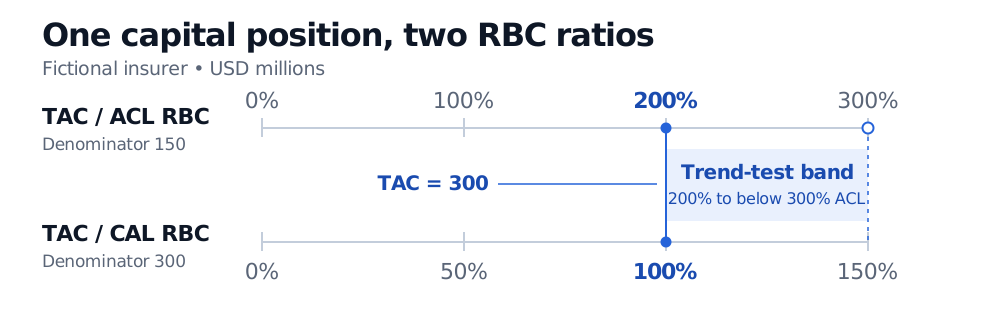
A single capital amount sits at the same point on both scales. The shaded band marks where the model trend test can trigger a Company Action Level Event.
Where the action levels begin
The table shows the ratio conditions for a filed report under the NAIC model acts. Every row uses TAC divided by ACL RBC, with a positive denominator. The model acts also allow other triggers, such as failure to file a required report or submit a required plan. States determine how the framework applies. For example, South Carolina’s code sets out separate trend provisions for life and health insurers, P&C insurers, and health organizations. NAIC Model Act No. 312, §§3–6 · NAIC Model Act No. 315, §§3–6 · South Carolina Code, §38-9-330
| Ratio on the ACL basis | Model act treatment |
|---|---|
| 300% or higher | Outside the ratio and trend-test triggers shown here |
| 200% to below 300% | Company Action Level Event if the applicable trend test triggers |
| 150% to below 200% | Company Action Level Event. The insurer submits a corrective plan. |
| 100% to below 150% | Regulatory Action Level Event. The regulator requires a plan, examines or analyses the insurer, and issues a corrective order. |
| 70% to below 100% | Authorized Control Level Event. The regulator can place the insurer under regulatory control or take the measures available at the Regulatory Action Level. |
| Below 70% | Mandatory Control Level Event. The model generally requires regulatory control, with limited provisions such as supervised run-off for eligible P&C insurers. |
At exactly 200%, the example meets the lower boundary of the trend-test band. The ratio leaves the trend outcome open. Under the NAIC’s adopted year-end 2025 instructions, the life and fraternal test looks at deterioration in the dollar margin between TAC and ACL RBC and tests the effect of a further decline. The P&C and health tests use a combined ratio calculated under their own instructions, with different cutoffs. A falling headline RBC ratio by itself gives too little information to reproduce any of those tests. NAIC, adopted formula changes · NAIC, year-end 2025 trend-test amendment, LR035, PR033 and XR027
To interpret a reported RBC figure, identify the reporting entity or group, confirm the denominator, and check the filing year, applicable formula and state rules. The ratio helps locate potential regulatory triggers. Assessing the insurer’s ability to meet claims calls for a broader look at its financial condition. NAIC, Risk-Based Capital overview
Sources
- NAIC, Risk-Based Capital overview
- NAIC, Risk-Based Capital for Insurers Model Act No. 312
- NAIC, Risk-Based Capital for Health Organizations Model Act No. 315
- NAIC, adopted modifications to risk-based capital formulas
- NAIC, 2025 year-end trend-test instructions amendment
- South Carolina Code of Laws, Title 38, Chapter 9, Article 3
- MetLife, Inc., 2025 Form 10-K