A return of capital is the portion of a nondividend distribution that recovers some of the shareholder’s investment and reduces their adjusted tax basis. An ordinary dividend is dividend income and leaves the basis of the existing shares intact. The same cash payment can therefore produce different taxable income when it arrives and a different gain when the shares are sold. IRS Publication 550
For an individual holding corporate stock as a capital asset in a taxable account, the general U.S. federal rule looks to the corporation’s current or accumulated earnings and profits as measured for tax purposes. The portion paid out of those earnings and profits is generally a dividend. The nondividend portion reduces adjusted basis to a floor of zero. Any excess is a capital gain, even while the investor still holds the shares. 26 U.S.C. § 316(a), 26 U.S.C. § 301(c)
One share, USD 6 in cash
Take one fictional share bought for USD 30 with no prior basis adjustments. Assume the holder keeps the cash and there are no other basis adjustments.
- Confirmed nondividend distribution. All USD 6 is a return of capital, leaving USD 24 of basis. The payment produces no current taxable income in this case.
- Ordinary dividend. All USD 6 is dividend income and the basis stays at USD 30. If part of the dividend qualifies for reduced tax rates, that part is still included in ordinary dividends on Form 1099-DIV. IRS Publication 550, Form 1099-DIV instructions
At a later sale for USD 32 with no fees, the nondividend case yields a sale gain of dollars and the ordinary-dividend case yields a sale gain of dollars. Both produce the same USD 8 of pre-tax profit over the life of the investment. In the dividend case, USD 6 of that profit is dividend income.
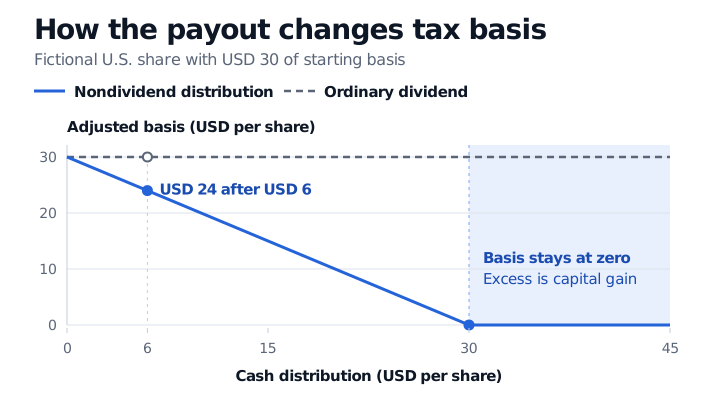
For this fictional share, the first USD 30 of a confirmed nondividend distribution uses up basis. The shaded region marks where any excess cash counts as capital gain.
If the share instead starts with just USD 4 of basis, the same USD 6 nondividend payment uses up USD 4 of basis and produces USD 2 of capital gain at the time of the distribution. Once basis is zero, any further nondividend distribution is all gain. The holding period determines whether the gain is short- or long-term. IRS Publication 550
The cash arrives before the tax label settles
A closed-end fund’s Section 19(a) notice can estimate the portion of a payment attributable to return of capital. The estimate can change as the fund’s fiscal year progresses or as it makes year-end tax adjustments. The calendar-year Form 1099-DIV reports the tax classification after year-end. BlackRock’s June 2026 Section 19(a) notice filed with the SEC
Box 1a reports total ordinary dividends, including any qualified portion separately identified in box 1b. Box 3 reports nondividend distributions. Box 2a reports capital gain distributions from the payer. A shareholder’s own gain from a box 3 payment exceeding their remaining basis depends on that shareholder’s basis. IRS Form 1099-DIV instructions, IRS Publication 550
Keep market returns and tax basis separate
Suppose the same share starts a period trading at USD 40, ends at USD 34 and pays USD 6 to its holder during the period. The price return is −15%, but the pre-tax total return is zero under either tax classification.
These are assumed market prices. The adjusted basis of USD 24 is used for tax gain or loss, and the market price reflects what the share trades for. In a backtest that uses distribution classifications as signals, store the dates when estimates and final classifications became available so a historical decision sees only information available at the time. The Corporate Actions and Survivorship lesson works through distribution cash flows and total return. The preview is public, and the full lesson requires membership.