Measure how often posted quotes execute, distinguish any-fill order counts from volume completion, and handle partial fills, replacements and observation windows.
Quote fill ratio
A quote fill ratio measures how often, or how much of, a trader's posted quotes execute within a specified observation rule. For a market maker, it helps diagnose whether resting liquidity actually attracts trades. Its meaning depends on the denominator: the fraction of orders receiving any execution can differ sharply from the fraction of submitted shares executed.
There is no single formula that the name alone safely identifies. Before comparing two dashboards, ask what each calls a quote, what qualifies as a fill and when observation stops.
Four partial fills: 40% or 13%?
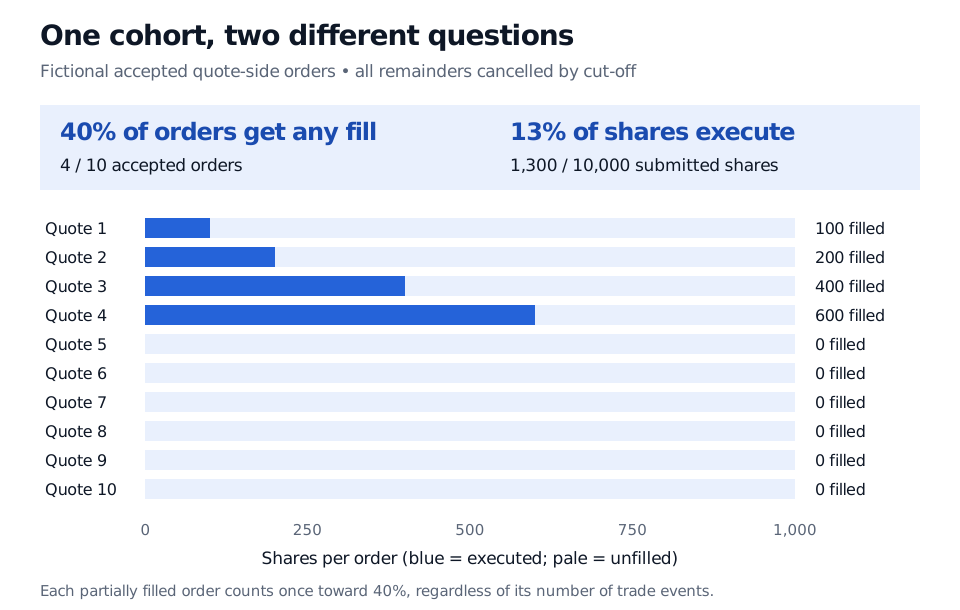
Consider a fictional cohort of ten accepted, displayed, one-sided quote orders, each for 1,000 shares in the same instrument and venue. A bid and an offer would count separately. All ten are accepted during a specified session interval; all their remaining quantities are confirmed cancelled by the evaluation cut-off. There are no replacements, rejected submissions, replenishments or trade corrections in this example.
Four orders receive cumulative executions of 100, 200, 400 and 600 shares. The other six receive none. Under an any-fill order convention,
Fany=accepted orders in the cohortaccepted orders with positive executed quantity=104=40%.
Under a volume completion convention,
Fvol=submitted shares in the cohortexecuted shares from the cohort=10(1,000)100+200+400+600=13%.
Both describe this ledger correctly. The first asks whether an order attracted any execution; the second asks how much submitted quantity actually traded. None of these orders completed its full 1,000 shares, so a fully-filled-order fraction would be zero. Always name that stricter outcome separately.
Fictional cohort of ten accepted 1,000-share quote-side orders. Four receive 100, 200, 400 and 600 shares; six receive zero. Any-fill order ratio is 40%; executed-volume ratio is 13%.
Original fictional cohort. Each row has the same submitted size. A small partial fill turns an order into an any-fill success without completing its quantity.
The SEC's Market Activity Report Methodology offers a useful contrast: its trade-to-order-volume measure divides trade volume by order volume, while its cancellation measure counts events. The SEC also discusses boundary and feed-granularity effects. These are specified market-data measures, not a universal definition of a market maker's quote fill ratio.
An execution event is not an order
If the first order's 100 shares execute as two trades of 40 and 60 shares, there are five trade events across the cohort. There are still only four orders with any fill, and still 1,300 executed shares. Dividing five events by ten orders produces a different statistic; repeated partial fills can even make such an event-per-order ratio exceed one.
The FIX execution-report specification, in its August 2019 edition, distinguishes order state from the event being reported. Pending cancellation is not completed cancellation; fills can arrive while a change is pending. Its cumulative quantities can span successive versions of an order. This illustrates why simply counting messages, or reading only the last status, cannot reconstruct the any-fill population.
For a reproducible report, specify these choices:
Choice
What must be explicit
Unit of observation
Quote side, two-sided quote, accepted order version, replacement chain or parent trading intention. A parent can contain many quote attempts.
Accepted versus attempted
This example excludes initial rejects. An attempted-submission measure includes them in a separate, explicitly named population.
Partial fills and cancellations
An order with a partial fill remains an any-fill success even if its remainder is later cancelled. A cancellation without execution is a nonfill.
Replacements
Count each accepted version separately, or join the chain and count once. Allocate fills to that same convention and avoid summing repeated cumulative quantities.
Quantity denominator
State whether replacements add newly exposed volume or revise an existing target. Reusing the same shares across quote attempts is different from unique parent demand.
Corrections
Deduplicate execution identifiers and reconcile busts or corrections before calculating positive final executed quantity.
A high number of replacements can depress a version-based ratio even when the eventual parent completes. That is a consequence of the chosen unit, not an arithmetic error. A limit order that crosses the spread may execute immediately; include only passive postings if the objective is to evaluate quote provision.
Window length changes the question
A submission cohort followed until completion or confirmed cancellation answers a lifecycle question. A fixed clock-time report answers a different one. If an order remains live at the cut-off, describe it as unfilled so far, retaining its outstanding quantity; its eventual outcome is not yet known. Orders arriving just before the cut-off have less exposure time than earlier ones.
For comparisons, use a stated common follow-up horizon, matched exposure groups or an explicit time-to-first-fill analysis with censoring. These approaches still require policies for cancellation and replacement. Do not count today's fills on yesterday's orders against only today's newly submitted orders unless that mixed-flow measure is deliberately intended and labelled. State venue, instrument, side, timestamps, session coverage and whether auction or hidden executions belong in the population.
Which way round is the ratio?
Under the example's matched order-count convention, ten quoted orders per four orders that receive any fill gives a quote-to-filled-order ratio of 2.5. Its reciprocal is the fill-to-quote fraction, 0.4. A reciprocal statement is valid only when the two quantities and their populations are identical and both are positive. A zero-fill cohort has a zero fill fraction and an undefined quotes-per-filled-order ratio; an empty cohort has no fill fraction.
The broader order-to-trade ratio may count submissions, modifications and cancellations against transactions under a different reporting rule. Do not invert such a number and call it a quote fill probability. Likewise, a trading strategy's hit rate, when defined as its fraction of winning trades, concerns profitability rather than whether a posted quote executes.
More fills need not mean better quotes
Moving a bid closer to the offer, leaving it live longer or changing its size can change both execution frequency and the economic exposure being taken. A high fill ratio can accompany adverse selection: buying just before prices fall, or selling just before they rise. A low ratio can accompany reasonable repricing when the market moves. The ratio alone neither establishes profitability nor demonstrates manipulative behaviour.
Read it alongside the spread earned, fees, inventory changes and price movements after fills, while comparing similar market conditions and quote policies. The Market, Limit and Conditional Orders lesson develops fill-contingent value and cancellation races; its public preview is open, and the full lesson requires membership.
FIX Trading Community, Business Area: Trade, EP97, August 2019, §3.1.2, pp. 10–13: execution reports, order states, cumulative quantities, replacements and execution corrections. This dated protocol edition supplies lifecycle examples, not a current venue-specific fill-ratio rule.