Compare raw messages per execution with regulatory order counts, volume ratios and venue denominator rules using one fictional trading log.
Order-to-trade ratio
An order-to-trade ratio (OTR) compares order activity with executed trading over a specified population and period. It helps a quant detect how much messaging accompanies execution, and helps venues monitor order traffic. The name does not identify a universal calculation: raw messages per execution, weighted order counts and volume-based regulatory ratios can give different answers for the same activity.
The distinction matters whenever a strategy repeatedly updates a limit order. One economic intention can generate many submissions, modifications and cancellations, while a single order can receive several partial executions.
First define what the dashboard counts
Consider a fictional participant, instrument and trading session, with this deduplicated input log:
Input-message type
Messages
New order
600
Modification request
300
Cancellation request
100
Total
1,000
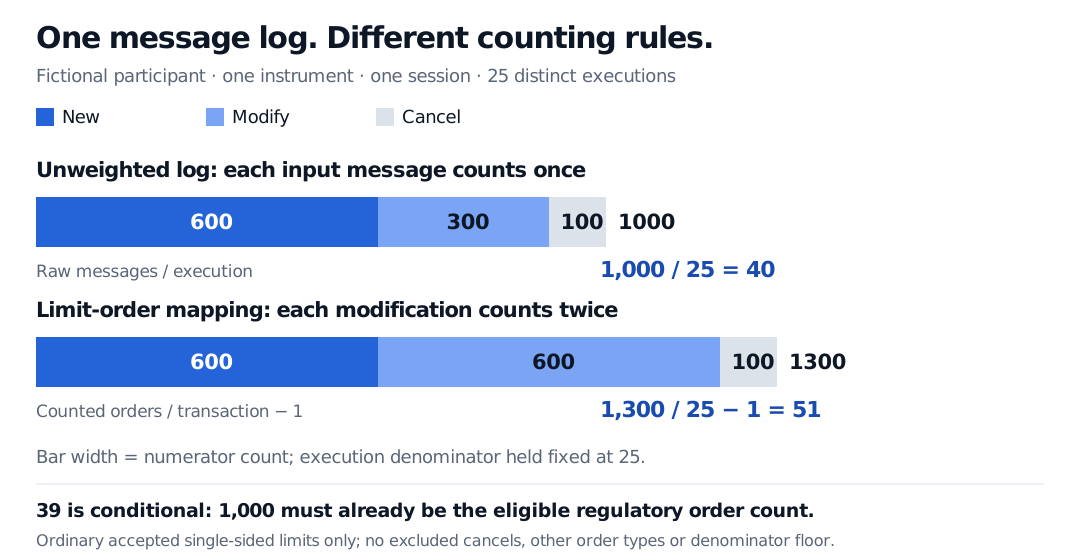
Suppose there are 25 unique execution events. Under a deliberately unweighted message convention, count each of the listed inputs once and exclude acknowledgements, duplicate deliveries and other administrative traffic. Then
Rraw=25600+300+100=40 messages per execution.
This is an activity statistic. It does not say that 40 distinct orders were placed for each completed parent trade, or that one in 40 orders filled. A quote fill ratio needs its own matched cohort and fill definition.
Why 40, 39 and 51 can all appear
EU Delegated Regulation 2017/566 (RTS 9) uses both number and volume ratios:
It covers participants in electronic continuous-auction, quote-driven and hybrid systems, per instrument and session, including auctions. A transaction includes partial execution. Article 1 excludes cancellations following auction uncrossing, venue-connectivity loss or kill functionality. The Annex counts ordinary limit additions/deletions once, modifications twice, and two-sided quote modifications four times; venue-generated updates are distinguished from counted inputs. Read Articles 1–3 and the Annex.
If 1,000 were already the eligible regulatory count, and 25 the matching transactions, the number ratio would be 1,000/25−1=39. That condition is not established by the raw log.
Instead, stipulate that all its requests concern accepted, single-sided ordinary limit orders, no cancellations are excluded, and the 25 executions occur on 25 distinct orders within the same session. Applying the Annex weights gives
That is a conditional worked mapping, not a universal conversion for every order type or venue. EUR-Lex lists RTS 9 as in force, applying from 3 January 2018, at this article's 31 October 2026 check.
Fictional log: 600 new, 300 modify and 100 cancel messages total 1,000. Counting limit modifications twice gives 1,300 orders. With 25 transactions, raw messages per execution is 40 and mapped orders per transaction minus one is 51. A result of 39 requires 1,000 to be the already eligible order count.
Original fictional comparison with a fixed denominator of 25. Bar widths show numerator counts; the second row assumes ordinary accepted limit orders, no excluded cancellations and no denominator floor.
Volume, partial fills and the observation window
The log alone cannot supply a volume OTR: it contains no order sizes or executed quantities. A 100-share instruction and a 10,000-share instruction each contribute one new message under our raw convention, but have different volume weights. Repeatedly revising the same intended position can count quantity repeatedly under a venue's ordered-volume rules; this is not unique investor demand.
Likewise, an order for 100 shares executed in two separately identified fills of 40 and 60 shares contributes two execution events, one order with any fill, and 100 executed shares. Splitting a fixed executed quantity across more events can lower messages per execution without improving completion or execution cost. Duplicate reports of one fill contribute no new economic execution.
State whether the denominator counts execution events, distinct orders with any fill, or completed parent orders. Keep participant, venue, instrument or product, session coverage and clock boundaries aligned. A cancellation at the cut-off does not erase earlier fills, and a request to cancel is not proof that the remaining quantity has stopped trading.
A real venue also specifies the denominator
Eurex's published OTR methodology, checked on 31 October 2026, calculates both count and volume measures per participant, product and trading day. It counts accepted order-book additions and deletions; a modification contributes a deletion plus addition, and an unexecuted IOC remainder contributes a deletion. Its trade count comprises executions. Importantly, Eurex replaces a trade count or traded volume below the corresponding minimum with that minimum. Thus simply applying the raw fraction can disagree with its reported OTR. Product parameters and quotation performance also affect limits. See Eurex's count and volume calculation sections.
For an unadjusted statistic, zero executions means division by zero, so report the ratio as undefined and show the numerator separately. Zero orders and zero trades is also undefined. ESMA's published answer of 7 July 2017 addresses no-trade cases through a breach test based on the maximum permitted order count, rather than evaluating the fraction. It remains labelled “Answer Published” in the Q&A register at the check date. This guidance and a venue's denominator floor are different conventions. ESMA Q&A 1615 explains that exception.
Diagnose the traffic before judging it
A rising OTR can result from more inputs, fewer trades, different execution fragmentation or a changed counting rule. Repricing stale quotes and correcting order state can increase messaging for legitimate reasons. Conversely, a low ratio says little about spread, depth, adverse selection or implementation shortfall.
A high ratio alone establishes neither manipulation nor poor market quality. Investigating intent or trading effects requires the underlying event sequence and economic context. For operational use, retain counts by message type, rejects separately, executed quantity, identifiers and the applicable venue rule version. Compare like populations before interpreting a change or attaching a penalty threshold; there is no universal acceptable OTR.
Live Execution Monitoring develops duplicate-event handling, cancellation uncertainty and reconciled order-state controls. Its public preview is open; the full lesson requires membership.
Eurex, Order-to-Trade Ratio: count and volume calculations, observation scope, minimum denominators and limit determinants. Current page checked 31 October 2026; its introductory recalibration date is historical, not a claim that all parameters remain at 2021 values.
ESMA, Q&A 1615, 7 July 2017: zero-trade treatment under RTS 9; published-answer status checked 31 October 2026.