Product notation writes a finite multiplication compactly using the capital Greek letter pi, . For a scalar sequence,
The integer index moves upward in steps of one; the lower and upper bounds are inclusive, so there are factors. The expression tells you which factor to use. This is the multiplication counterpart of summation notation, which uses to add terms.
The index is a dummy variable: replacing every bound occurrence of with changes no value. Changing the bounds does change which factors enter. For example,
There are two factors here, not three. Expand a short product before calculating whenever the indexing is unfamiliar. The University of Western Australia's notation chapter develops this finite-product convention.
Three returns, three changing bases
An investment starts with USD 100 and earns simple returns of +10%, −10% and +5% over three consecutive periods. Assume no deposits or withdrawals, no distributions, and no costs. Each return acts on the value at the start of its own period:
| Period | Simple return | Gross factor | Ending wealth, USD |
|---|---|---|---|
| 1 | +10% | 1.10 | 110.00 |
| 2 | −10% | 0.90 | 99.00 |
| 3 | +5% | 1.05 | 103.95 |
The wealth recursion gives
The product is 1.0395, a dimensionless growth multiple. Subtract one to obtain the cumulative simple return: 3.95%. Multiplying the percentages themselves would give a completely different quantity.
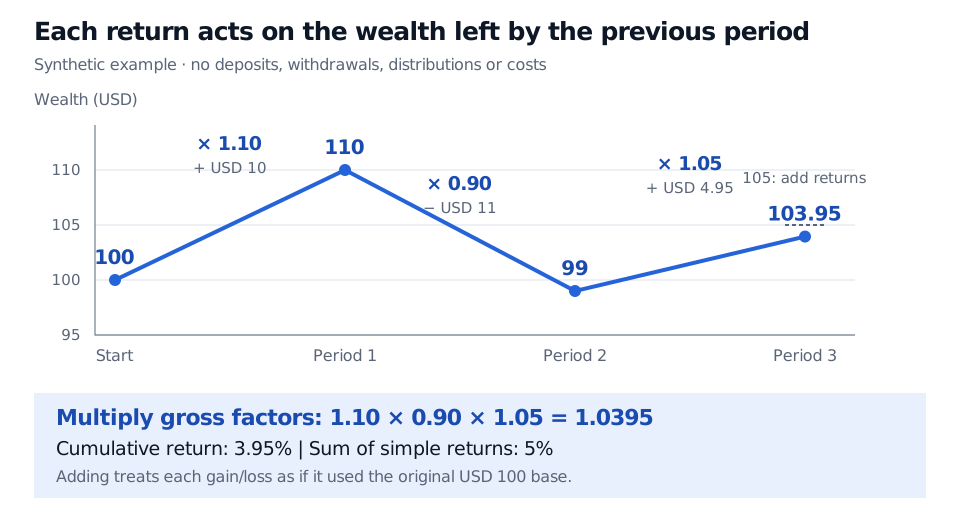
Original synthetic example. The gross factors multiply to 1.0395; adding the simple returns gives 5% and overstates cumulative return by 1.05 percentage points.
Why don't +10% and −10% cancel? The loss is 10% of USD 110, or USD 11, after a gain of USD 10. Their two-period product is . Compound interest uses the same mechanism: successive percentage changes act on a changing base. The university notes by Heng Peng at HKBU derive multiperiod returns from products of one-period gross returns.
This is aggregation through time for one investment. For different assets held over the same period, fixed holdings and beginning-of-period value weights give a weighted sum of simple total returns. Multiplying those assets' gross returns does not produce the portfolio return.
Distributions require an explicit total-return convention, including reinvestment timing, before linking periods. External deposits and withdrawals must be separated from investment performance; multiplying returns alone will not account for those added or removed dollars.
The product before the first period
An empty product equals one:
With no periods elapsed, wealth should remain . Zero would erase the starting capital. Empty means no factors, rather than a factor whose value is zero: any product containing a zero factor is zero. Equal bounds select one factor, so .
For a positive integer , two useful algebra checks are
A constant inside every factor appears times. These are finite scalar products; matrix multiplication needs an ordering convention and does not generally allow reordering.
When multiplication becomes addition
For strictly positive factors, the logarithm gives
Thus log returns add through time, while simple returns compound in gross form. Recover the cumulative simple return by exponentiating the sum and subtracting one. The real-log identity requires every . A −100% return makes the gross product zero; it does not give a finite log return. This algebraic identity needs no assumption that returns are independent.
For a guided explanation of the log laws, see Exponentials and Logarithms. For the distinction between time compounding and portfolio aggregation, read Financial Return Characteristics. Both provide public previews; their full lessons require membership.
Sources
- University of Western Australia, Summation and Product Notation, Chapter 10, product-notation section — finite products, indices and the empty-product convention.
- Heng Peng, Hong Kong Baptist University, Financial Time Series and Their Characteristics, 17 January 2021, “Multiperiod Simple Return,” “Continuously Compound Return” and “Portfolio Return.”
- John C. Hull, Options, Futures, and Other Derivatives, 9th Global Edition, §4.2, “Measuring Interest Rates” — reinvestment and compounding conventions.