Subtract levels; divide for relative change
Let and be the numbers before the percent signs, so a 3% rate has . Let and be decimal rates. Then
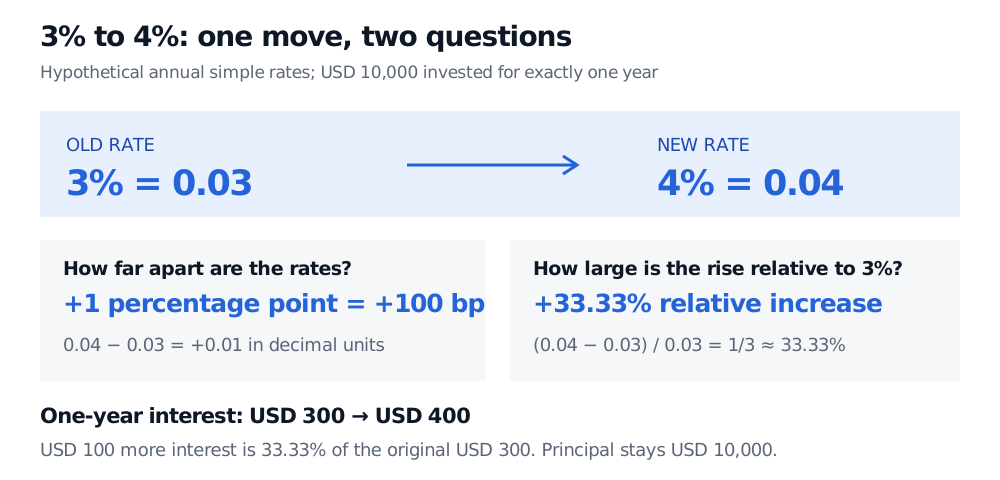
For the move from 3% to 4%:
| Description | Calculation | Result |
|---|---|---|
| Percentage-point change | +1 percentage point | |
| Basis-point change | +100 basis points | |
| Decimal-rate change | +0.01 | |
| Relative percentage change | Approximately +33.33% |
Both the point change and the relative change are valid; they measure different things. The relative calculation divides by the original rate. Reversing the move gives a decrease of 1 percentage point; always state the direction or retain the sign.
What the same rate move means in cash
Suppose a hypothetical deposit of USD 10,000 earns simple interest for exactly one year. Compare a 3% annual rate with a 4% annual rate on the same principal, before fees or tax, with no reinvestment:
The extra USD 100 is 33.33% of the original USD 300 interest, rounded to two decimals. It is 1% of the USD 10,000 principal. Choosing the denominator changes the question; neither denominator changes the 1 percentage point rate difference.
Zero and negative starting rates
Point differences remain useful when a relative growth rate becomes awkward:
- From 0% to 1%: the increase is 1 percentage point, or 100 basis points. The relative percentage change is undefined because its denominator is zero.
- From −0.50% to −0.25%: the rate rises by 0.25 percentage points, or 25 basis points. Applying the signed relative-change formula gives , or −50%. Calling that a “50% fall in the rate” would obscure that the rate moved upward toward zero. Report the endpoints and the positive point change instead.
Keep the underlying quantity consistent too. A percentage-point change in volatility compares two volatility levels; it is not a percentage-point change in variance. Variance is volatility squared and uses different units.
Sources
- European Union, Data Visualisation Guide, “Percentages versus percentage points”: distinguishes simple subtraction of percentages from relative percentage change.
- U.S. Bureau of Labor Statistics, Calculating percent changes: the earlier value is the denominator for relative change.
- Hull, J. C. (2018), Options, Futures, and Other Derivatives, 9th Global Edition, §4.1, “Types of Rates”: basis-point quotation for interest rates.