For old value and new value , define the fractional change by
A gain and its reversal use different denominators
Suppose a share rises from USD 200 to USD 250. Its change is . If it then falls back to USD 200, the change is . The cash movements have equal magnitude, but the second starts from a larger price.
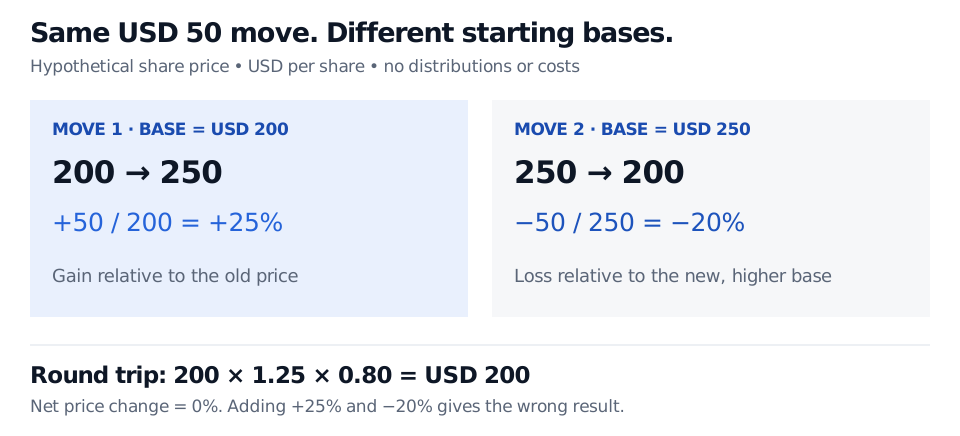
Successive fractional changes combine through compounding:
Here . Adding would incorrectly report a gain. More generally, after a change from a positive starting value, the fractional change needed to return is
A complete loss takes the value to zero; there is then no finite percentage gain that restores the original value from that zero base.
Percentage change is not every kind of return
A change in an account balance also includes deposits and withdrawals. Depositing USD 200 into a USD 200 account doubles its balance without earning an investment profit. Measuring performance requires separating external cash flows and their timing from investment gains. Likewise, a raw price fall caused by a stock split is not an economic loss: compare consistently adjusted prices or the value of the complete holding.
Check the baseline before interpreting the sign
- Zero: a move from zero has no defined percentage change under this formula. Report the absolute change instead.
- Negative: a loss shrinking from USD 20 to USD 10 means a reported profit moves from to . The formula gives , even though the result improved. State that the loss narrowed by USD 10 or by 50% of its previous magnitude; do not present the signed-baseline ratio as an ordinary growth rate.
- Already a percentage: a rate moving from 5% to 6% rises by one percentage point, or by 20% relative to the old rate. Those are different descriptions of the same change.
Always state the interval. A percentage change over a holding period is not automatically an annual rate.
Sources
- U.S. Bureau of Labor Statistics, “Calculating percent changes.”
- FINRA, “Key Concepts: Return and Rate of Return.”
- John C. Hull, Options, Futures, and Other Derivatives, 9th Global Edition (Pearson, 2018), §3.5, “Stock Index Futures”: price-index changes and dividend-reinvesting total-return indices.