This matters when a trading fee looks small. A quoted is a multiplier of , and the cash charge depends on the stated fee base.
From a rate to a cash amount
For a percentage number and reference amount ,
Here is the number before the percent sign. If you already have the decimal rate , multiply by directly; dividing by 100 again would convert twice. Conversely, an amount is of a nonzero base . The numerator and denominator must use compatible units.
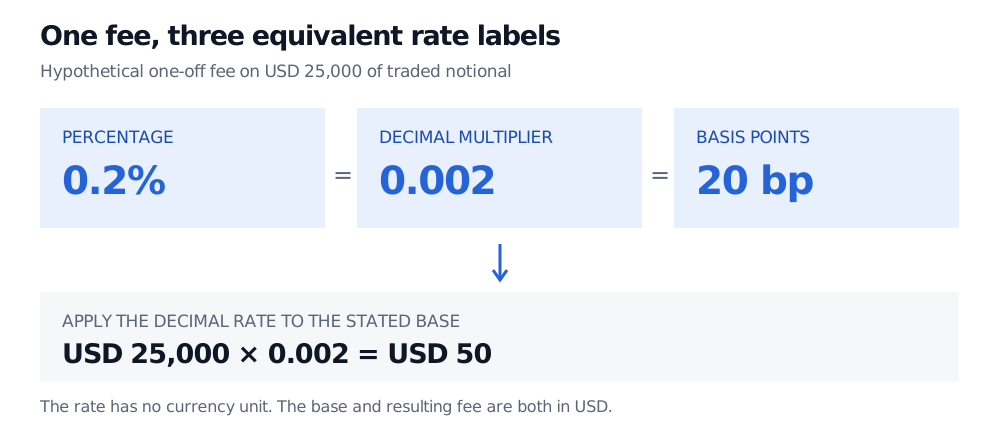
Always ask: percent of what?
Likewise, a USD 10 profit is a currency amount. It is 10% of USD 100 and 1% of USD 1,000; without a chosen capital base, “10% profit” is incomplete. A zero base makes the ratio undefined. A negative base needs an explicit interpretation before a percentage is useful for comparing performance.
Read the base and period together. For example, a fund's annual expense ratio uses average net assets and annual operating expenses, rather than a single trade's notional. An annual percentage cannot be treated as a one-off charge without a time convention.
A percentage level is different from its change
A rate moving from 5% to 6% illustrates three distinct statements:
| Measure | Result | What it compares |
|---|---|---|
| New percentage level | 6% | The new rate itself |
| Percentage-point change | +1 percentage point, or +100 basis points | The difference between the two rate levels |
| Percentage change | +20% | The increase divided by the original 5% rate |
For the last row, . Saying only “up 1%” hides which calculation is intended. Use “one percentage point” for the subtraction and “20% relative increase” for the ratio.
Sources
- Statistics Canada, Using basic statistical techniques, “Percentages”: per-hundred notation and reference-base calculations.
- U.S. Bureau of Labor Statistics, Calculating percent changes: relative change uses the earlier value as denominator.
- U.S. Securities and Exchange Commission, Investor.gov, Expense Ratio: annual fund operating expenses as a percentage of average net assets.
- Hull, J. C. (2018), Options, Futures, and Other Derivatives, 9th Global Edition, §4.1, “Types of Rates”: basis-point quotation for interest rates.