A negotiated cross agrees both sides before using a permitted crossing procedure. Separate the price bargain, venue checks, execution and trade report.
Negotiated cross
A negotiated cross is a prearranged trade whose buyer and seller agree price and quantity before it is effected through a permitted exchange crossing procedure or reported to the exchange under its rules. It lets compatible buying and selling interest meet directly. For a quant, the useful distinction is between the agreed bargain, the event that creates an executed trade, and the subsequent market-data print: treating them as one timestamp can distort execution-cost measurement.
The term is descriptive; it is not one universal legal order type. A venue may distinguish ordinary order-book crossings, price-improvement crossings and special or block crossings. ASX, for example, permits crossings only in specified circumstances under rule 4060 and its procedures. Agreement between the parties does not itself establish that one of those circumstances applies.
Internal crossing focuses on matching opposing instructions within an organisation. A negotiated exchange cross focuses on the agreed transaction and the venue procedure; the descriptions can overlap, but an internal allocation alone need not be an exchange trade.
A bargain at 50.10
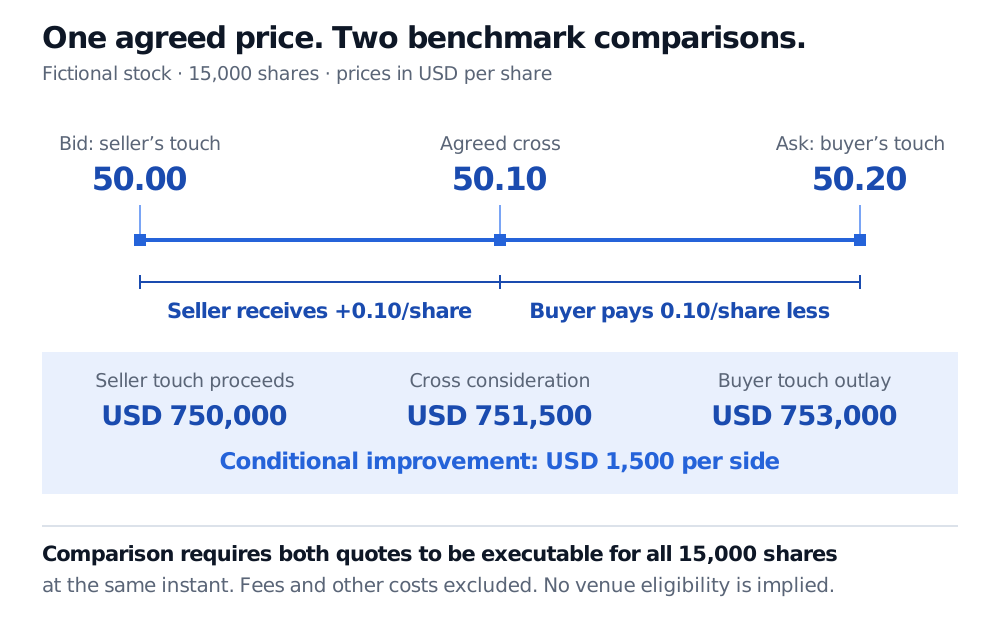
Suppose a broker brings together a buyer and a seller of 15,000 shares of a fictional stock. They agree USD 50.10 per share. At the comparison instant, the best bid and ask are USD 50.00 and USD 50.20. The agreed price happens to equal their midpoint.
The gross consideration changes hands once:
15,000×50.10=751,500USD.
The buyer acquires 15,000 shares and owes USD 751,500; the seller delivers those shares and is owed the same amount, before charges. Recording both sides does not create 30,000 shares of economic traded volume.
Now make a strong additional assumption: both quoted touch prices are executable for the entire 15,000 shares at that same instant, independently of the proposed cross. Exclude fees, taxes and every other cost. A buyer taking the offer would pay USD 753,000; a seller hitting the bid would receive USD 750,000. Against those stipulated alternatives, the cross improves each side's price by USD 0.10 per share:
Fictional 15,000-share cross at USD 50.10 between bid 50.00 and ask 50.20. Gross consideration is USD 751,500. Conditional improvement is USD 1,500 per side against executable same-instant full-size touch prices.
Original fictional comparison. Both touch quotes must be executable for all 15,000 shares at the same instant; fees and other costs are excluded. The arithmetic does not establish permission to cross on any venue.
These are conditional touch-benchmark differences, not guaranteed savings. A best quote may cover only a small part of the size; prices can change during negotiation; brokerage and other charges can offset the difference. Nor does avoiding an aggressive order prove that all market impact disappeared. Information disclosed while finding the other side and trading needed to complete any remainder can matter.
The midpoint divides this particular benchmark difference equally. An agreed price nearer the ask would shift more of it to the seller and less to the buyer. It would not enlarge the total USD 3,000 difference between these two frozen full-size touch alternatives. None of those prices is automatically permissible merely because it lies inside a displayed spread.
Keep the bargain and the print separate
A useful trade record answers four different questions:
Question
Evidence to retain
What was negotiated?
Instrument, beneficial trading interests, quantity, price, instructions and agreement time.
Which procedure was used?
Venue, instrument eligibility, session, participant capacity and applicable price or size tests.
What actually executed?
Confirmed trade terms, execution time, identities and any subsequent correction or cancellation.
What was reported?
Reporting party, submission and acceptance times, trade condition and publication time.
This is a record design, not a claim that every venue sends those events in that order. A trade report can describe an execution already agreed outside the order book. An exchange match can instead be the contract-forming event: ASX rule 4040 specifies that result for messages matched on its trading platform. Submitting a report is not automatically a second order execution.
The reporting party also needs to be established. ASIC's RG 265, paragraphs 265.422–265.424, distinguishes a single executing participant from a manually negotiated transaction where both parties execute, and explains reporting responsibility. Preserve the actual rule and capacity rather than assuming the buyer always reports.
For cost analysis, join the trade to quotes using the relevant execution and rule-defined checking times, retaining publication time separately. A delayed print matched to the quotes at publication can turn an ordinary negotiated price into apparent price improvement or an apparent trade outside the spread.
One jurisdiction shows why the checks matter
For ASX cash-market crossings, the procedures checked on 31 October 2026 distinguish two routes relevant here. Procedure 4060 Part A paragraph 1's ordinary matching routes require that entry was not prearranged; paragraph 1(b) applies price/time priority to non–Centre Point orders. They are not a general route for forcing an agreed pair ahead of resting interest.
Paragraph 5 separately allows equity-market-product and government-bond-depositary-interest crossings under ASIC rule 6.2.3(1), during the relevant Open Session State. They must be effected and reported during that state; Procedure 3500's NX entry requires immediate reporting to the platform. This is a specific route, not permission inferred from the word “negotiated”.
ASIC rule 6.2.3 includes either the prescribed improvement from both best available quotes or the defined Best Mid-Point, participant-capacity conditions for trades away from an order book, and positive consideration. Rule 6.3.4A separately requires operator validation; its price-improvement check uses the operator's best available quotes when the transaction is reported. A midpoint calculated earlier by a broker can therefore be an inadequate check.
These provisions do not establish that the fictional USD trade above qualifies. They also do not make every negotiated cross a block trade. Instrument, procedure and eligibility conditions must be identified independently. The operative compilation checked was dated 15 October 2024; Amendment Instrument 2026/574, section 2, specifies commencement 18 months after registration and was not yet operative at this article's check date.
Finally, a broker representing both sides, or trading as principal against a client, has a conflict over the negotiated price and allocation. A favourable touch comparison does not resolve it. ASIC rule 5.1.3 requires fair treatment and due turn for client and own-account orders. Best execution remains a separate question from whether a crossing procedure's mechanical conditions were met.
For a fuller treatment of measurement, SelfMadeQuant's Spread Measurement separates quoted spreads, execution concessions and later midpoint changes. Its preview is public; the full lesson requires membership.
Sources
ASX Operating Rules, section 4, rules 4030, 4040 and 4060 — priority, contract formation and permitted crossing circumstances.
ASX Operating Rules Procedures, Procedure 4060 Part A paragraphs 1 and 5, and Procedure 3500's NX reporting entry — distinct matching and price-improvement routes.
ASIC RG 265, paragraphs 265.422–265.424 — reporting-party responsibility. Issued 2 August 2022; the current download was checked alongside operative rules on 31 October 2026.