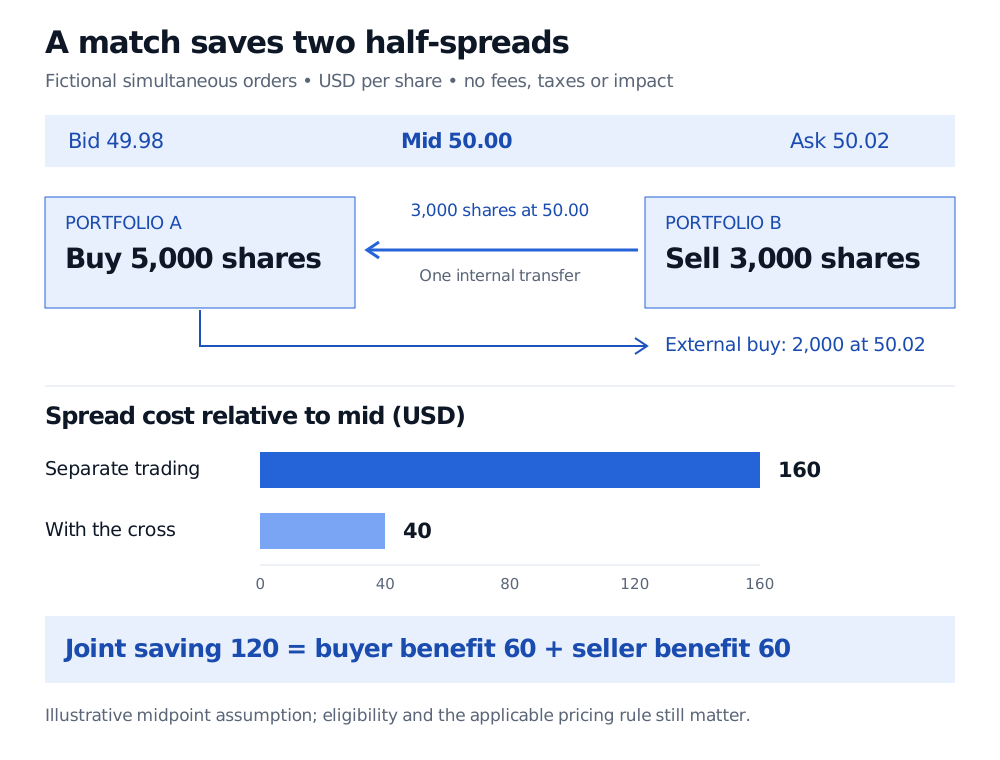
Matching eligible opposing portfolio orders internally can save two half-spreads, but the transfer price, client fairness and execution rules still matter.
Internal crossing
Internal crossing is matching compatible buy and sell instructions within the same investment-management or execution organisation, with an internal transaction or allocation at a specified price. Instead of sending both sides to the market independently, the organisation matches the overlapping quantity and trades the remainder externally. The practical gain can be lower execution cost; the essential constraint is that a saving for the organisation must not conceal an unfair outcome for either participating portfolio.
Here the focus is two genuinely distinct portfolios with opposite investment decisions. Reducing their combined external trading requirement is arithmetic. Executing a transfer between them also requires an eligible transaction, a defensible price and a record of which portfolio received what.
One match, two avoided half-spreads
Consider two fictional portfolios. A wants to buy 5,000 shares of a stock; B wants to sell 3,000 shares of the same stock. Both instructions are available at the same time, have compatible settlement and price limits, and are assumed eligible for the illustrated cross. The executable market bid is USD 49.98 and ask USD 50.02, with enough size for either route below. The midpoint is USD 50.00.
Assume the internal transfer occurs at that midpoint. Ignore fees, taxes, price movements and market impact. These assumptions isolate the bid–ask spread; they do not establish that midpoint execution is permitted under any particular rule.
The matched quantity is 3,000 shares, counted once as stock transferred from B to A. A still needs to buy 2,000 externally. Counting the internal buy and sell legs gives 6,000 shares of two-sided gross activity, but it does not create a second 3,000-share transfer.
Portfolio
Separate external execution
With midpoint crossing
Benefit
A, buyer
Pays USD 250,100
Pays USD 250,040
USD 60 less paid
B, seller
Receives USD 149,940
Receives USD 150,000
USD 60 more received
A's crossed-route payment is 3,000(50.00)+2,000(50.02)=250,040. B receives 3,000(50.00)=150,000. The internal cash payment cancels when combining the two portfolios' cash flows: only the external purchase remains.
Each external share costs USD 0.02 relative to mid. Thus the combined spread-cost comparison is
The joint saving is USD 120: two avoided half-spreads on each of 3,000 matched shares. Both portfolios reach their original targets. Crossing reduces external turnover without changing those investment decisions.
Fictional portfolios buy 5,000 and sell 3,000 shares. Crossing 3,000 shares once at USD 50 leaves an external buy of 2,000 at USD 50.02. Spread cost relative to mid falls from USD 160 to USD 40, saving USD 60 for each portfolio.
Figure: Original fictional ledger. Cost bars share a common USD scale. The midpoint is an illustrative pricing assumption, not a finding of regulatory eligibility or best execution.
A joint saving does not settle the price
Under the same fixed executable quotes, an internal price p gives the matched buyer a benefit of 3,000(50.02−p) and the seller a benefit of 3,000(p−49.98) relative to separate execution. Their sum remains USD 120. At USD 50.01, the buyer benefits by USD 30 and the seller by USD 90. The midpoint splits this particular spread saving equally; a different price redistributes it.
That is why portfolio-level outcomes matter. A manager cannot infer fairness from the aggregate saving alone. The relevant comparison includes each client's instructions, available alternatives, contemporaneous independent price information and the treatment of any unmatched quantity. A stale midpoint or a quote unavailable at the required size can make the simple comparison misleading.
Timing matters too. If the sell instruction arrives later, waiting for it is a new execution decision: the buyer can lose forecast value or miss a required hedge. Evaluate the entire intended order with implementation shortfall, rather than reporting only favourable matched fills. The owned Implementation Shortfall lesson develops the delay and noncompletion ledger (public preview; full lesson requires membership).
Identify the transaction before applying a rule
The label covers related mechanisms whose obligations differ:
Crossing between investment portfolios or funds: the manager arranges a transaction between separately managed interests. Eligibility and conflicts need assessment for those parties and instruments.
Broker internalisation: the broker may fill a customer order from its own inventory, as the SEC's investor explanation describes. This adds a principal counterparty, rather than merely pairing two portfolio instructions.
An exchange crossing: this is an execution governed by the venue's rules. For example, the ASX definition includes a participant acting for both clients or for a client against its own principal account. Rules 4060 and 4810 constrain the circumstances in which crossings can occur. An internal allocation is not automatically an ASX crossing.
A central risk book is the broader function that can match flows, warehouse unmatched inventory and manage subsequent external execution. Crossing itself is the matching event. Nor is matching orders the same as legal netting of settlement or close-out obligations.
One concrete jurisdictional distinction is especially important. US Rule 17a-7 provides a conditional exemption for specified transactions involving registered investment companies and affiliates. Its conditions include independent current-market pricing, consistency with participating funds' policies, restrictions on remuneration, governance procedures and records. It does not generally prescribe the midpoint for NMS stocks: paragraph (b)(1) specifies the consolidated last sale, using the independent bid–offer average if there are no consolidated reported transactions that day. Our numerical example does not establish compliance with this exemption. The eCFR text was current through 28 October 2026 when checked.
For FINRA members handling customer orders, Rule 5310(a) and Supplementary Material .09 require best-execution diligence and execution-quality review, including internalised order flow. Comparing competing markets, execution likelihood, speed and size reaches beyond observing that a price lies inside a spread. A hypothetical USD 120 saving proves the stated arithmetic; it does not prove best execution or permission to cross clients' orders.
Sources
17 CFR 270.17a-7, opening scope and paragraphs (a)–(g), especially (b)(1). Current eCFR text through 28 October 2026; checked 30 October 2026.
FINRA Rule 5310, paragraph (a) and Supplementary Material .09. Current rulebook page checked 30 October 2026.
SEC, Market Centers: Buying and Selling Stock, “Internalization.” Investor education last modified 15 October 2012; used for terminology, not current legal requirements.
ASX, Operating Rules Section 7, page 711, “Cross” or “Crossing”; and Section 4, rules 4060 and 4810. Current official PDFs checked 30 October 2026; relevant definition page dated 1 June 2026.