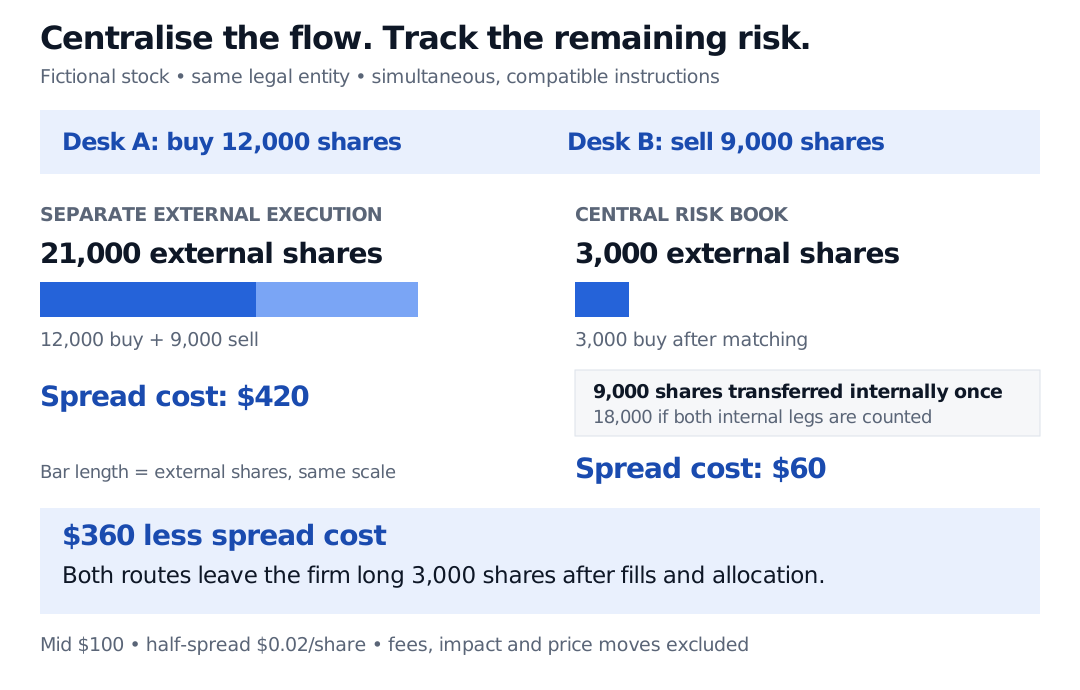
How a central risk book offsets compatible desk flows, reduces external spread costs and manages inventory without making the remaining risk disappear.
Central risk book
A central risk book (CRB) is a central trading desk or inventory-management function that aggregates trading needs across an institution, offsets compatible opposing flows and manages what remains. Its practical value is that two desks can avoid paying the market to take opposite sides of the same exposure. The central book also decides when to carry inventory temporarily and when to trade externally. Nutz, Webster and Zhao describe this internalisation-versus-externalisation problem in their original paper on unwinding stochastic order flow.
A CRB is more than a screen showing consolidated positions: someone owns the execution decisions, inventory limits and resulting profit and loss (P&L). The precise mandate varies. For example, Morgan Stanley's March 2026 EMEA order-handling FAQ, question 32, describes its CRB liquidity category as house inventory with client-related trading and hedging, managed in real time.
One stock, two desks, one external need
Consider a fictional firm with two strategy desks inside the same legal entity. Starting from zero stock positions, desk A wants to buy 12,000 shares and desk B wants to sell 9,000 shares of the identical stock. Assume both instructions are available simultaneously, allow the same execution time and are eligible for an internal transfer at the contemporaneous mid-price of USD 100. The market bid is USD 99.98 and ask USD 100.02, with enough available size at those prices.
The bid–ask spread is USD 0.04 per share; each external buy or sell costs half of that spread relative to mid, or USD 0.02 per share. Ignore fees, taxes, financing, price changes and market impact.
Execution route
Shares transferred internally, counted once
External shares traded, gross
Spread cost relative to mid
Desks trade separately
0
12,000 + 9,000 = 21,000
USD 420
CRB offsets compatible instructions
9,000
Buy 3,000
USD 60
The matched quantity is the smaller instruction: 9,000 shares. Calling this an 18,000-share internal trade would count both its buy and sell legs. That two-sided gross convention is legitimate if labelled, but it represents the same 9,000-share transfer, not twice as much matched stock.
The illustrative saving is USD 360. The mid-price sets the cash benchmark; it is not multiplied into a spread already expressed in dollars per share.
Fictional compatible same-entity instructions buy 12,000 and sell 9,000 shares. Separate external trading totals 21,000 shares and USD 420 spread cost. A central book transfers 9,000 internally once and buys 3,000 externally for USD 60 spread cost, saving USD 360. Both routes leave the firm long 3,000 shares.
Figure: Original fictional comparison. External-share bars use a common scale. Internal matching reduces external turnover; both routes produce the same net stock position.
The risk and P&L still need owners
For this illustration, suppose the strategy desks receive internal fills at USD 100: A is allocated +12,000 shares and B −9,000. The CRB buys the unmatched 3,000 externally at USD 100.02 and allocates them onward. Under this deliberately simple transfer-pricing convention, the CRB bears the USD 60 execution cost and any interim execution-inventory P&L; the strategy desks bear subsequent P&L on their assigned positions. Other transfer-pricing agreements could charge that cost back to the desks.
Once allocation is complete, the execution book can be flat while the firm remains long 3,000 shares. A USD 1 stock-price fall then loses the firm USD 3,000 on that net position, before other exposures and costs. Moving the booking location has not removed this exposure. If the CRB instead retains residual inventory under its mandate, that inventory and its P&L must sit explicitly on the central book.
This also separates a CRB from internal crossing: crossing is the matching event; a CRB is the broader function that can also retain and unwind unmatched risk. Our example assumes eligible house instructions. It does not authorise crossing separate clients' orders, accounts or funds merely because they have opposite signs.
Waiting for the other side is a decision
The example gives the CRB both instructions at once. If the buy arrives first and the sell arrives later, the central desk cannot treat the eventual match as already available. It must either execute, carry inventory risk, or adjust the schedule within the instruction's constraints. Waiting may avoid another spread payment, but the opposite flow may never arrive and the stock can move before it does.
The original unwind paper explicitly models uncertain incoming flow, and its strategy depends on projected future orders. It does not establish that every real desk should wait for a reversal. Its model takes incoming flow as exogenous and does not model using client information for speculative trading. Practical timing also has to respect deadlines, price limits, settlement compatibility, information barriers and the institution's inventory mandate.
For the cost-versus-delay trade-off behind external execution, see Transaction Costs and Implementation (public preview; full lesson requires membership). It develops spread and impact costs alongside the risk of leaving a trade unfinished.
A central book is not a capital-relief designation
The CRB operating model is distinct from the Basel Framework's internal risk transfer treatment. RBC25, paragraphs 25.18–25.29, addresses documented transfers of risk within or between bank books and their conditions for capital recognition. The current Basel chapter, effective 1 January 2023, does not grant capital relief simply because a bank centralises trading. Basel is an international prudential standard; the applicable jurisdiction's implementation determines a particular bank's legal obligations.
Basel Committee on Banking Supervision, Basel Framework: RBC25, current chapter effective 1 January 2023, especially paragraphs 25.18–25.29 and the FAQ distinguishing internal derivatives transfers from securities reassignment. Checked 30 October 2026.