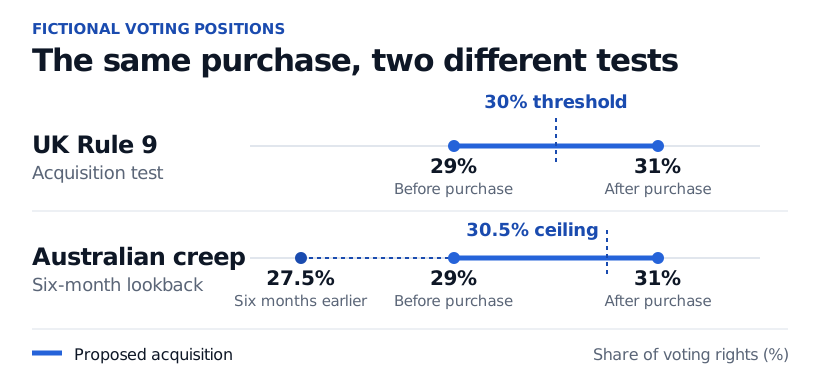
Compare the UK’s mandatory offer threshold with Australia’s six-month creep exception using the same fictional voting-rights purchase.
Mandatory Offer Thresholds and Creeper Rules
A mandatory offer threshold is the level of voting rights at which an acquisition can oblige the buyer to make a takeover offer to other security holders. A creeper rule governs how a holder can build a stake through further purchases, sometimes by limiting the increase over a stated period. For merger arbitrage, a small block purchase can change which deal scenarios to price. The applicable rule determines whether the purchase can create an offer obligation or needs a permitted route before it can go ahead.
UK Rule 9 measures voting rights
For a company covered by the UK Takeover Code, Rule 9.1(a) generally requires an offer when an acquisition takes the buyer’s aggregated interest to 30% or more of the company’s voting rights. Rule 9.1(b) generally requires an offer on a further acquisition that increases the buyer’s voting-rights percentage when it is already interested in shares carrying at least 30% of the votes and does not hold shares carrying more than 50%. In both tests, aggregate the buyer’s interests with those of persons acting in concert, such as parties who agree to cooperate to obtain control. Takeover Code, Rule 9.1 · Acting in concert · Companies subject to the Code
The denominator is the company’s voting rights under the Code, measured outside treasury. Share classes can carry different votes per share. The numerator uses the Code’s definition of interests in securities, which can reach beyond the names on the register or the ordinary account-level distinction between registered and beneficial ownership. For example, a right to direct voting can count. Voting rights · Treasury shares · Interests in securities
A purchase that takes the buyer from 29% to 31%
A fictional company has 200 voting shares with one vote each. A buyer with 58 shares and no concert parties buys four existing shares from an unrelated holder. The number of votes stays fixed.
20058=29%,20062=31%.
If the UK Code applies, the purchase reaches the Rule 9.1(a) trigger. The obligation depends on the transaction and any applicable exception or dispensation. For example, the Panel can waive an obligation on some new share issues following an independent shareholder vote. Rule 9.1 also specifies an exception for control acquired through a qualifying voluntary offer. Takeover Code, Rule 9.1 · Rule 9 dispensations
Fictional 29% to 31% purchase. It crosses the UK Rule 9 threshold at 30%. In the separate Australian example, voting power was 27.5% six months earlier, so 31% is above the 30.5% ceiling for the creep exception.
The solid segment marks the proposed purchase. The Australian example also needs the voting power six months before that purchase.
When an offer is required, it extends to voting and non-voting equity classes and to other transferable voting securities. Rule 9.5 requires cash or a cash alternative for each class at least as high as the top price the bidder or a concert party paid for an interest in that class in the 12 months before announcement, subject to Panel adjustments. That price history informs a bid scenario. Holders can choose whether to accept, and any subsequent compulsory acquisition has its own legal test. The target may use a takeover defence to deter or reshape an unwanted bid. Takeover Code, Rule 9.1 · Rule 9.5 · UK Companies Act 2006, s 979
Australia measures creep over six months
For listed companies and unlisted companies with more than 50 members, Australia’s Corporations Act 2001 generally prohibits a covered acquisition that raises someone’s voting power from 20% or less to above 20%, or increases it from a starting point above 20% and below 90%, unless an exception applies. Under section 610, voting power divides the votes attached to shares in which the person or their associates have a relevant interest by the total votes attached to all voting shares. Section 611 item 9 provides a creep exception. At least one person must have had 19% or more voting power throughout the preceding six months, and the acquisition may leave none of the people who meet that test more than 3 percentage points above their own voting power six months earlier. Acquisitions through acceptances under a takeover bid or with qualifying prior shareholder approval are separate exceptions. Corporations Act 2001, ss 606, 610 and 611
Put the same 29% to 31% purchase in a separate Australian example. Assume the acquisition falls within section 606 and only the buyer meets the continuous 19% test. The buyer held 27.5% six months earlier and stayed at or above that level. The proposed purchase adds 2 percentage points on the day, but leaves the buyer 3.5 points above the six-month starting level. The creep ceiling in this example is 30.5%, so item 9 cannot cover the purchase. In a deal model, an acquisition that depends on another exception belongs in a separate scenario from an ordinary block purchase.