Limit Up–Limit Down (LULD) is the U.S. equity-market framework that restricts trades in covered individual NMS stocks to specified price bands and couples those bands with a Trading Pause mechanism. For a quant, the consequence is immediate: a model's desired execution can become unavailable while the position remains exposed to price risk.
This article explains the regular-hours rolling-band mechanism, checked on 31 October 2026. The NYSE overview distinguishes it from market-wide circuit breakers, which respond to a decline in the S&P 500 rather than a single stock's band state.
A moving reference, not a daily loss allowance
The Plan's calculation overview describes a reference based on the arithmetic mean of eligible reported transaction prices over the preceding five minutes. The securities information processors calculate and disseminate the bands. Opening and reopening rules differ; when no eligible transaction occurs in the lookback, the previous reference persists. Normal updates require a reference move of at least 1%, with each new reference held for at least 30 seconds.
The parameter depends on tier, price category and time. The previous closing price selects the price category; the rolling reference determines the current band levels. Tier 1 includes S&P 500 and Russell 1000 constituents and selected ETPs; Tier 2 covers other eligible NMS stocks. Rights and warrants are excluded. For the above-USD-3 category, the base parameters are 5% for Tier 1 and 10% for Tier 2. Lower-priced securities and leveraged ETPs have other provisions. Parameters double in the final 25 minutes for all Tier 1 securities, and for Tier 2 securities priced at or below USD 3. The normal full-day regular session is 9:30 a.m.–4:00 p.m. ET; early closes need their own session clock. Check the Plan and Appendix A, not a universal “5% rule.”
One fictional snapshot
Take a fictional covered U.S. share, with a current reference of USD 100 and a stipulated 5% parameter. Freeze that reference for this calculation; it is not a claim about every security or time:
A hypothetical price of USD 106 is above the upper band of USD 105. That arithmetic identifies an outside price; it establishes neither an execution nor the treatment of any reported transaction.
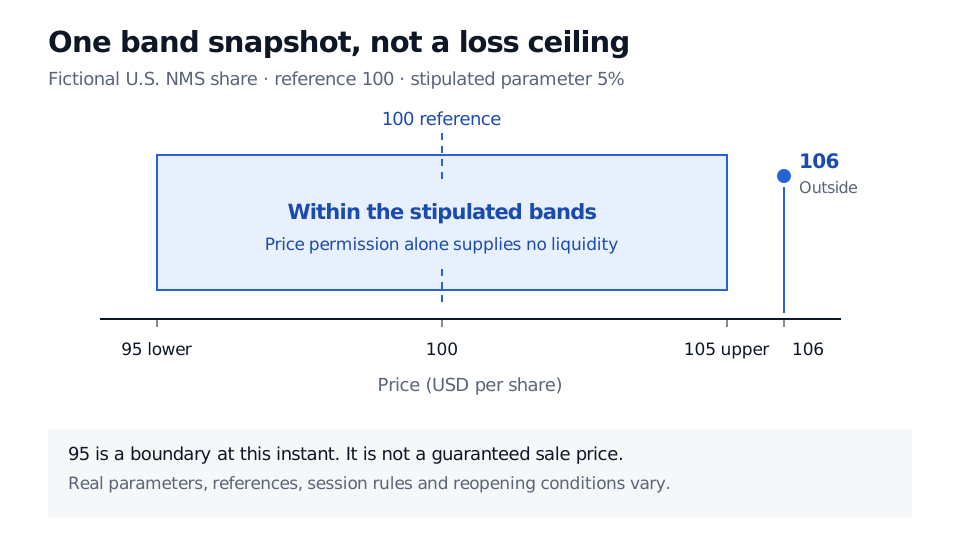
Original fictional snapshot in USD per share. The reference and 5% parameter are stipulated; the shaded range supplies no promise of execution.
In particular, a seller cannot assume liquidation at 95. Buyers may be absent, a pause may intervene and later bands may differ. LULD neither creates liquidity nor caps total loss. A limit order adds an investor's price instruction; it cannot create a counterparty either.
Band, Limit State and Trading Pause are different observations
Under Plan Sections VI–VII:
- A Limit State begins when the national best offer equals the lower band without crossing the national best bid, or the national best bid equals the upper band without crossing the national best offer. An arbitrary trade touching a band is insufficient to establish this quote condition.
- If all Limit State quotation size executes or is cancelled within 15 seconds, the state exits. Otherwise, during regular hours, the primary listing exchange must declare a Trading Pause. A qualifying Straddle State can also produce a discretionary pause.
- During the pause, trades stop while quotes may remain displayed. After five minutes, absent a Regulatory Halt, the primary exchange attempts reopening under its procedures. This is an attempt, not a guaranteed resumption time. Extensions and special late-session procedures matter; trading centers need price bands before resuming.
A trading halt is therefore a distinct state from trading within a band. The Plan also excludes specified transactions from the ordinary band restriction, including single-priced primary-exchange opening, reopening and closing transactions.
An outside print is not an automatic cancellation
Do not label the hypothetical 106 transaction “void” merely because the snapshot band ends at 105. First establish the effective bands, execution time, session and transaction type. Clearly erroneous trade review follows separate exchange rules. Nasdaq's policy distinguishes reviewability, filing requirements and determinations; its regular-hours exceptions include unavailable bands and certain system failures. LULD prevention and retrospective trade adjudication answer different questions.
Likewise, “limit up” in a futures contract may refer to a product-specific daily price limit. CME's explanation describes session limits and product-dependent responses. The name does not import this equity Plan's rolling reference or pause procedure into futures.
Keep the rule version in the replay
An execution replay should retain effective bands, quote flags, Limit State entry/exit, pause and resumption messages, plus when the strategy received each event. Interpolating a price through a pause or clipping a desired fill to the band silently invents executable liquidity. Trades, Quotes and Market State develops this distinction between observed prices and a feasible execution. Its preview is public; the full lesson requires membership.
Session scope is changing. The SEC approved Amendment 27 on 5 August 2026, establishing a separate overnight framework with static bands and no automatic band-hit Trading Pauses. The 7 October 2026 Amendment 29 order put its overnight reference-time revision into effect temporarily, with an operative date to be announced and anticipated for 6 December 2026. As of this article's date, that commencement remains future. Do not apply regular-hours rolling bands or the 15-second mechanism to an overnight replay by assumption.
Sources
- LULD Operating Committee: Plan overview, reference calculation, tiers, sessions and band parameters.
- SEC Release 34-105596, 1 June 2026, full Plan text in the Amendment 27 filing, Sections V–VII and Appendix A. Read with the subsequent approval and amendment orders below.
- SEC Release 34-106042, 5 August 2026, approval of Amendment 27 and the separate overnight framework.
- SEC Release 34-106624, 7 October 2026, temporary summary effectiveness of Amendment 29 and anticipated operative date.
- NYSE: Trading Information, LULD and market-wide circuit-breaker scope.
- Nasdaq Trader: Clearly Erroneous Transactions Policy, review guidance and regular-hours reviewability.
- CME Group: What are Price Limits and Price Banding?, product-specific futures safeguards.