A clearly erroneous trade is an executed transaction with an obvious error in a term such as its price, quantity or security identity, assessed under the relevant venue’s rules. A trade bust makes the execution null and void. For a quant desk, that creates a second event to reconcile after the fill: holdings, cash obligations and market data may change when the authorised decision arrives. An expensive fill or regretted order is not, by itself, a right to unwind it. The U.S. equity examples here use Nasdaq Rule 11890 and NYSE Rule 7.10. Nasdaq rulebook, NYSE rule text.
Fifty percent away still leaves a question
Suppose a fictional buyer receives a confirmed fill for 1,000 shares at USD15. Take USD10 as a supplied reference price. The arithmetic is
These numbers describe the fill; they do not determine whether an exchange will bust it. We have not supplied the venue, security’s eligibility, session, valid rule-specific reference, available price bands, filing time or exceptional circumstances. The USD10 comparison might be useful for measuring slippage while being the wrong reference for exchange review.
Now stipulate that the exchange has reviewed this execution and ruled it void. Ignore fees, financing, other trades and subsequent market moves. A buyer starting with USD20,000 cash and no shares records:
| Event | Change in shares | Change in cash or settlement cash obligation | Resulting shares / cash |
|---|---|---|---|
| Original purchase | +1,000 | −USD15,000 | 1,000 / USD5,000 |
| Authorised full reversal | −1,000 | +USD15,000 | 0 / USD20,000 |
If the purchase had stood and the shares were marked at USD10, wealth would have been USD15,000, a USD5,000 mark-relative loss. That loss is not the cash amount reversed: voiding the whole purchase reverses its USD15,000 consideration and 1,000 shares. Before settlement this may reverse obligations rather than money already delivered. Separate fees or hedges require their own treatment; voiding this fill does not automatically unwind a hedge placed elsewhere.
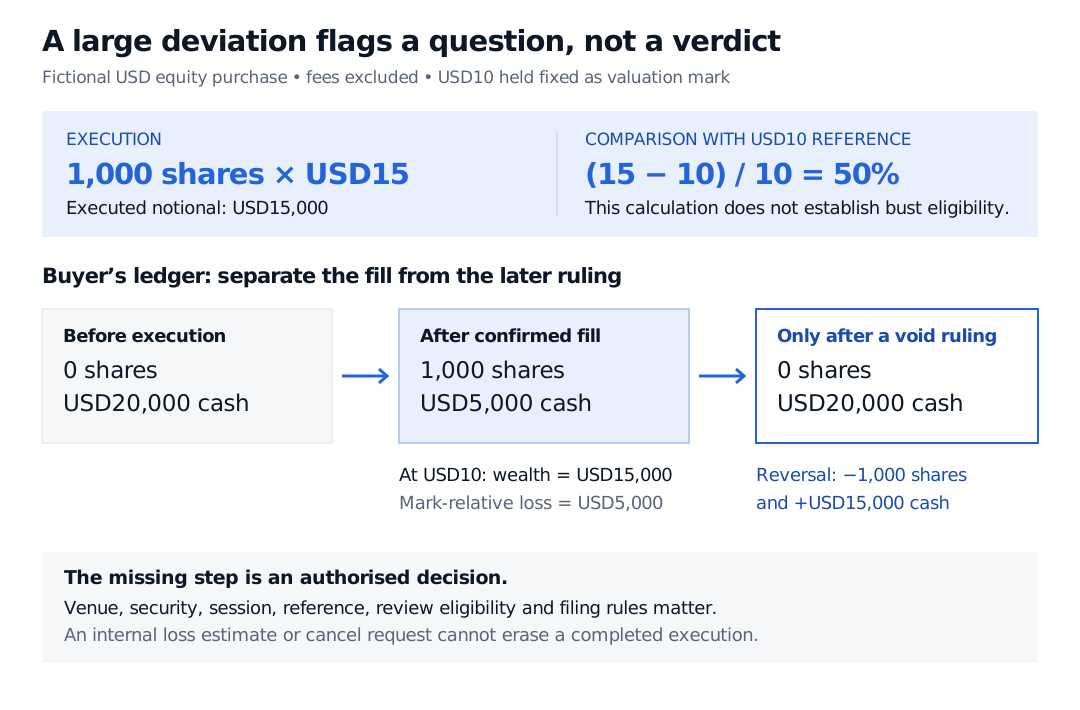
Original fictional ledger, with no fees and a fixed USD10 valuation mark. The final state is conditional on an exchange ruling that the trade is void; the figure does not decide eligibility.
Eligibility comes before the percentage table
Rule snapshot: 31 October 2026, U.S. equities. During regular/core hours, Nasdaq and NYSE generally exclude executions from clearly erroneous review when the LULD protections apply. Exceptions include securities outside the plan, unavailable bands, specified systems or halt events, and specified erroneous-reference cases. Limit Up–Limit Down prevents executions outside bands; clearly erroneous review addresses completed trades under a separate framework. Nasdaq Rule 11890(a)(2)(C), NYSE Rule 7.10(c).
For an ordinary single-stock case eligible for the numerical-guideline route, the base price tiers are:
| Valid reference price | Regular/core hours, stock not subject to LULD | Nasdaq pre-/post-market; NYSE early session |
|---|---|---|
| Above USD0 through USD25 | 10% | 20% |
| Above USD25 through USD50 | 5% | 10% |
| Above USD50 | 3% | 6% |
The test concerns an adverse buy above, or sell below, the reference. Additional factors and separate leveraged-product and multi-stock provisions matter. The usual reference is the consolidated last sale immediately before the questioned execution, with rule-defined alternatives. A strategy’s fair-value estimate cannot simply replace it. Nasdaq Rule 11890(a)(2)(C)–(D), NYSE Rule 7.10(c)–(d).
The two exchanges’ 2026 overnight amendments extend LULD-related restrictions to overnight protected hours, but their implementation sections schedule operation with 23/5 trading on 6 December 2026. They are not an operative overnight assumption for this October snapshot. A further NYSE reorganisation published on 20 October is a proposal, with Commission action still contemplated in the notice. NYSE implementation, Nasdaq implementation, NYSE October proposal.
A request is not a cancellation
The ordinary written complaint deadline at both venues is 30 minutes from execution. Routed-market filings and qualifying outlier cases can have limited extensions, generally capped at 60 minutes under the specified provisions; an extension is not automatic. A Nasdaq official or NYSE Officer determines the result. Appeals have separate deadlines and exceptions. NYSE Rule 7.10(b), (c)(2)(D), (e), Nasdaq filing guidance.
Nasdaq’s complaint requires execution time, symbol, quantity, price, side and a factual explanation. Its current guidance directs filers to the online form and warns that a preliminary phone call can delay filing. A participant cannot unilaterally erase a completed fill by sending an order-cancel message. Nasdaq MarketWatch procedure.
Keep three other operations distinct:
- Order cancellation removes an unexecuted remainder once accepted; it does not undo shares already filled.
- Corporate-action adjustment changes units or entitlements, such as split-adjusted prices and shares. An erroneous corporate-action reference can trigger a specific exchange-review exception, but routine adjustment is not itself a bust.
- Allocation or give-up assigns an executed trade to an account or carrying broker. Correcting that assignment does not by itself void the market execution.
Preserve the decision timeline
For research, retain the original execution identifier, raw print, review request and ruling, together with event and receipt times. Apply a reversal to the ledger when its authorised message becomes available. In historical analysis, keep the corrected trade history distinguishable from the information a live strategy saw before the correction. Otherwise a backtest can silently remove a signal or exposure that really existed at decision time.
Positions, Trades, Fills and P&L develops the cash-and-holdings accounting; Trades, Quotes and Market State develops the two-clock data record. Both have public previews; the full lessons require membership.
Sources
- Nasdaq Equity 11, Rule 11890: definition, review eligibility, numerical guidelines, references and authority.
- NYSE Rule 7.10, Exhibit 5 to Release 34-106407: unchanged provisions plus marked overnight amendments; read with the implementation section in the notice.
- Nasdaq MarketWatch clearly erroneous procedure: filing requirements and deadlines.
- SEC Release 34-106631: Nasdaq overnight amendment and scheduled implementation.
- SEC Release 34-106705: NYSE’s October 2026 proposal, distinguished from operative rules.