The LIFO reserve is the gap between inventory valued under first-in, first-out (FIFO) and the same inventory valued under last-in, first-out (LIFO). A LIFO liquidation occurs when a reduction in a LIFO inventory pool releases costs carried in an earlier layer into cost of goods sold (COGS). If those older costs are below current costs, the release lifts reported gross profit relative to costing the same sales at today’s unit costs. The reserve helps compare companies on a common inventory costing basis. The liquidation helps explain how much of a period’s margin came from older costs. FASB staff summary of ASC Topic 330 · Seneca Foods Form 10-K, Note 4
Use the reserve balance for inventory and its change for COGS
Suppose a fictional supplier starts the period with inventory of USD 110 on a FIFO basis and USD 80 on a LIFO basis. It adds USD 130 of purchases. At period-end the same stock is valued at USD 150 under FIFO and USD 110 under LIFO. The closing reserve is USD 40, up from USD 30.
| Inventory roll-forward (USD) | FIFO | LIFO |
|---|---|---|
| Opening inventory | 110 | 80 |
| Purchases | 130 | 130 |
| Ending inventory | 150 | 110 |
| Cost of goods sold | 90 | 100 |
Each column gets COGS by subtracting ending inventory from the sum of opening inventory and purchases. With identical purchases and no other reconciling items, the difference between the two columns is the change in the reserve. If is FIFO inventory less LIFO inventory at the end of period ,
Add the full USD 40 to closing LIFO inventory to obtain its FIFO equivalent. Subtract the USD 10 increase from reported LIFO COGS to obtain the period’s FIFO COGS. In a filing, check that both balances cover the same inventory and use the same comparison basis. A change in scope from an acquisition or a separate write-down can require an additional reconciliation.
What happens when an older layer is used
In a separate periodic LIFO example, a supplier opens with 10 units carried at USD 6 each, buys 12 units at USD 10 each and sells 16 units. The 12 current units go into COGS first. The remaining four sales draw on the older layer. Recorded COGS is USD 144, compared with USD 160 if all 16 sales were costed at the current USD 10 per unit. With sales revenue held fixed, using the older layer lifts gross profit by USD 16 on that comparison. Higher-cost older layers can have the opposite effect. FASB staff handout, paragraphs 8–9
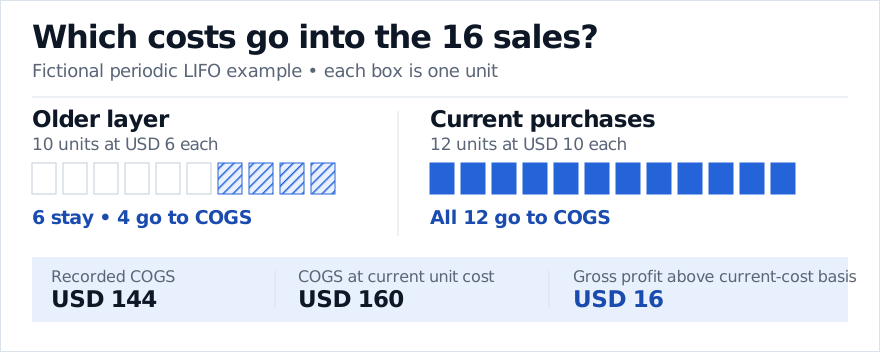
The hatched units are the four costs released from the older layer. The comparison holds the number of sales and revenue fixed.
A drop in total inventory can come from stock valued under another method or a lower carrying value. The relevant question is whether a LIFO pool used up an earlier cost layer, even in part. Seneca Foods’ fiscal 2025 liquidation reduced cost of products sold by USD 14.5 million, even as the overall LIFO adjustment increased that cost by USD 34.5 million. In fiscal 2026 the reserve fell from USD 359.3 million to USD 337.0 million, and Seneca reported no LIFO liquidation. Read the disclosed liquidation effect separately when assessing whether a reported margin is likely to persist. Seneca Foods Form 10-K, Note 4
What to look for in a filing
US GAAP permits LIFO under ASC Topic 330. Where applicable, SEC Regulation S-X requires disclosure of a material excess of replacement or current cost over stated LIFO value. Check the benchmark before treating a disclosed amount as an exact FIFO difference. SEC staff guidance also calls for disclosure of material income from a LIFO liquidation. Under IFRS, IAS 2 uses FIFO or weighted average for ordinarily interchangeable inventory. A FIFO bridge addresses the cost-flow difference in a peer comparison. FASB staff summary of ASC 330-10-30-9 · Regulation S-X Rule 5-02.6(c) · SEC Staff Accounting Bulletin Topic 11.F · IAS 2, paragraphs 23–27