An indication of interest helps discover potential trading counterparties. Separate preliminary interest, firm commitment and confirmed execution, including actionable-IOI caveats.
Indication of interest
An indication of interest (IOI) is a communication of willingness to buy or sell a security, used to discover potential counterparties before or alongside the process of arranging a trade. In institutional execution, a preliminary IOI can help locate liquidity for a large order. For a quant, the essential distinction is between interest observed, quantity executable and quantity actually filled: recording an IOI as a trade invents a position and its profit or loss.
An IOI may be nonfirm and subject to confirmation, but the label alone does not establish that. Some actionable IOIs function like orders or quotations. Their treatment depends on the message's content, the parties' dealings and the applicable market rules. This article focuses on secondary-market trading interest, rather than acquisition proposals or IPO demand collection.
What is the message really offering?
A broker may distribute IOIs to locate the other side of a block trade. A discovery service can bring potential interest to a trader's attention without making it displayed depth in an order book. LSEG's Autex description illustrates this role: it distributes broker IOIs and trade advertisements to support counterparty discovery. A trade advertisement and an IOI serve different purposes; evidence of previous trading does not by itself supply currently executable quantity.
Before treating a message as available liquidity, resolve its terms:
Detail
Execution question
Security and side
Which instrument, and is the sender buying or selling?
Size
Is this exact available quantity, an approximate indication or a minimum execution size?
Price
Is it fixed, indicative or linked to a reference price?
Capacity
Is the broker representing client interest or trading for its own account?
Conditions and lifetime
Is confirmation required, and when does the interest expire or need refreshing?
Ability to execute
Can a response trade against it immediately, or does it begin a negotiation?
Capacity labels require care. In Wells Fargo Securities' own IOI disclosure, a natural message can concern a live customer order, while house-interest qualifiers identify principal interest. Its “Working Order” qualifier may involve contingencies, and “In Touch With Firm Interest” can describe potential client interest without a firm order in hand. These are that provider's disclosed usages, not universal meanings that every feed shares.
Fifty thousand indicated, twenty thousand bought
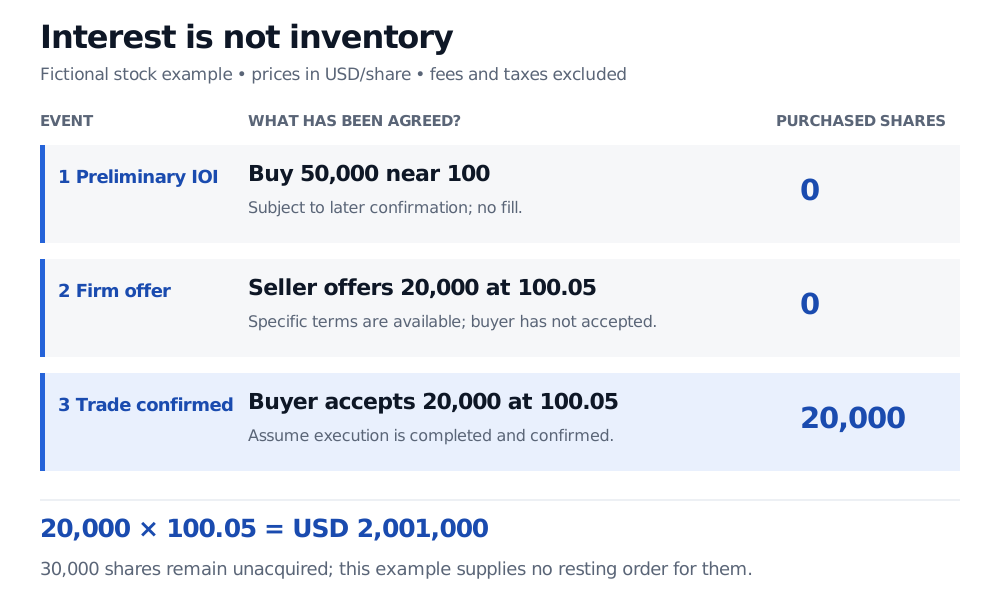
Consider a fictional stock with prices in USD per share. An investor communicates preliminary interest in buying 50,000 shares near 100, explicitly subject to later confirmation. This is not a limit order authorising a purchase at 100, and no execution occurs at this stage.
Later, a seller makes a firm offer for 20,000 shares at 100.05. The investor accepts those terms; assume the transaction executes and is confirmed for the entire 20,000. Exclude fees and taxes. The executed notional is
20,000×100.05=2,001,000 USD.
The investor has acquired 20,000 shares, not 50,000. The remaining 30,000 shares are unacquired relative to the earlier interest. This example supplies no live order for them. Nor does “near 100” authorise every subsequent offer: acceptance of 100.05 is a separate, stipulated decision.
Fictional USD stock example: preliminary interest in buying 50,000 shares near 100 books no fill. A later firm offer for 20,000 at 100.05 is accepted and stipulated executed, producing 20,000 purchased shares and USD 2,001,000 notional. The other 30,000 shares remain unacquired interest, with no resting order supplied.
Original fictional lifecycle; prices are USD per share. Only the final stipulated execution changes the purchased-share ledger. Fees and taxes are excluded; no named venue's matching rules are assumed.
A conditional liquidity-search workflow can automate part of this distinction. Cboe's current BIDS Europe overview separates submitting IOIs, finding potential matches, firming up and executing. Its October 2024 service description, §§4.1 and 4.3, explains that an IOI must be replaced by a firm-up before trading; invitations can expire, and matching conditions still apply. That is a documented venue mechanism, not a claim that every IOI uses the same protocol or timing. Read the service description.
“Nonbinding” is not a safe blanket definition
In the US Regulation NMS context, current 17 CFR 242.600(b)(1) defines an actionable IOI by information conveyed explicitly or implicitly about an available order: symbol, side, a qualifying price relative to the national best bid or offer, and size of at least one round lot. This is a specific regulatory definition, not a global synonym for any detailed message.
The SEC's 2018 adopting release, pp. 58–60, explains the intended functional equivalence to firm orders or quotations. Further agreement genuinely required before execution can distinguish conditional interest; agreement presumed from the circumstances or prior dealings can change that assessment. Separately, CAT reporting applies its own order definition: CAT FAQ B38 says firm trading interest is reportable regardless of its label. The practical lesson is to classify the actual commitment under the relevant regime, rather than hard-code “IOI means nonfirm.”
Discovery has an information cost
Communicating a security, direction or size can reveal intentions while seeking a counterparty. Restricting recipients or withholding public display can limit exposure, but it does not establish zero information leakage from orders. The SEC's adopting discussion specifically identifies potential leakage from actionable IOIs about a large parent order. There is no universal confidentiality guarantee attached to the initials “IOI.”
For execution research, retain a sequence of messages and outcomes: initial interest, updates or withdrawals, responses, firm commitments and confirmed fills. Preserve timestamps and capacity or qualifier fields. Do not add repeated broadcasts of the same interest as independent liquidity, or sum conditional interest across venues as if all of it were simultaneously committed. A backtest needs a defensible response and execution model before it can turn these observations into fills.
The Market, Limit and Conditional Orders lesson develops the related discipline of separating requests, acknowledgements, partial fills and cancellation state. Its public preview is open; the full lesson requires membership. Its trigger-order examples explain a different use of “conditional” from the firm-up search mechanism above.
eCFR — 17 CFR 242.600(b)(1): current US actionable-IOI definition; consulted 31 October 2026, with eCFR showing Title 17 current through 28 October 2026.