How eligible operating expenses charged to a hedge fund reduce investor returns, with a worked fee bridge, contract boundaries and checks against double counting.
Hedge-fund pass-through fee
A hedge-fund pass-through fee is an arrangement under which specified operating or investment-related expenses are charged to a hedge fund, and therefore borne economically by its investors, rather than absorbed entirely by the management company. The practical consequence is a further deduction between investment profit and the investor's return. A headline management or performance fee alone does not describe the whole cost burden.
Despite the word fee, the charge may reimburse costs rather than represent a fixed percentage of assets. Its scope depends on the fund's documents: which costs qualify, how they are allocated and whether limits apply. Some arrangements retain a separate management fee; the numerical example below explicitly does so.
What is being passed through?
Start with the distinction between a cost charged to the fund and a cost paid from the manager's own revenue. If the management company pays an employee from its management-fee income, that payment is not automatically an additional fund expense. If the fund separately bears an eligible compensation charge, it reduces fund assets as a distinct charge. Follow the actual payer and accounting entry.
AIMA's 2022 investor questionnaire, question 13, gives a useful map of potential categories: fund administration and custody, audit and director fees, employee compensation, organisational legal costs, research and alternative data. Question 14 separately asks about operating-expense caps. This is a questionnaire about investor experience, not a list of expenses every fund may charge, and it supplies no market-average fee for this example.
An expense list and a cap answer different questions. A list defines eligible items; a cap limits an amount under a stated base and period. A charge below a cap can still be ineligible. Shared research or infrastructure also needs an allocation between the manager and benefiting funds or accounts; the total invoice is not automatically the right charge to one investor pool.
A USD 12 million profit is not a USD 12 million investor gain
Consider one fictional fund over one period, with all amounts in USD millions. Beginning net asset value is 100. There are no subscriptions, redemptions or distributions. The stipulated terms are:
Investment P&L of 12 is before the three charges below. Any other investment or trading costs are already reflected in that P&L.
Eligible pass-through expenses total 4.
A separate, fixed management fee is 1; it is an amount, not a percentage applied to ending NAV.
The incentive fee is 20% of positive profit after both those deductions. There is no hurdle or high-water mark in this example.
Step
Calculation
USD millions
Gross investment P&L on the stated basis
Given
12.0
Deduct eligible pass-through expenses
12−4
8.0
Deduct fixed management fee
8−1
7.0
Deduct incentive fee
7−0.20(7)
5.6
Ending NAV
100+5.6
105.6
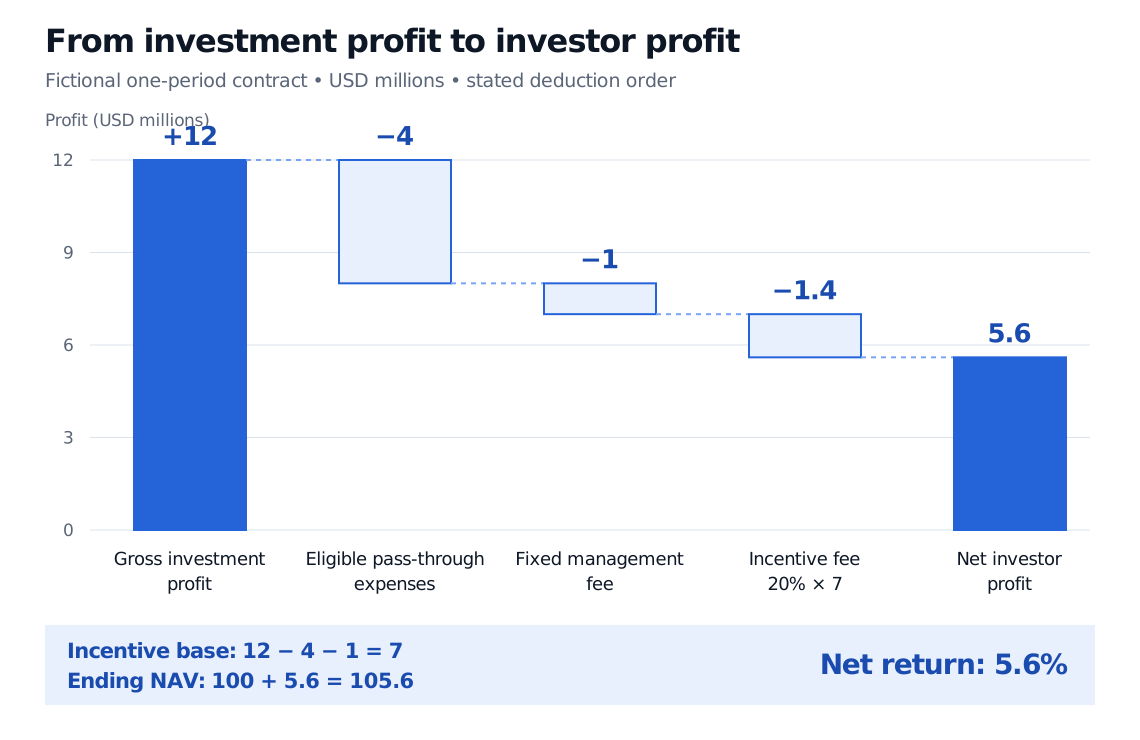
The incentive fee is 1.4, so the three charges total 6.4. The investor's net return, on beginning NAV, is
Rnet=100105.6−100=5.6%.
Compared with the stated 12% gross return, that is a 6.4 percentage-point reduction. The pass-through expense is only one component of that reduction; calling the entire 6.4 a pass-through fee would misclassify the management and incentive fees.
Fictional USD-million profit bridge: gross investment profit 12, eligible pass-through expenses minus 4, fixed management fee minus 1, incentive fee minus 1.4, leaving net profit 5.6. Incentive base is 7; beginning NAV 100 becomes 105.6 and net return is 5.6%.
Original fictional fee bridge. The 20% incentive applies to profit after both prior charges; these amounts and this order are stipulated contract terms, not market averages.
The deduction order matters: applying 20% directly to 12 would use the wrong incentive base for this fictional contract. Actual arrangements may specify different bases, accrual timing, offsets, caps and performance-fee provisions. These illustrative amounts are neither typical market rates nor a forecast.
Do not deduct the same cost twice. If a supplied P&L already includes the expense, it must not be subtracted again merely because it appears in an expense report. Reconcile each charge against the definition of “gross,” the fund's accruals and the final NAV. The same principle applies to transaction costs embedded in trade prices.
Read the expense authority alongside the return
For an actual fund, identify the eligible categories, allocation method, cap base and measurement period, and any waivers or offsets. Then reconcile expense accruals and incentive calculations to the reported NAV. A charge may recur even when investment performance is poor; do not model it as a fixed share of profits unless its terms actually say that.
The SEC staff's 23 June 2020 examination alert, section II.B, records cases of expenses inconsistent with disclosures, expenses not permitted by operating agreements and failures to observe contractual limits. It is historical staff examination evidence, not a new rule or a universal schedule of permitted charges. Contract terms and the applicable legal framework must be assessed for the particular fund.
A pass-through expense also differs from hedge-fund seeding arrangements in which a seed investor receives a share of the management company's revenue. An allocation of manager fee revenue concerns who receives that revenue; it does not, by itself, establish an additional expense charged to fund investors. Nor does “pass-through” here describe the fund's tax treatment.
For the broader cost-accounting discipline, Financing, Borrow and Transaction Costs develops explicit ledgers and double-counting checks. A public preview is available; the full lesson requires membership.