Early capital for a hedge-fund manager in exchange for negotiated economics. Separate fund returns, revenue sharing, equity ownership and withdrawal rights.
Hedge-fund seeding
Hedge-fund seeding is an arrangement in which an early investor supplies capital to support a hedge fund launch or young manager in exchange for negotiated economic benefits. Those benefits can include a share of manager revenues, an equity interest or preferential investment terms. The practical consequence is that a seeder may hold both an investment in the fund and a claim on the manager's business. Each needs its own cash-flow and risk analysis.
This differs from a portfolio manager gradually allocating risk to a new trading signal. It also differs from an ordinary early subscription that receives discounted fees without a continuing claim on the manager's economics. Tages Capital's 2016 account describes fund capital, revenue participation and negotiated fee or capacity benefits as distinct components; its historical terms are examples, not a universal contract.
Follow the money into two ledgers
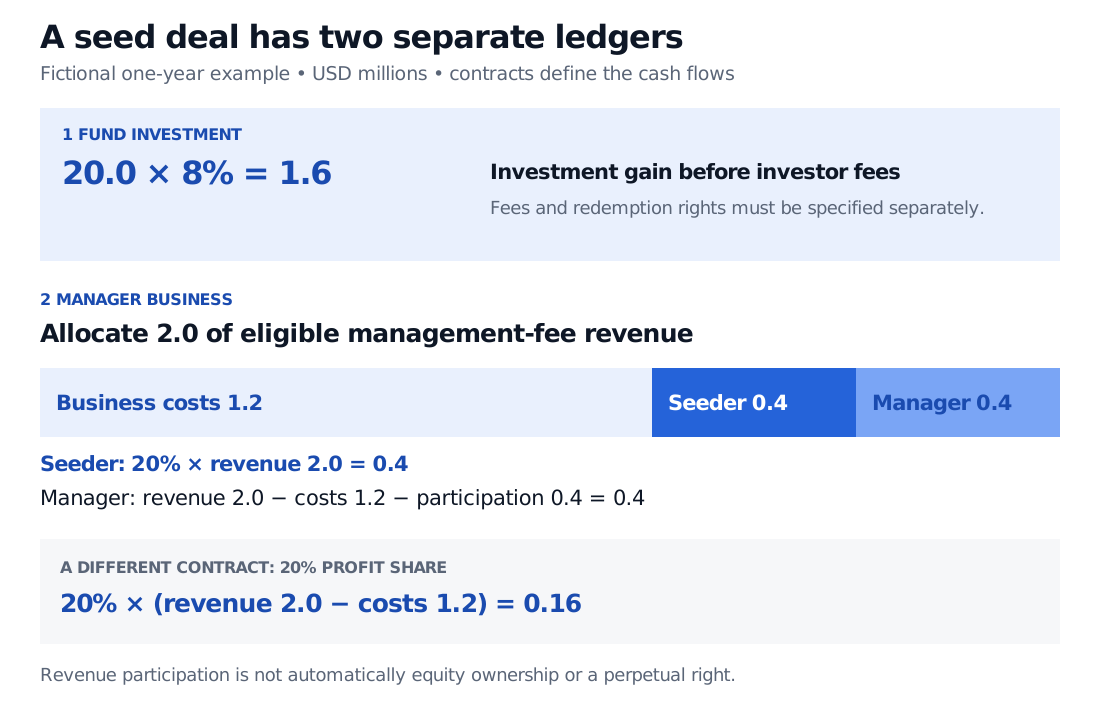
Consider a fictional one-year arrangement. A seeder invests USD 20 million in the fund and, under a separate agreement, receives 20% of specified management-fee revenue earned by the manager. Eligible revenue is USD 2 million for the year. The manager's own business costs are USD 1.2 million. Assume those costs are separate from, and do not reduce, the contractual revenue-sharing base. Exclude taxes, financing and payment delays.
Manager-business item
USD millions
Eligible management-fee revenue
2.00
Business costs
−1.20
Seeder payment: 20% × 2.00
−0.40
Manager residual after costs and participation
0.40
A 20% profit share would be a different agreement. If its specified profit base were revenue less the same business costs, its payment would be 0.20(2.00−1.20)=0.16 million. Calling both arrangements “a 20% stake” hides a material distinction. Under the revenue contract, raising costs to USD 1.8 million leaves the seeder payment at USD 0.4 million and the manager with a USD 0.2 million business loss, assuming no contractual deferral or adjustment.
Now examine the fund investment separately. If the USD 20 million earns a stipulated 8% one-year return before investor fees, its profit and loss is USD 1.6 million. The USD 2 million of eligible manager revenue is a separate input; it has not been derived from the seeder's USD 20 million. It could reflect a broader pool of fee-paying assets, but this example does not specify that pool or a fee rate.
Fictional one-year example in USD millions: fund capital 20 earns 1.6 at 8 percent before investor fees. Manager revenue 2 funds costs 1.2, seeder revenue participation 0.4 and manager residual 0.4. A hypothetical 20 percent profit share would pay 0.16 instead.
Fictional one-year cash-flow comparison, all amounts in USD millions. The fund-investment gain and manager-business payments have separate contractual bases; investor fees, taxes and timing effects are excluded.
Adding the two receipts and quoting a combined investment return would require the actual investor fees, payment dates, any additional business capital and the valuation of the continuing business claim. Neither USD 0.4 million of revenue participation nor USD 1.6 million of fund gains is guaranteed.
A percentage leaves most of the deal unspecified
The Seward & Kissel 2024 study distinguishes revenue participation from direct equity ownership and describes negotiated lock-ups, buyouts and termination provisions. Its observations concern its historical transaction sample, which was concentrated among institutional seeders; they do not establish the terms of a new deal.
Read the agreement for these separate questions:
What income is shared? Define eligible products, management versus incentive fees, exclusions and any permitted deductions. A revenue percentage does not automatically convey the same percentage of voting equity.
When can fund capital leave? A lock-up, notice period, gate and exceptional release provision affect liquidity risk. Expiry of a lock-up need not mean immediate payment.
When does participation end? Fund redemption and the business claim may have different lives. Check any sunset, continued-investment condition, buyout right and pricing mechanism rather than assuming perpetual payments.
Seeding can also include working-capital support for the management business, separate from money invested in the portfolio. The study discusses several forms, including revenue-share deferral. A fund subscription alone should not be treated as unrestricted cash available to pay the manager's staff.
Underwrite the manager as well as the strategy
A viable revenue claim depends on fee-paying assets under management, retention and an operating business able to deliver the strategy. Portfolio losses and investor withdrawals can damage both legs together. A gross-revenue share also creates a different cost exposure from an equity claim: the manager bears the residual operating-cost burden in the example.
The seeder's preference for asset growth can conflict with the strategy's capacity constraints. Preferential fees, information or liquidity rights also warrant scrutiny alongside the treatment of other investors. These are issues to evaluate in the specific agreements and disclosures, not rights implied by the word “seeding.”
Ewald and Zhang's 2016 model, §3.2, explicitly separates a seeder's fund-investment claim from its allocated fee claim. Its valuation rests on model assumptions, including diversification of the seeder's idiosyncratic risk; it does not supply a market price for every seed contract.
Manager selection also needs an honest comparison set. The survivorship section of Performance Persistence and Survivorship Bias explains why excluding closed funds can flatter historical results. Its preview is public; the full lesson requires membership. That is a track-record assessment extension, rather than a guide to structuring a seed agreement.
Tages Capital — Hedge Fund Seeding, June 2016, pp. 3–4 and 7–8: separate sources of returns, negotiated transaction terms and contractual protections. An industry participant's historical analysis, not an independent return forecast.