Hasbrouck pricing-error variance is the variance of the stationary deviation of a transaction price from its latent efficient price. It measures transitory pricing dispersion: a smaller value means transactions track that benchmark more closely. The efficient price is unobserved, so estimating the dispersion requires a model. Hasbrouck (1993), §1
Write the decomposition as
Hasbrouck uses log transaction prices, a random-walk efficient component , and a zero-mean stationary error . His general model permits serially dependent errors and correlation with efficient-price innovations. §1
Why a price change contains two errors
Consider a deliberately simpler dollar-price toy, indexed by transactions. Stipulate
where efficient innovations are independent across time, have mean zero and standard deviation USD 0.02 per share. Let errors be independent and identically distributed, with mean zero and standard deviation USD 0.03 per share, independent of every . These assumptions are supplied, not discovered from prices.
The pricing-error variance is
Its square root is USD 0.03 per share, equivalent to 3 basis points at a fixed reference price of USD 100. That conversion describes the error's standard deviation, not a quoted transaction charge.
A transaction-price change is a different random variable:
The current and previous errors both vary. Independence makes their variances add even though one enters with a minus sign:
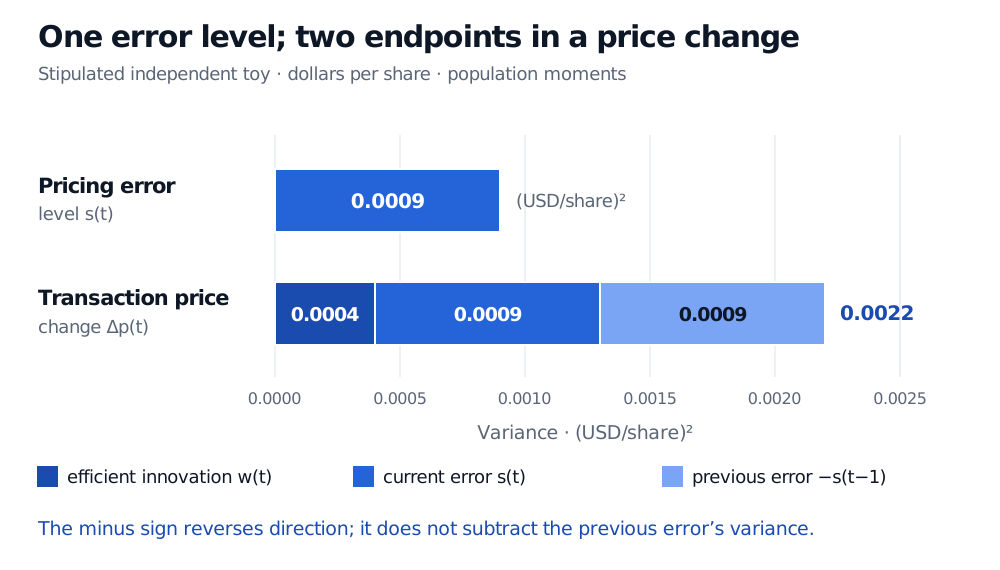
Original stipulated toy, not fitted market data. All variances use (USD/share)². Independent error levels enter a price difference twice; both add to its variance.
The same previous error enters consecutive changes with opposite signs. Every other cross-term has zero expectation, giving
Here, minus the lag-one covariance recovers the stipulated error variance. This shortcut depends on the independence assumptions above. If errors persist or co-move with information, the discarded covariance terms need not vanish. Computing a negative sample covariance alone does not validate the toy.
What the Hasbrouck estimation adds
Hasbrouck fits a vector autoregression (VAR) of price changes and trade variables, then converts it into a moving-average representation in innovations. Tail sums of the price-change response coefficients recover the Beveridge–Nelson (BN) transitory component; its variance uses the innovations' covariance matrix. This is not the variance of the VAR's one-step residual.
The BN estimate is a lower bound on pricing-error variance under the model: additional error orthogonal to the conditioning variables can remain. Including trades can strengthen the bound. Lag truncation and price discreteness matter. Hasbrouck (1993), §§2–5
For a reported estimate, ask which variables and lags were included, whether prices were in dollars or logs, and whether the result is a variance or its square root. Comparing 0.0009 (USD/share)² with 3 bps would mix both units and transformations. A transaction-minus-observed-midpoint residual also changes the benchmark; it does not reveal the latent efficient price by definition.
Read the number as dispersion
A bid-ask spread is a quote gap; an effective spread compares a signed execution with a midpoint. Neither definition is a variance. Three bps of error standard deviation does not by itself specify an expected per-trade cost. Spread Measurement develops those spread conventions and the Roll benchmark; its preview is public and the full lesson requires membership.
Hasbrouck information share instead attributes efficient-price innovation variance across markets. It answers where price discovery occurs, rather than how dispersed transitory errors are. Hasbrouck (1995), introduction
Sources
- Hasbrouck, J. (1993), Assessing the Quality of a Security Market: A New Approach to Transaction-Cost Measurement, Review of Financial Studies 6(1), 191–212. §§1–2 define the decomposition and identification problem; §§3–5 develop trade conditioning, VAR estimation and limitations. Readable paper text.
- Hasbrouck, J. (1995), One Security, Many Markets: Determining the Contributions to Price Discovery, Journal of Finance 50(4), 1175–1199. The introduction distinguishes information shares from transitory pricing errors.