The Global Master Repurchase Agreement (GMRA) is a standard contract under which two parties can enter into multiple repurchase agreements without renegotiating the common terms for each trade. The agreement defines which trades can be assessed together for margin and close-out netting. For a counterparty exposure model, the signed agreement determines which trades belong in the same group. ICMA’s guide to the GMRA
Where each term is recorded
ICMA lists the 2011 GMRA as the latest standard edition. The contract that governs a relationship is the version the two parties entered into, together with the annexes and amendments they agreed. ICMA’s guide to the GMRA
| Document | What it covers |
|---|---|
| Master agreement | Shared provisions for title transfer, settlement, margin, and default and close-out. The single-agreement clause connects the covered trades into one contractual relationship. |
| Annex I and incorporated annexes | Annex I records elections and supplemental terms such as the base currency for netting and the time allowed to deliver margin. The parties can incorporate additional annexes for specific products or arrangements. |
| Trade confirmation | Records the terms of one repo, including the securities, purchase price and currency, dates or on-demand terms, and pricing rate. Annex II provides a model confirmation. |
From a trade confirmation to a cash flow
In a hypothetical seven-day repo, the seller transfers securities for USD 1,000,000. The parties agree to a simple 4% annual pricing rate and an ACT/360 day-count convention, which divides actual elapsed days by 360. With normal settlement and no other payments, the price differential is USD 777.78, rounded to cents, and the seller pays the following amount in exchange for equivalent securities at maturity.
The standard form provides for title to pass on transfer and for equivalent securities to be delivered on the return leg. Economically, the exchange provides secured funding. The interest above accrues on cash advanced. An agreed collateral haircut affects how much cash the securities raise at the start. While the repo is open, revaluation can create net exposure across covered trades and give the exposed party a right to call for cash or securities under the agreed margin terms. GMRA 2011, paragraphs 2–4 and 6
For a worked haircut calculation, see the Margin and Collateral lesson. The preview is public and the full lesson requires membership.
What gets netted at close-out
Under the 2011 form, if an event of default occurs and is continuing, the non-defaulting party can designate an early termination date by notice. The parties can also elect automatic early termination for specified insolvency events. At early termination the outstanding repos under that agreement come due. The close-out calculation values the securities obligations, accounts for cash obligations and outstanding margin, and offsets the amounts in a common currency to produce one balance. ICMA’s repo default FAQ
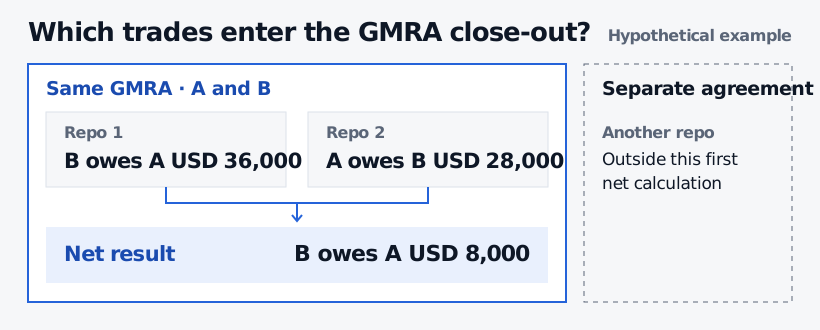
The first close-out balance offsets valued obligations under the same GMRA. A separate agreement sits outside this calculation.
The diagram illustrates the balance under paragraph 10(d), before any separate set-off under paragraph 10(n), which the non-defaulting party may invoke for qualifying amounts owed in the opposite direction under another agreement. Whether close-out netting can be enforced in insolvency depends on the relevant laws, counterparty type and signed terms, including material amendments. ICMA’s 2026 legal-opinion coverage tables distinguish jurisdictions, counterparty types and annexes. GMRA 2011, paragraph 10, ICMA’s legal-opinion coverage