Funds from operations (FFO) is a supplemental earnings measure for U.S. equity real estate investment trusts (REITs). Nareit FFO starts with U.S. GAAP net income and reverses specified real estate accounting items, including qualifying depreciation and amortisation and gains or losses on qualifying property sales. It helps compare operating performance across periods when book depreciation or a building sale has a large effect on reported profit. Nareit, FFO White Paper, December 2018
Why the two adjustments have opposite signs
Depreciation reduced GAAP profit, so add back the qualifying charge. A qualifying sale gain increased profit, so subtract it. A qualifying sale loss would go the other way. The depreciation add-back reverses an allocation of historical cost. Market values and the cash needed to keep a building lettable are separate questions. Under Nareit's December 2018 restatement, certain impairments and gains or losses from changes in control are also excluded, and the reconciliation adjusts for FFO from partially owned entities where applicable. Ordinary non-real-estate depreciation, such as that on company office equipment, remains an expense. Nareit, FFO White Paper, definitions and sections IV–V
A fictional equity REIT reports GAAP net income of USD 30 million, including USD 20 million of qualifying depreciation and a gain of USD 8 million on the sale of a rental building from its operating portfolio. Assume no other FFO adjustments.
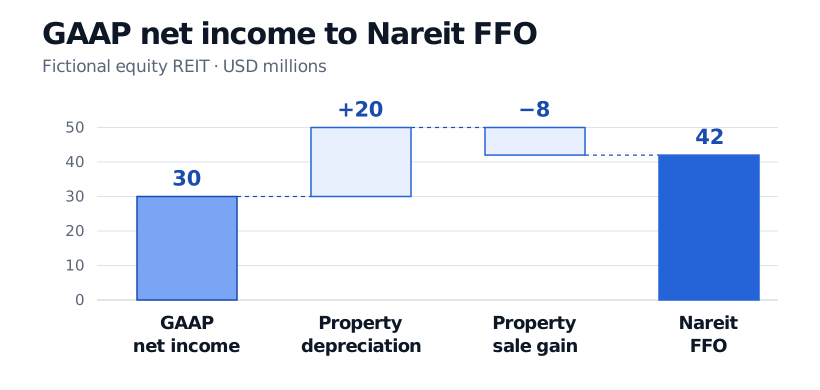
The depreciation expense and the sale gain moved GAAP earnings in opposite directions, so their reversals do too.
Follow the reconciliation past FFO
Adjusted funds from operations (AFFO) is an issuer- or analyst-defined measure that makes further adjustments to FFO, often for recurring capital spending and non-cash rent accounting. Definitions vary. Kite Realty Group's first-quarter 2026 supplement, for example, adjusts for straight-line rent in Core FFO, then deducts maintenance and qualifying tenant-related capital expenditures to reach its recurring AFFO. Read the actual adjustment schedule, even when two issuers use the same label. Nareit, Adjusted Funds from Operations, Kite Realty Group, Q1 2026 financial supplement, p. 7
In the fictional REIT, suppose GAAP rent was 60 and cash rent was 58 because of straight-line rent recognition. Other operating expenses were 18, with 20 paid in cash because the REIT also settled a bill from a prior period. With no other operating cash flows, cash flow from operating activities (CFO) is million. If the REIT defines AFFO by removing the 2 of straight-line rent and deducting 6 of recurring capital spending, its AFFO is million. CFO reflects the prior bill payment. This AFFO definition keeps accrued expenses and deducts the capital spending, an investing cash outflow in the cash flow statement. Kite Realty Group, Q1 2026 Form 10-Q, consolidated statements of cash flows
To assess how much cash can reach common owners, start with reported cash flows and check required reinvestment, debt principal due and cash claims senior to common distributions. For peer valuation, a price-to-FFO multiple divides the share price by FFO per share. Compare the same period and dilution basis, and check whether the numerator covers common shareholders alone or also operating partnership units. The name FFO can also refer to a separately defined credit-analysis measure, as in S&P Global Ratings' corporate research. Nareit, FFO White Paper, sections IV and V.G, Nareit, EBITDA for Real Estate White Paper, p. 1, S&P Global Ratings, Global Nonfinancial Corporate Medians History and Outlook, p. 69
What SEC staff guidance says about per-share FFO
SEC staff accepts Nareit's definition in effect on 17 May 2016 as a performance measure, including when presented per share under the applicable non-GAAP rules. The December 2018 Nareit paper consolidated and clarified the industry's guidance. For issuer variants, the adjustments determine whether the measure functions as performance or liquidity. The staff guidance bars a non-GAAP measure of cash generated from being shown per share in documents filed with or furnished to the SEC. Item 10(e) requires a reconciliation and equal or greater prominence for the most directly comparable GAAP measure in covered filings. Regulation G also governs public non-GAAP disclosures, including materially misleading presentations. SEC staff, Non-GAAP Financial Measures, Questions 102.01, 102.02, 102.05 and 102.10, Regulation S-K, Item 10(e), Regulation G, Rule 100
Sources
- Nareit, Funds From Operations White Paper, December 2018
- Nareit, Adjusted Funds from Operations glossary
- Nareit, EBITDA for Real Estate White Paper, September 2017
- Kite Realty Group, Q1 2026 financial supplement and Q1 2026 Form 10-Q
- S&P Global Ratings, Global Nonfinancial Corporate Medians History and Outlook, midyear 2024
- SEC staff, Non-GAAP Financial Measures Compliance and Disclosure Interpretations
- Regulation S-K, Item 10(e) and Regulation G, Rule 100