The fair value hierarchy classifies an accounting fair value measurement by how observable its significant inputs are at the measurement date. The level helps a reader see where the reported mark comes from and which inputs to scrutinise. IFRS 13 and US GAAP Topic 820 use the same core ordering. IFRS 13, paragraphs 72–90 · FASB ASC Topic 820
- Level 1. Use the price quoted for the identical asset or liability in an active market that the reporting entity can access at the measurement date. Trading must be frequent and substantial enough to keep producing price information. A qualifying quote is used without adjustment, subject to specified exceptions.
- Level 2. The measurement uses other observable evidence, directly or indirectly. Examples include active-market quotes for similar instruments and relevant yield curves backed by market data. For an instrument with a contractual term, a Level 2 input must be observable for substantially the full term.
- Level 3. At least one input that matters to the overall measurement is unobservable. The reporting entity estimates what market participants would assume using the best available information, including evidence that could change its own estimate.
Classify the whole measurement by the lowest-priority input that is significant to it. That is the highest level number among its significant inputs. Significance requires judgement about the effect on the measurement as a whole. For instance, an observable price for a similar instrument can still lead to Level 3 if valuing the actual instrument requires a significant unobservable adjustment. IFRS 13, paragraphs 72–75 and 81–89 · FASB amendments introducing ASC 820-10-35-37A and 35-38A
Three marks of USD 100
- Listed share, Level 1. The identical unrestricted share is quoted at USD 100 in the active principal market, which the reporting entity can access on the measurement date. The entity uses that price without adjustment.
- Fixed-payment claim, Level 2. There is no qualifying quote for the claim, which contractually pays USD 105 in exactly one year. An observable benchmark curve and market-corroborated spreads support a 5% annual effective discount rate. The curve is observable over the claim's term and there is no significant unobservable input.
- Contingent claim, Level 3. There is no qualifying quote for a claim whose sole payment, due in one year, depends on a project's outcome. The market-participant estimate of the expected payment is also USD 105. That projection is unobservable and significant. Assume the appropriate risk-adjusted annual effective discount rate of 5% is observable for this claim too.
Both models produce the same present value. Holding the discount rate fixed, a lower expected payment of USD 94.50 would move the third mark to USD 90.
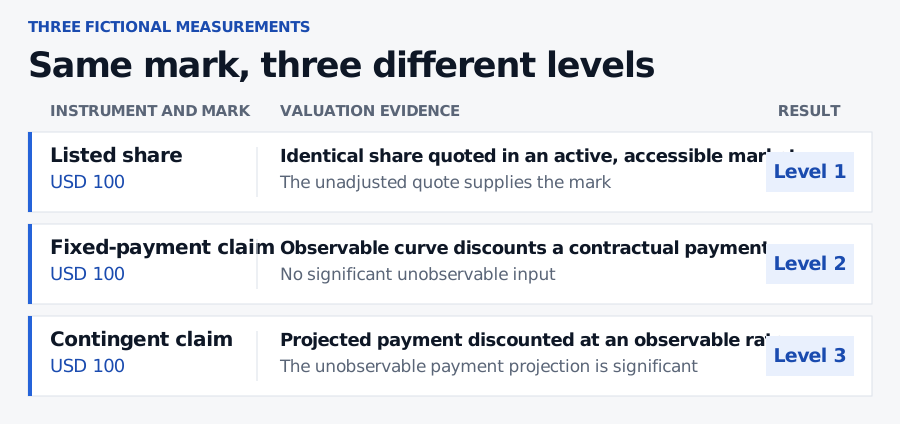
The two models use the same discount rate. Only the contingent claim depends on a significant unobservable payment projection.
For the curve behind the second mark, SelfMadeQuant’s Bootstrapping the Spot Curve from Market Instruments shows how quotes on traded instruments imply discount factors. The preview is public and the full lesson requires membership.
What a change in level tells you
A drop in trading activity calls for a closer look at how current and representative the available quotes are. It does not by itself make the measurement Level 3. For example, a significant event after market close but before the measurement date can make an otherwise qualifying quote unrepresentative. If the quote is adjusted for that event, the resulting measurement falls below Level 1. Which level applies depends on the evidence used in the adjustment. IFRS 13, paragraph 79 and B37–B42 · FASB amendments introducing ASC 820-10-35-41C and 35-54C through 35-54H
When a position moves levels, read the valuation note for the input or market evidence that changed. An actively quoted bond can be Level 1 even if its issuer faces a high risk of default. The level describes the evidence behind the mark. A credit rating addresses default risk, and a confidence interval would require a separate analysis.
Sources
- IFRS Foundation, IFRS 13 Fair Value Measurement, 2026 issued text for the hierarchy in paragraphs 72–90, the active market definition in Appendix A, and declining market activity in B37–B42.
- FASB Accounting Standards Codification, Topic 820 for the US GAAP hierarchy in ASC 820-10-35-37 through 35-54A. FASB ASU 2011-04 shows the amendments that established the common hierarchy.