A dual-listed company (DLC) structure has two separately listed legal parent companies that agree by contract to operate as one economic enterprise. The parents keep their own shares and shareholder registers. Their agreement specifies how shareholders on each side participate in the combined business, including how covered distributions and voting rights are coordinated. For a quant comparing the two shares, the agreement supplies the economic units to compare before measuring a price spread. BHP's December 2021 Shareholder Circular, §2.1.1.
A secondary listing can put shares of a single issuer on another exchange. An American depositary receipt (ADR) represents an interest in shares deposited with a bank, via American depositary shares. In a DLC, each set of ordinary shares is issued by a different parent. The issuer behind each share matters more than the number of exchanges where it trades. SEC investor bulletin on ADRs.
How the equalisation ratio works
Suppose a fictional agreement assigns one B share half the economic units of one A share and uses that ratio for a covered cash dividend. Express both amounts in USD before withholding and investor-level taxes. If the gross dividend is USD 2 per A share, the equivalent gross dividend per B share is
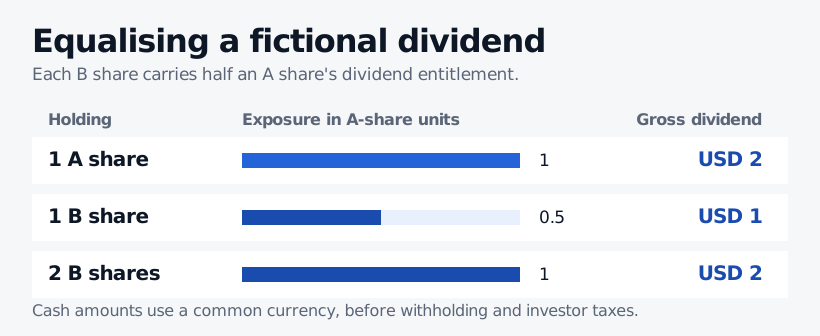
Two B shares match one A share's gross dividend in the example. The bars show economic exposure in A-share units.
The same unit conversion gives a price comparison. After converting quotes to a common currency at the same observation time, compare the price of one A share with the combined price of two B shares. Check whether both quotes carry the same dividend entitlement around the ex-dividend date. Equal gross dividends can leave investors with different after-tax cash. Where the shares cannot be exchanged for each other, the spread can persist or widen. A long–short position can incur borrow costs or be forced to close before convergence, so the price gap alone is insufficient to establish arbitrage. de Jong, Rosenthal and van Dijk's study of DLC spreads.
The Financing, Borrow and Transaction Costs lesson shows how to model borrow availability, recall and dividend obligations on the short leg. The preview is public and the full lesson is for members.
BHP's structure before and after unification
From June 2001 to January 2022, BHP Group Limited and BHP Group Plc had separate boards staffed by the same directors and operated under one management team. Their sharing agreement set a one-for-one equalisation ratio. A special dividend share let Limited fund matching cash dividends at Plc when needed. For designated joint matters, a special voting share at each parent carried votes from the other parent's meeting, effectively pooling the votes. BHP's 2021 circular reported that Plc shares had generally traded below Limited shares even in a common currency. It identified differences between markets and the tax credits attached to Limited dividends as possible explanations. BHP's Shareholder Circular, §§2.1.1 and 5.3.4, and the independent expert's report, §5.
On 31 January 2022, BHP completed unification. BHP Group Limited became the sole parent and issued one Limited ordinary share for each Plc ordinary share exchanged. The FY2022 report still listed trading in Limited shares in Australia, London and Johannesburg, with depositary receipts in New York. The two-parent structure had ended while investors could still access the remaining parent's equity through several markets. BHP's FY2022 Form 20-F, §§9.1–9.3 and Note 16.
Sources
- BHP, December 2021 Shareholder Circular on Unification details the former agreement and its price and voting implications.
- BHP, FY2022 Annual Report on Form 20-F records the completed unification and post-unification listings as of the report date.
- SEC, Investor Bulletin on American Depositary Receipts explains how receipts relate to deposited shares.
- de Jong, Rosenthal and van Dijk, The Risk and Return of Arbitrage in Dual-Listed Companies (2009) documents spread volatility and uncertainty over the time to convergence.