A designated market maker (DMM) is a market maker assigned by an exchange to particular securities, with formal responsibilities under that exchange's rules. On the New York Stock Exchange (NYSE), the role combines quoting, liquidity provision and facilitating auctions. For a quant, designation changes the problem: a dealer's trading decisions must satisfy market responsibilities as well as manage its own inventory and execution economics.
The NYSE assigns one DMM to each NYSE-listed security. Its current participant overview describes fair and orderly market responsibilities and both manual and electronic participation. This is a specific exchange role within the broader activity of market making. A firm posting bids and offers elsewhere does not thereby become an NYSE DMM; similarly named roles on other venues need their own rule analysis.
What designation adds
Three parts of the NYSE role matter when interpreting a quote or an auction print:
- Quoting: the exchange's November 2025 regulatory memo identifies Rule 104 among the rules imposing a continuous two-sided quotation obligation. Displayed trading interest and the applicable normal trading unit matter; “two-sided” is more specific than occasionally executing a buy and a sell.
- Opening and reopening: Rule 7.35A governs DMM-facilitated core opens and trading-halt auctions. The February 2026 SEC notice, describing that rule, pairs timely opening or reopening with avoiding undue haste. An auction is a price-discovery process, particularly when supply and demand have shifted.
- Closing: the NYSE's March 2026 reminder, §II.C states the duties to select a closing auction price satisfying better-priced orders on the imbalance side and maintain a fair and orderly market under Rule 104. These are responsibilities within an auction rule, rather than freedom to choose any convenient closing price.
The role also carries a defined place in the venue's allocation mechanism. The NYSE's October 2026 explanation, §3.1 connects enforceable liquidity duties with its parity model and rule-bound human judgement. Designation therefore concerns both obligations and participation rights. It does not make the DMM the counterparty to every transaction or the sole source of liquidity.
A liquidity obligation is not an unlimited guarantee to execute every order, absorb every imbalance or prevent prices falling. An auction market still has order eligibility, price formation and allocation rules. The SEC's February 2026 closing-auction notice describes constrained price selection and a narrowly defined ETP exception, illustrating why “facilitate the close” cannot mean unrestricted discretion.
A positive spread contribution can leave more inventory
Consider a fictional dealer ledger, using USD per share. Start with 200 shares, buy 100 at 49.99, and sell 80 at 50.01. Hold the valuation midpoint fixed at 50.00 throughout. The assumed fills illustrate balance-sheet consequences; they do not establish that an NYSE auction occurred or that any quoting obligation was met.
| Item | Change |
|---|---|
| Shares | |
| Cash | USD |
| Inventory value at the fixed midpoint | USD |
| Marked wealth: cash plus inventory value | USD |
Ending inventory is 220 shares. Pairing 80 bought shares with the 80 sold shares attributes USD 1.60 to the two-cent bid–ask spread. The remaining 20 newly bought shares contribute USD 0.20 when marked one cent above their purchase price. Together these give the USD 1.80 wealth change before fees, rebates, financing and hedging costs. Pairing is an explanatory attribution, not a claim about the firm's inventory accounting method.
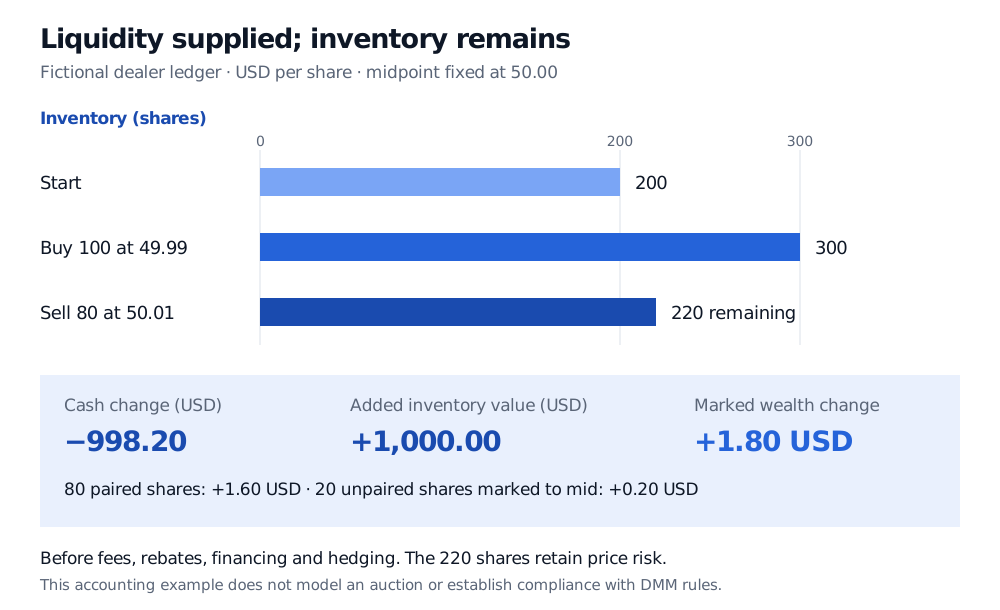
Original fictional inventory ledger, not an auction simulation. A positive spread contribution coexists with 220 shares of continuing price exposure.
The fixed midpoint makes the arithmetic transparent, but does not remove inventory risk. With no further trades or hedges, a subsequent ten-cent price fall reduces the value of the full 220-share position by USD 22. The initial 200 shares remain exposed too. Future fills and prices are uncertain, so today's positive mark is not a promised final profit.
How to use the label in a model
Keep the institutional role, trading phase and position ledger separate. A DMM assignment identifies an accountable participant; an auction flag identifies a matching process; cash and inventory determine economic exposure. None alone establishes the others.
In a backtest, do not grant a strategy fills merely because a DMM was present. Represent the relevant orders, auction eligibility and allocation, then update cash and inventory for the fills actually assumed. A model of dealer risk also needs price changes and adverse selection: liquidity can be supplied just before information moves the market against the dealer.
For the underlying distinction between a principal and a client agent, Market Participants has a public preview; the full lesson requires membership.
Sources
- NYSE Equities, “Market Participants — Designated Market Maker”: assigned securities, orderly markets and manual/electronic participation.
- NYSE, The busiest room on Wall Street, 26 October 2026, §3.1: enforceable duties and the allocation model.
- NYSE RM-25-12, 3 November 2025: Rule 104 quotation obligations and the round-lot change operative that day.
- NYSE RM-26-03, 20 March 2026, §II.C: closing-price and fair-and-orderly-market duties.
- SEC Release 34-104856, 18 February 2026, background to Rule 7.35A; SEC Release 34-104887, 25 February 2026, background to Rule 7.35B and the ETP amendment. These are dated rulemaking notices, not a consolidated current rulebook.