The Commitment of Traders report refers to the U.S. Commodity Futures Trading Commission’s (CFTC) Commitments of Traders (COT) reports. These public snapshots break down open interest in covered futures markets by trader category. A researcher can use it to track whether a group such as managed money is becoming more or less net long, then test how that positioning relates to later returns. The relevant clock for that test starts when the snapshot becomes public. CFTC reports and staff FAQ
Pick the series before reading the number
Open interest counts outstanding contracts on one side of the market. Each open long has a matching short. Trading volume counts contracts traded over a period. The CFTC generally publishes a market when at least 20 traders meet its reporting threshold for that market. In the main reports, nonreportable longs and shorts are calculated separately by subtracting the corresponding reportable positions from total open interest. They form a residual with no published breakdown by trader type. CFTC staff FAQ · Legacy explanatory notes
| Report | Coverage and reportable categories |
|---|---|
| Legacy | Markets grouped by exchange, with commercial and non-commercial traders. |
| Disaggregated | Physical commodity markets, with Producer/Merchant/Processor/User, Swap Dealers, Managed Money and Other Reportables. |
| Traders in Financial Futures (TFF) | Financial markets such as currencies, Treasury futures and equity indexes, with Dealer/Intermediary, Asset Manager/Institutional, Leveraged Funds and Other Reportables. |
| Supplemental | Selected agricultural markets, with commercial, non-commercial and Index Traders. Available only in the combined format. |
The Legacy, Disaggregated and TFF reports each have a futures-only version and a futures-and-options-combined version. The combined version converts options into futures-equivalent positions using exchange-supplied delta factors. A long put contributes to the short futures-equivalent side. Changing deltas can move the combined series even when the number of options held stays the same. Keep the contract market code, report family, category and futures-only or combined basis consistent across dates. CFTC report types · CFTC calculation notes
Still net long, by 2,000 fewer contracts
Take two fictional Disaggregated Futures Only rows for Managed Money in the same contract market. Subtract the published short column from the long column.
| Position date | Long contracts | Short contracts | Net contracts |
|---|---|---|---|
| First Tuesday | 12,000 | 9,000 | +3,000 |
| Second Tuesday | 11,000 | 10,000 | +1,000 |
The net change is contracts. The group remains net long. The fall combines 1,000 fewer reported longs and 1,000 more reported shorts. Where the report has a spreading column, it contains matched long and short positions. Adding the spread to both sides leaves the net unchanged. CFTC Disaggregated explanatory notes
A trader category reflects the trader's business activity. A producer's reported positions can include both hedging and speculation. A change between snapshots may also reflect traders entering or leaving the reportable group or a change in classification. The snapshots show the group's reported holdings and leave the trades and motives behind the change unidentified. For the mechanics of how trades change outstanding positions, see Futures Mechanics (full lesson with membership). CFTC staff FAQ
Use the release clock in a backtest
As of 8 November 2026, the CFTC's posted schedule still showed the usual weekly cycle. Positions are typically measured at Tuesday's close and published Friday at 3:30 p.m. U.S. Eastern time. Holidays and publication disruptions can move those dates. On 27 October 2026 the CFTC announced a plan to begin publishing twice weekly by year-end. The announced schedule pairs Monday positions with Wednesday publication and Wednesday positions with Friday publication, both at 3:30 p.m. Eastern time. CFTC release calendar · CFTC semiweekly announcement · CFTC notices on disruptions
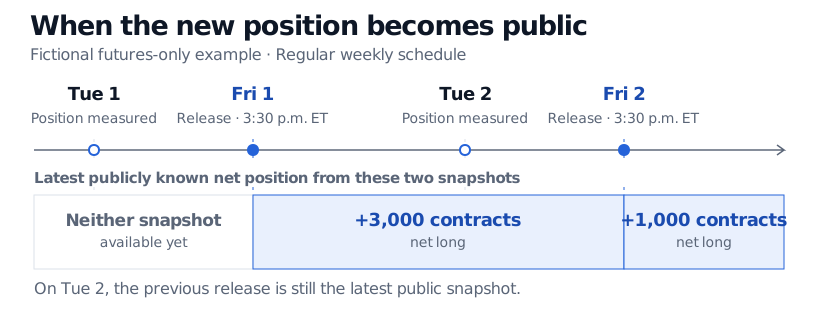
The fictional second snapshot is measured on Tuesday. The first snapshot stays the latest public figure until the second Friday release.
In a backtest, giving Tuesday's new number to a Tuesday decision introduces look-ahead bias. Keep the position date and actual public release time in separate fields. The CFTC's historical report listings use the position date. If your model consumes a vendor feed, the number becomes usable when that feed delivers it and your system can process it. CFTC historical reports
The current staff FAQ says historical data is generally left as published. The CFTC's archive nevertheless documents specific corrections and historical replacements, and some early Disaggregated rows were reconstructed with later trader classifications. Preserve original and corrected versions where you can verify them. A correction becomes eligible only when it was released and usable. If you only have a current download, document any historical periods for which you cannot establish the version available at the time. The Point-in-Time Data lesson (full lesson with membership) works through that version-selection rule. CFTC staff FAQ · Historical special announcements · Disaggregated historical data notes