Channel stuffing is pushing distributors or retailers to buy more stock than near-term demand supports, often through quarter-end discounts or other incentives. Bill-and-hold is an arrangement in which the seller bills the customer and keeps the goods for later delivery. Channel stuffing can make the seller’s sales growth look stronger than end demand. For bill-and-hold, the revenue recognition question is when the customer obtained control of the goods. SEC, Bristol-Myers Squibb litigation release · FASB, ASC 606-10-55-81 through 55-84
The distributor has the goods
Sell-in is the supplier’s sale to the distributor. Sell-through is the distributor’s sale to its customers. A distributor may order early to build seasonal stock or protect against a supply interruption. If it takes control under a qualifying contract, the supplier can recognise the sale before the distributor resells the goods. Excess sell-in can still lift this quarter’s revenue and leave fewer orders next quarter while the channel works through its stock. FASB, ASC 606-10-25-30 and 55-79 through 55-80 · Bristol-Myers Squibb, 2004 Form 10-K, MD&A
The contract terms can change both the timing and the amount. If the supplier can redirect the goods and the distributor owes nothing unconditionally, those are signs of consignment. If the supplier retains control, delivery to the distributor earns no revenue. If control has passed but the buyer has a right of return, the seller excludes expected returns from revenue, applies the constraint on variable consideration, and records a refund liability and an asset for its right to recover returned goods. Side agreements and customary concessions can matter alongside the purchase order. FASB, ASC 606-10-32-5 through 32-13, 55-22 through 55-29 and 55-79 through 55-80 · IFRS 15, paragraphs 50–59, B20–B27 and B77–B78
The seller still has the goods
For a point-in-time sale, ASC 606 and IFRS 15 both look at evidence of control, such as a present right to payment, legal title, physical possession, significant risks and rewards, and customer acceptance. Bill-and-hold revenue before physical delivery requires that assessment and all four additional conditions. FASB, ASC 606-10-25-30 and 55-81 through 55-84 · IFRS 15, paragraph 38 and B79–B82
- There is a substantive reason to hold the goods, such as a customer request while its installation site is being prepared.
- The specific goods are separately identified as the customer’s.
- The goods are ready for immediate physical transfer.
- The seller cannot use them or send them to another customer.
When control has passed, the seller may still owe the customer a storage service. If that service is a separate performance obligation, the seller allocates part of the price to it and recognises that revenue as it provides the service. In its 2025 Form 10-K, Broadwind describes recognising revenue from qualifying bill-and-hold sales once manufacture is complete and the customer has accepted the product. FASB, ASC 606-10-55-84 and Example 63 · IFRS 15, B82 · Broadwind, 2025 Form 10-K, Revenue Recognition
Ten crates at quarter-end
In a fictional qualifying contract, the supplier bills for ten crates at USD 100 each. Each crate has an inventory carrying cost of USD 60 and transfers separately at a point in time. Assume fixed prices, no returns, no separate service and no inventory write-down. At the close, the customer has received and controls six crates. The other four are still with the seller at its own direction, with no substantive reason for a bill-and-hold arrangement. The seller still controls those four.
The four held crates remain in the seller’s inventory at USD 240. Booking all ten as sold would overstate this quarter’s revenue by USD 400 and gross profit by USD 160, and understate inventory by USD 240. If control of the four passes next quarter at the same price, the error has pulled that quarter’s contribution forward. Billing, collection and recognition under accrual accounting can occur on different dates. IFRS 15, paragraphs 31 and 38 · IAS 2, paragraph 34
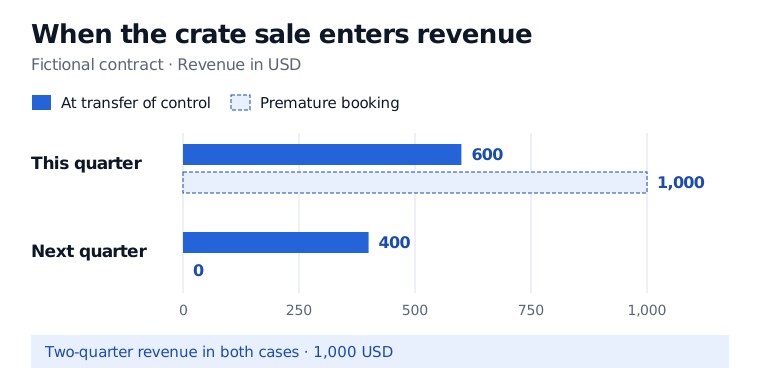
Booking four crates early moves USD 400 between quarters. The comparison assumes the customer takes control of those four next quarter and there is no double counting.
What the filings can tell you
Start with the revenue footnote and management’s discussion of sales. If the issuer reports sell-through or distributor stock, compare it with sell-in for the same products and season. Look for evidence such as quarter-end volume spikes alongside slower end sales, unusually generous credit terms, or a jump in subsequent returns. Rising receivables alongside weak collections can reinforce a concern, but ordinary payment timing can produce the same pattern. Distributor stock that the distributor controls will generally be absent from the supplier’s inventory balance. An analyst can use these patterns to test how much of a sales increase is likely to persist. Establishing premature recognition takes evidence about the terms and control at the reporting date. Bristol-Myers Squibb, 2004 Form 10-K, MD&A and Note 1 · FASB, ASC 606-10-25-30 and 55-79 through 55-84
In its 2004 settled civil fraud action against Bristol-Myers Squibb, the SEC alleged the company pushed excess stock into its wholesale channel and improperly booked revenue on certain shipments to two wholesalers. The SEC described the sales as consignment-like because, among other things, the company covered carrying costs and guaranteed the wholesalers a return until they resold the goods. The company restated its financial statements to correct the timing of those sales and settled without admitting or denying the SEC’s allegations. SEC, Litigation Release 18820 · SEC, Bristol-Myers Squibb complaint · Bristol-Myers Squibb, 2004 Form 10-K, MD&A
In the SEC’s 2001 Sunbeam order, the Commission found that Sunbeam induced customers to place orders early, held the products and often let customers return unsold goods. It concluded that the resulting bill-and-hold sales failed the accounting requirements then in force. Sunbeam consented to the order without admitting or denying the findings, except as to jurisdiction. For SEC registrants, Topic 606 superseded the earlier SEC bill-and-hold criteria upon adoption. SEC, Sunbeam cease-and-desist order · SEC, 2017 bill-and-hold interpretive release
Sources
- FASB Accounting Standards Codification, Topic 606 and FASB ASU 2014-09, Section A, the original issuing text for the cited US GAAP paragraphs.
- IFRS 15, Revenue from Contracts with Customers, 2026 issued text and IAS 2, Inventories, 2026 issued text.