Alpha capture programmes collect and score human trade ideas. Learn how timestamps, shadow portfolios and contributor credit differ from executed net performance.
Alpha capture programmes
Alpha capture programmes are structured processes for collecting human investment ideas, recording their provenance and assessing their subsequent performance. A broker, analyst or other eligible contributor supplies a trade idea; the recipient can evaluate the contributor and use the information in investment decisions. The quant problem is to turn opinions into a comparable, time-stamped dataset without confusing an idea's hypothetical score with money earned by an investor.
The captured idea may become an input to an alpha signal, but it is not itself an executed order. Nor does “alpha capture” here mean mining mathematical trading formulas: the defining input is the contributed investment view.
From a person's view to a usable record
There are real examples of this distinction. Marshall Wace describes selected contributors submitting investment ideas as virtual portfolios. Its disclosed process assesses those contributions, combines them with other information and then applies portfolio construction, risk management and execution. The firm explicitly includes liquidity and trading, borrow and liquidation costs in that later stage. This is a description of its disclosed approach, rather than a specification shared by every programme. Marshall Wace, Investment approach.
The platform provider TIM Group separately describes electronic idea distribution, performance analysis, author selection and contributor scorecards. Capturing and evaluating ideas is therefore a service in its own right; a scorecard does not demonstrate that the recipient followed every recommendation. TIM Group, Overview, Buy-side and Sell-side.
Consider a submission: “Long stock X for five trading sessions; an upcoming catalyst is underappreciated.” To test that view, the recipient needs more than the sentence. The following is an illustrative evaluation contract, not a claim about a particular firm's rules:
Fix before scoring
Why it changes the interpretation
Instrument, direction, contributor identity and idea version
Identifies exactly what was recommended and who receives credit. A sector view and a stock-specific view are different claims.
Receipt time, eligibility window and reference-price rule
Prevents giving an idea a price from before it was received. State the time zone and when a submission becomes eligible.
Holding horizon and exit rule
Stops the evaluator choosing the most flattering exit after observing the price path. Define sessions, calendar days or an explicit event rule.
Shadow sizing, benchmark and return basis
Makes comparisons interpretable. Equal cash allocations, conviction weights and risk-scaled positions answer different questions.
Amendment, closure and contributor-credit rules
Preserves what was known at each time. State how revisions, repeated ideas and shared ideas affect the record and its attribution.
An amendment can be useful new information. It should enter as a dated event, with its stated effective time, while the old version remains recoverable. Overwriting a losing original with a later successful revision creates look-ahead bias. Similarly, crediting several contributors for the same thesis does not create several independent investment opportunities.
A score that earns no cash
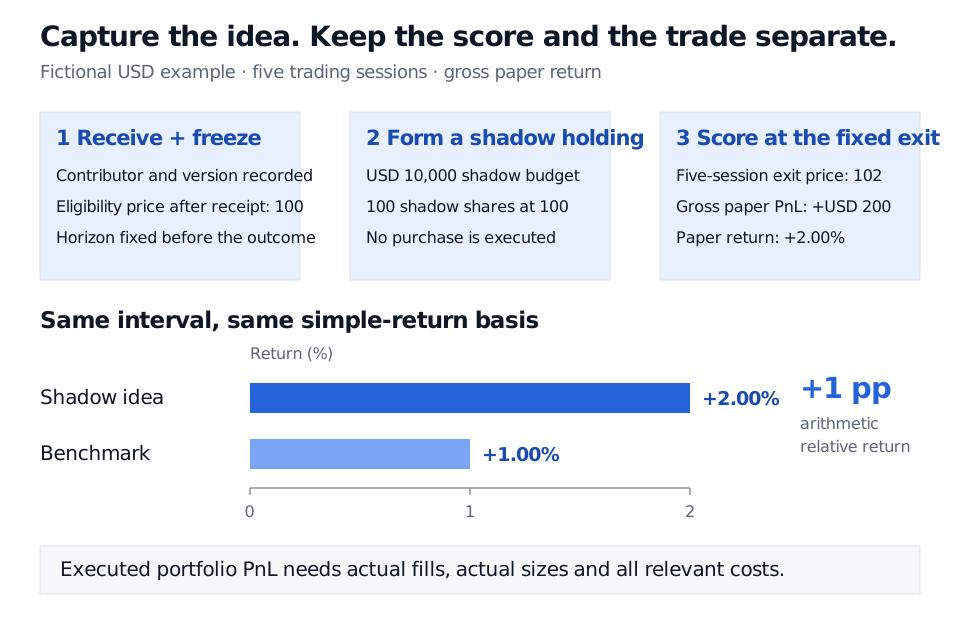
Take a fictional eligible long idea with a USD 10,000 shadow budget. The formation reference price, available after receipt under the stipulated rule, is USD 100 per share. The predeclared exit is the close five trading sessions later, at USD 102. Assume no dividends, corporate actions, financing or transaction costs, and use a price-return benchmark measured over exactly the same interval. No actual purchase or sale occurs.
Dividing the paper profit by the initial shadow budget gives a 2% simple return. The benchmark rises from 100 to 101, earning 1%. Under the arithmetic benchmark-relative convention,
Rrelative=2%−1%=1 percentage point.
This difference is a comparison of returns, not proof of risk-adjusted alpha. A broad-market benchmark may leave sector, style or other exposures unaccounted for. It is also not USD 200 of extra wealth relative to the benchmark: investing the same USD 10,000 in the stipulated benchmark would end at USD 10,100, versus the idea's shadow USD 10,200, a difference of USD 100.
Fictional five-session long idea: USD 10,000 at a formation price of 100 gives 100 shadow shares; an exit at 102 produces USD 200 gross paper profit and a 2% return. The benchmark returns 1%, so arithmetic relative return is 1 percentage point. Actual portfolio performance requires its own executed-trade record.
Original fictional example. The bars compare simple returns over the same five trading sessions; the shadow record contains no actual fills, trading costs, dividends or financing.
To report executed net performance, a separate record must establish actual position sizes, fills, cash flows and relevant transaction costs. A received idea may be rejected, delayed, combined with an existing position or only partly filled. For a short idea, borrow availability, borrow charges and position constraints also matter. Adding assumed costs to a shadow portfolio produces a cost-adjusted simulation; it still does not turn it into client-fund performance.
Winton's alpha-capture notice explicitly refers to possible hypothetical performance rankings, alongside use of ideas in its investment activities. That wording is a useful reminder to ask what a displayed ranking actually measures. Winton, Alpha capture privacy notice.
From ranking contributors to testing usefulness
A contributor who looks best on the history used to select contributors has won an in-sample comparison. The next question is whether a frozen selection and weighting rule helps on later ideas. Out-of-sample evaluation should preserve the receipt, amendment and eligibility history, and retain the eligible ideas covered by the declared scoring policy, including losers and withdrawn recommendations where that policy requires them.
A high hit rate alone says little about the size of gains versus losses. Repeated ideas in the same name, overlapping holding periods and common sector views can make a large submission count much less informative than it appears. Evaluate the contributor's score, the combined forecast and the implemented portfolio separately: each stage can add or remove value. Rules for contributor credit or rewards should also be fixed before the measured outcome, so changing attribution cannot improve an already observed result.
For the investment step beyond the scorecard, From Thesis to Position: The Practitioner Alpha Pipeline connects a view to sizing, factor risk, costs and attribution. Its preview is public; the full lesson requires membership.
TIM Group, platform overview, “Overview”, “Buy-side” and “Sell-side”: distribution, idea-performance analysis, author selection and scorecards. Provider descriptions establish the service's purpose; their marketing statements are not evidence of achieved returns.
Winton, Alpha capture privacy notice, submission-use and hypothetical-performance-ranking paragraphs. This article uses those operational descriptions, without drawing conclusions about privacy law or compensation requirements.