Whole-business securitisation raises debt against cash generated by an operating business. The deal secures the notes with specified assets and rights, such as franchise contracts, brand licences and collection accounts. An investor has to forecast how the business will keep generating the cash and trace how much of it can reach the notes on each payment date.
Follow the cash in Domino’s Series 2025-1
Domino’s Pizza Master Issuer LLC and its co-issuers issued senior secured notes in September 2025. Domino’s identifies franchise royalty income, U.S. supply-chain income and intellectual property among the assets securing its securitised debt. The indenture defines the rights that the co-issuers pledge to Citibank as trustee, subject to exclusions. For example, its definition of excluded property covers certain contracts or licences where granting security would cause a breach or require consent that the issuer has been unable to obtain, subject to applicable overrides. Domino’s 2025 Form 10-K, Note 3 · Series 2025-1 Supplement · Ninth Base Indenture Supplement, §3.1 and Annex A
Franchise fees go to royalty accounts, and licence fees from company-owned stores go to the intellectual-property holder’s account. Product purchase payments go to supply-chain accounts, which can reimburse specified costs. The indenture moves an amount based on weekly supply-chain profit to the central collection account. That distinction matters in a model because gross product sales can hold up while higher costs squeeze the cash that reaches the payment waterfall. The trustee allocates cash from the collection account weekly under the indenture’s priority of payments, including allocations towards quarterly note payments. Ninth Base Indenture Supplement, §§5.10–5.12
Why the business has to keep running
For a fixed pool of auto loans, an asset-backed security draws on payments from loans already made. A credit-card master trust can add new receivables, with collateral defined by those balances. A franchise deal depends on the operating network continuing to generate receipts. Slower store sales can reduce both sales-based royalties and orders from the supply chain. Under the Domino’s management agreement, Domino’s Pizza LLC collects franchise payments, supports and trains franchisees, prepares renewals and runs supply-chain services on behalf of the financing entities. The agreement provides for a management handover in specified circumstances. Domino’s management agreement, §1.1 and §§6.1–6.2
How quickly the cash cushion can disappear
Suppose a fictional franchise has USD 12 million available for debt service this quarter after the relevant operating outlays. Scheduled principal and interest total USD 10 million for the same quarter. Before any reserve deposits, draws or covenant effects, its debt service coverage ratio is
That leaves USD 2 million after the scheduled payment. If eligible receipts are USD 3 million lower and the operating outlays and payment stay fixed, available cash falls to USD 9 million. Coverage drops to 0.90×, leaving a USD 1 million cash shortfall before any reserve draw or change in payment priority.
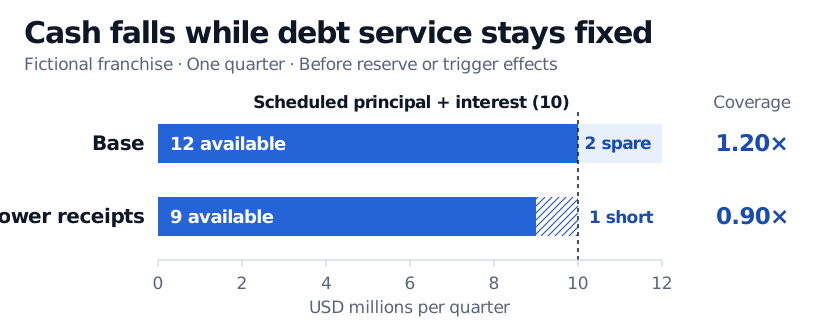
The dashed line marks the same payment in both cases. The shaded extension is cash above the payment, and hatching marks the part of the payment that operating cash cannot cover.
Cash left after a scheduled payment may still have to stay inside the deal. Domino’s indenture provides for cash trapping and faster principal repayment under separate conditions. Its coverage tests use contract definitions of cash flow, debt service and the measurement period. The two fictional ratios measure cash coverage under the stated assumptions. Ninth Base Indenture Supplement, §5.11 and Annex A
The SelfMadeQuant lesson on non-agency MBS and the securitisation waterfall shows how payment priorities and reserves work for a pool of loans. The preview is public and the full lesson requires membership.
Sources
- Domino’s Pizza, Inc. 2025 Form 10-K, Note 3, “Financing Arrangements”
- Domino’s Pizza Master Issuer LLC and co-issuers, Ninth Supplement to the Amended and Restated Base Indenture, 5 September 2025. Exhibit A contains the redlined base indenture.
- Domino’s Pizza Master Issuer LLC and co-issuers, Series 2025-1 Supplement, 5 September 2025.
- Domino’s securitisation, Amended and Restated Management Agreement as amended