See how warehouse receipts support inventory finance, how a futures delivery instrument changes hands, and what it takes to release the goods.
Warehouse Receipts and Physical Delivery
A warehouse receipt is a document of title issued by a warehouse for goods it holds. It records what the warehouse holds and supports the lawful holder’s claim to the goods under the receipt and applicable law. A merchant can pledge receipted inventory as collateral while the goods stay in storage. A physically settled futures contract may also settle by transferring an approved delivery instrument before the buyer takes the goods away. New York UCC § 1-201(b)(16) and (42)
When stored inventory can support a loan
The lender checks the receipt against the warehouse’s records and verifies the quantity, grade, condition and location. It also checks that the borrower can grant the security interest, who can transfer the receipt or authorise release, and what competing claims or warehouse charges could reduce recovery. The steps needed to make a pledge effective against others depend on the document and governing law.
For example, under the U.S. Warehouse Act and USDA rules, an agricultural warehouse receipt may be negotiable or non-negotiable. For an electronic receipt in that regime, there is one recorded holder at a time, and a transfer must come from that holder or someone acting on its behalf. The Act treats the designated holder as having possession for purposes of perfecting a security interest. Applicable federal or state law still determines which of several security interests has priority. At release, surrender and cancellation are governed by the warehouse rules, and the operator may require payment of accrued charges and satisfaction of its lien. 7 U.S.C. § 250(b), (d) and (e), 7 CFR §§ 869.110, 869.300 and 869.303
A fictional borrowing base
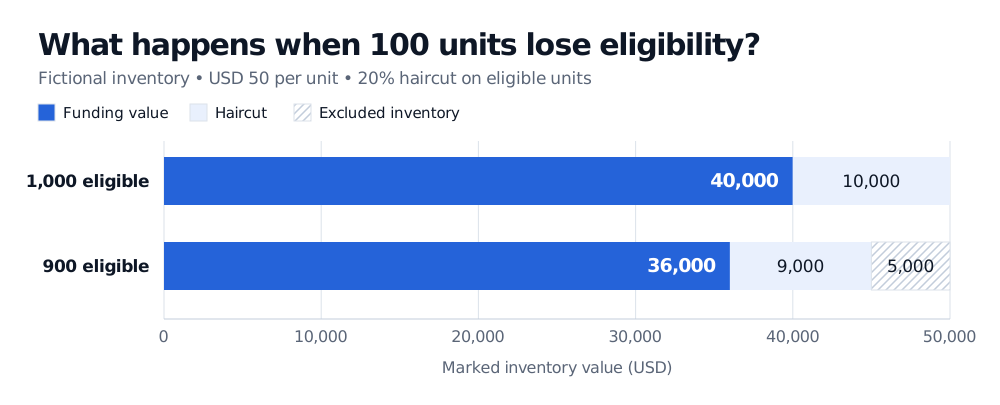
A merchant has 1,000 eligible units in storage. The lender marks the stock at USD 50 per unit and applies a 20% haircut. Assume the lender has an enforceable pledge and control over release, with no competing claims, additional reserves or facility cap. The inventory contributes USD 40,000 of funding value to the borrowing base.
1,000×USD 50×(1−0.20)=USD 40,000.
Suppose the warehouse can no longer verify 100 of the units and the lender excludes them until it reconciles the records. With the same mark and haircut on the remaining 900 units, funding value falls by USD 4,000 to USD 36,000. If the merchant sells part of the stock, the assumed pledge requires the lender’s authorisation for release. Once released from the pledge, those units come out of the borrowing base.
Fictional inventory marked at USD 50 per unit. With 1,000 eligible units, the 20% haircut leaves USD 40,000 of funding value. With 900 eligible units, USD 5,000 of stock is excluded and the same haircut leaves USD 36,000 of funding value.
Eligibility determines which units enter the borrowing base. The haircut applies to the value of those units.
What changes hands on a futures delivery day
The exchange specifies which document satisfies the contract. An LME warrant entitles its holder to a specific lot of approved metal. A CBOT corn shipping certificate is a commitment by an approved facility to supply conforming grain on request. The facility can make that commitment without identifying a lot already stored there. An ordinary warehouse receipt qualifies for exchange delivery only if the contract accepts that instrument and the receipt meets its requirements. LME warrants, CME Group’s comparison of receipts and certificates, CBOT Rule 712
For CBOT corn, the short tenders notice through its clearing member using a registered shipping certificate. The clearing house assigns the delivery to an eligible long. The buyer pays the delivery invoice and receives the certificate through the clearing system. The invoice can reflect grade and location differentials and applicable charges. To obtain the grain, the holder cancels the certificate for load-out, submits loading orders and arranges suitable transport. Holding the certificate in the meantime carries charges. CBOT Rules 703.C, 712 and 713, CBOT Corn Futures Rules 10104–10108
A merchant can have verified, financeable corn at a site outside the contract’s delivery network. That stock still has a local cash value. To compare it with the futures price, check what the contract accepts and what it would cost to move, store and load the grain. Grade, location and timing differences contribute to the spot–futures basis. CBOT Corn Futures Rules 10104–10108